HubbardGames guide
How Rival Week works: challenge a friend to a week of puzzles
Choose four games each, compete on the same daily puzzles and follow a week-long head-to-head contest. Learn how to set up Rival Week on HubbardGames.
Read the guide → HubbardGames
Puzzle guides
Clear examples, useful techniques and practical guides for the daily puzzle league.
HubbardGames guide
Choose four games each, compete on the same daily puzzles and follow a week-long head-to-head contest. Learn how to set up Rival Week on HubbardGames.
Read the guide →
Rectangles · Solving guide
Solve a worked Rectangles example by listing factor-pair shapes, ruling out shapes that contain another clue, and using a forced rectangle to settle a 6.
Read the guide →
Sun & Moon · Solving guide
Learn a reliable Sun & Moon deduction: two matching neighbours force the opposite symbol at both open ends. Follow a six-cell row example, use an equals sign, and finish without guessing.
Read the guide →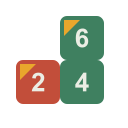
Cross Sums · Solving guide
Solve a small Kakuro example by combining two crossing sums. Learn which digit pairs make 3 and 4, why repeats are forbidden and how one answer unlocks the next.
Read the guide →
More or Less · Solving guide
Learn how inequality chains reduce candidates in Futoshiki, called More or Less on HubbardGames. Follow a 4×4 example and see when a chain forces every number.
Read the guide →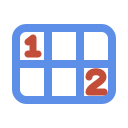
Mini Sudoku · Solving guide
Learn how to combine row and column clues in 6×6 Mini Sudoku. Follow a small worked example, cross out impossible candidates and make a move without guessing.
Read the guide →
Bridges · Solving guide
Learn Hashi (Bridges) with illustrated beginner strategies: neighbour capacity, forced single and double bridges, crossing limits and one connected network.
Read the guide →
Nonograms · Solving guide
Learn the Nonogram overlap technique with a six-cell worked example. Find guaranteed filled squares, respect gaps and use row and column clues together.
Read the guide →
Slant · Solving guide
Learn Slant deductions with illustrated examples: zeros, full-capacity clues, satisfied numbers and the no-loop rule. Practise each technique on HubbardGames.
Read the guide →Meet the games and see how to play each one.
Explore the games