Hubbard

Why a row comes in whole pieces
Each outlined region is one aquarium with a single water level. Every cell of that aquarium at or below the level is water, and every cell above it is air. Two cells of the same aquarium in the same row are at the same height, so they always agree.
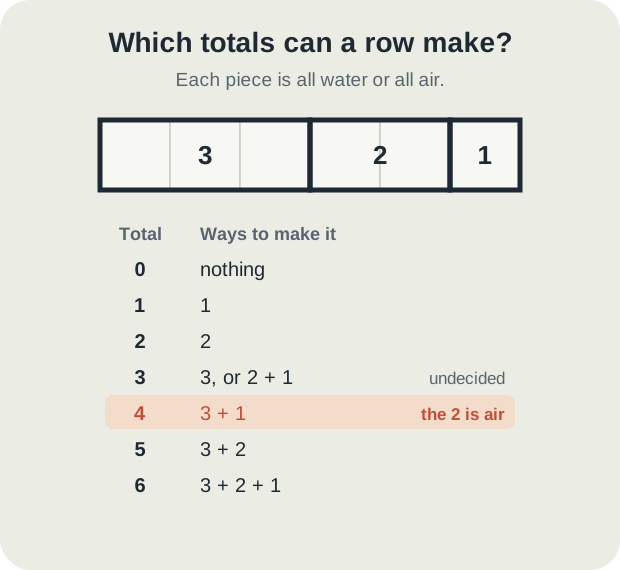
Read a row as a list of pieces rather than six cells. The bottom row of the board below crosses three aquariums: a piece three cells wide, then a piece two wide, then a piece one wide. Each piece is all water or all air, so the only totals the row can reach are sums of 3, 2 and 1, each used at most once.
Write those sums out and most of them have one recipe. A total of 4 can only be 3 plus 1. A total of 3 can be 3 alone or 2 plus 1, so it decides nothing about which piece is wet. The lesson is to check which kind of total you are looking at before you mark anything.
The board
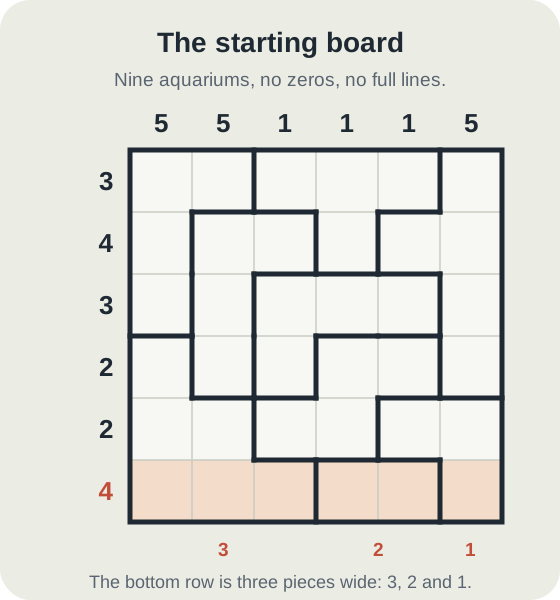
Six by six, nine aquariums. Rows are numbered from the top and columns from the left. Row clues read 3, 4, 3, 2, 2, 4. Column clues read 5, 5, 1, 1, 1, 5. This board has exactly one solution.
There is no 0 and no 6 anywhere, and every column clue of 5 still leaves one cell open, so the usual first pass finds nothing. The bottom row is where to look: its clue is 4, and its pieces are 3, 2 and 1.
Step 1: the bottom row has one recipe
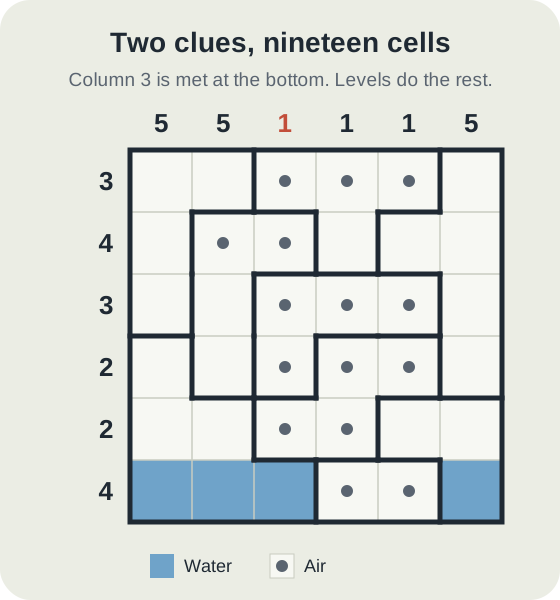
Four out of pieces sized 3, 2 and 1 can only be 3 plus 1. So row 6, columns 1 to 3 are water, row 6, column 6 is water, and row 6, columns 4 and 5 are air.
Those two air cells are the whole of a small aquarium, so that tank is empty. The water cells sit at the bottoms of two taller aquariums, which tells you nothing about how high they fill yet. Water only travels downwards, and there is nothing below row 6.
Step 2: column 3 is already full
Column 3 is clued 1, and row 6, column 3 is now water. The other five cells in column 3 are air.
Air travels upwards through its own aquarium, and four of those five cells unlock more. Row 1, column 3 belongs to the bent aquarium across the top middle, so the rest of its top row, columns 4 and 5, is air. Row 2, column 3 belongs to the small aquarium that starts at row 2, column 2, so its neighbour in that row, row 2, column 2, is air too.
The two cells lower down do the most. Row 4, column 3 is the lowest cell of the aquarium in the centre of the board, and row 5, column 3 is the lowest row of the aquarium beside it. A dry lowest row empties a whole tank, so both of those aquariums are air throughout. That is nineteen cells settled from two clues.
Step 3: the rows fill themselves
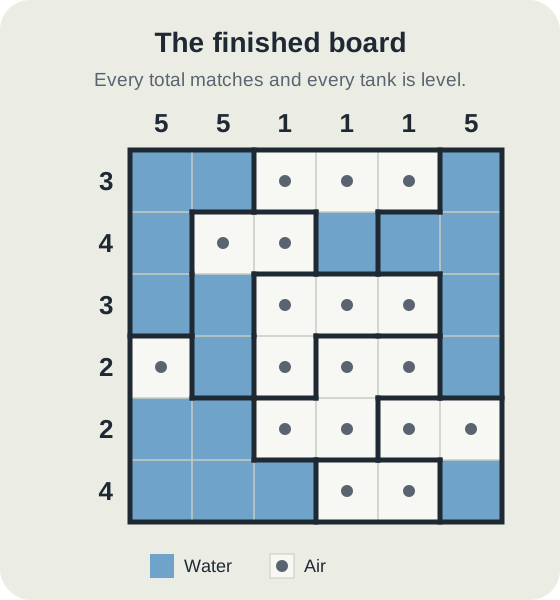
Row 1 is clued 3 and now has only three undecided cells, columns 1, 2 and 6, so all three are water. Row 2 is clued 4 and has exactly four undecided cells left, columns 1, 4, 5 and 6, so they are water. Row 3 is clued 3 with columns 3 to 5 already air, so columns 1, 2 and 6 are water.
Now let the water fall. Row 1, column 6 is the top of the aquarium down the right-hand side, so that whole tank is water, including row 4, column 6. Row 3, column 2 is water in the small aquarium that starts at row 2, column 2, so its lower cell, row 4, column 2, is water as well.
Step 4: the last four cells
Row 4 is clued 2, and columns 2 and 6 already supply both. Row 4, column 1 is air. It is the top cell of the aquarium in the lower-left corner, so it only rules out that one row of the tank.
Column 1 is clued 5 and has one cell left undecided, row 5, so it is water. Column 2 is clued 5 and likewise needs row 5, column 2 as water. Row 5 is clued 2, which those two cells meet, so row 5, columns 5 and 6 are air. That is the same whole-piece reading as step 1: the two-cell piece at the left of row 5 made the total on its own, so the piece on the right stays dry.
Check the finished board. Every row and column matches its clue, and every aquarium has one flat level, with nothing floating.
The mistakes this causes
The first is carrying the rule over to columns. A column does not come in whole pieces, because a tall aquarium crossing a column can be wet in its lower cells and dry in its upper ones. In this board, column 1 runs through the tall top-left aquarium in rows 1 to 3, and that aquarium could have given column 1 anything from zero to three cells. Only rows get the all-or-nothing treatment.
The second is picking a recipe when there are two. A row whose pieces are 3, 2 and 1 with a clue of 3 might be the wide piece alone or the other two together. Choosing one because it looks tidier is a guess, and it tends to fail several moves later with no sign of where it went wrong. Leave the row and come back once another clue has marked one of its pieces.
The last is miscounting a bent aquarium. If one aquarium crosses a row in two separate places, those places are still one piece for this purpose: they fill together, so add their widths and treat them as a single number.
Where to practise it
Aquarium is a timed game in the Library and the Just for fun dailies. It is not one of the competitive dailies, so a finish is ranked on time among players of that board but pays no league points.
Larger Library boards make the habit more useful rather than less. A wider row usually crosses more aquariums, so there are more recipes to rule out, and a total with a single recipe often opens a board that has no zero anywhere. For the other half of the level rule, the one about bottom rows, see the earlier guide on reading the bottom row first.
Put it into practice
Try an Easy Aquarium Library puzzle and look for one deduction from this guide.
Play an Aquarium boardSign in or create an account to save your progress.