Hubbard
Three places you will see it
The first is the Library list itself. Choose a game and each Practice row can carry a small people icon with a number beside it. That number is how many players have finished that exact board. A row with no icon has no counted finishers yet, which makes it an easy way to find a board nobody has tried, or one plenty of people have.
The second is the play screen. Open a Practice board that at least one player has finished and a panel headed This exact puzzle, all finishers sits underneath the puzzle, listing each finisher with their place and result. You can read it before you start. On a board nobody has finished the panel stays hidden, so an empty screen means you would be first. When you finish, the panel refreshes and your own row appears, marked (you).
The third is the result. Finish a Practice board opened from the Library and the result screen shows the same table. Finish one served by For You and the table sits beside the countdown to the next puzzle, headed Practice standings; touching it pauses the countdown, and a Standings button opens it again later.
Which results take a place
All three places read the same list, so the count, the panel and the result can never disagree about who finished. A result appears only when it meets every one of these:
- It is a completed board. Giving up, or running out of guesses, is saved to your history but does not take a place.
- It is your first run at that board. A replay is its own attempt and never enters the table, so playing again faster will not move you up.
- The board is a dateless Practice board. A Catch-up row, which is an old daily, shows no all-finishers table, and a dated Just for fun board shows that day's fun field instead.
- It belongs to a real player. Test accounts are left out.
How a place is decided
Each game ranks on its usual measure. Timed games rank on the clock, fastest first. A hint on a timed board adds ten seconds to that clock as you play, so the time shown already includes it. Games counted in moves or tiles left rank on that number, lowest first.
Five Letters, Equation, Colour Code and Lattice work differently. The table shows the guesses or swaps you actually used, with a bulb and a number when you took hints, but each hint counts as one more when places are worked out. So a row can show a better number than the row below it and still share a place with it.
Equal results share the higher place, and the next result skips the places they used. Nothing is averaged, because a Practice board has no points to split.
One Five Letters board, worked through
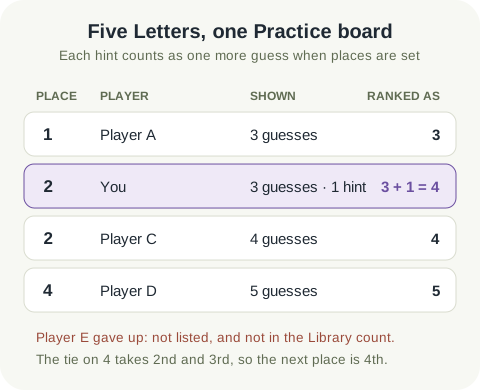
Here are five invented players on the same dateless Five Letters board. Player A solves it in 3 guesses with no hints. You take a hint after your second guess and solve it on your third. Player C solves it in 4, Player D in 5, and Player E gives up.
Player A ranks as 3 and is 1st. You show 3 guesses with one hint, which ranks as 4. Player C's 4 guesses also rank as 4, so you are both 2nd, even though your row shows the smaller number. That tie uses up 2nd and 3rd, so Player D is 4th. Player E does not appear, and the Library row for this board reads 4.
Now say you come back next week and press Play again, solving it in 2 guesses with no hint. That run is saved as a replay. The table still shows your first result, 3 guesses with one hint, in 2nd place.
What it is good for
Practice standings are the only comparison a dateless board can honestly make, because the players on it did not play on the same day. They pay no points and never touch your league average, streak or Board place. What they do give you is a benchmark: before starting a Hard board, a glance at the panel tells you whether other players finished it in two minutes or ten.
If the panel says it could not load, that is a failed read rather than an empty board. In the panel on the play screen, Try again reloads it, and on For You you can still move on to the next puzzle.
Put it into practice
Explore the league and find a puzzle that suits you.
Open the LibrarySign in or create an account to save your progress.