Hubbard

Why the biggest ship is the easiest to place
The number beside each row, and above each column, counts the ship squares in that line. Ships lie straight, across or down, and no two ships touch, not even at a corner.
A four-square ship lying across a row puts four ship squares in that row, so the row's total has to be at least 4. It also puts one ship square in each of the four columns it crosses, so none of those columns can have a total of 0. The same holds the other way round for a ship lying down a column.
That gives you two checks for any line. Is its total at least 4? And does it have four squares in a row whose crossing lines are all above zero? A line that fails either check cannot hold the four, whatever else is on the board.
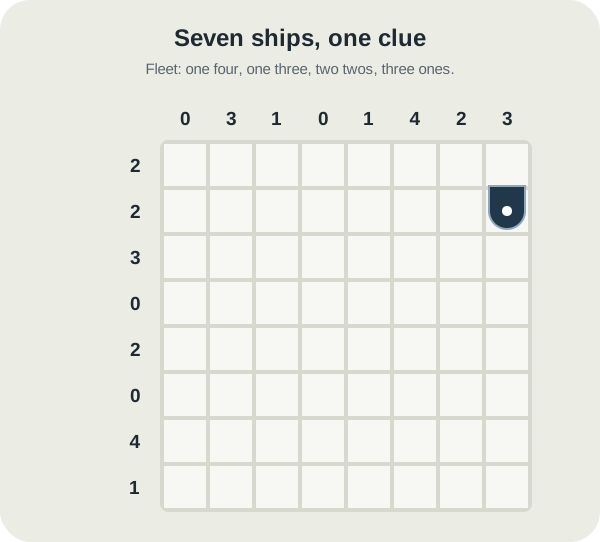
The board below is eight by eight, with one clue: the rounded bottom end of a ship at row 2, column 8. Rows are numbered from the top and columns from the left.
Two totals of 4, and only one home
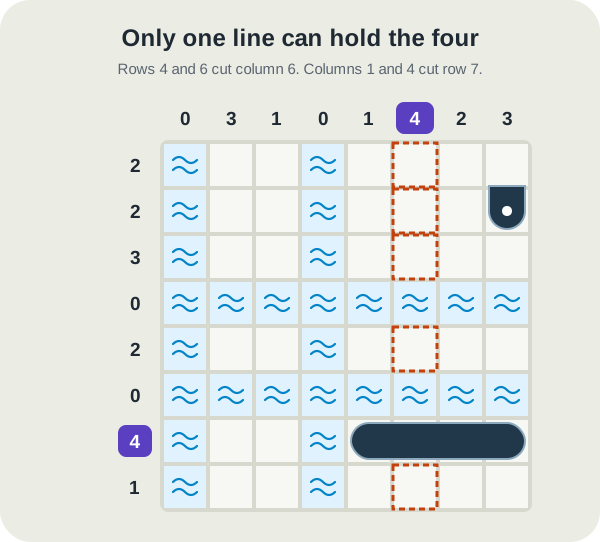
Start with the zeros. Rows 4 and 6 and columns 1 and 4 all have a total of 0, so every square in them is sea.
Now look for totals of 4 or more. There are two: row 7 and column 6. Nothing else on the board is big enough, so the four-square ship lies in one of those two lines.
Column 6 looks the stronger candidate, because it is a column of eight squares with the largest total on the board. Walk down it, though. The sea in row 4 and row 6 cuts it into three pieces: rows 1 to 3, row 5 on its own, and rows 7 and 8. The longest piece is three squares, so the four cannot fit anywhere in column 6.
Row 7 is cut the same way by the sea in columns 1 and 4, into columns 2 and 3 and then columns 5 to 8. That second piece is exactly four squares long. It is the only place on the board the four-square ship can go, so it goes there, and row 7's total of 4 is used up. Columns 2 and 3 of row 7 are sea, and because ships never touch, so is row 8 from column 4 to column 8.
The rest of the board follows
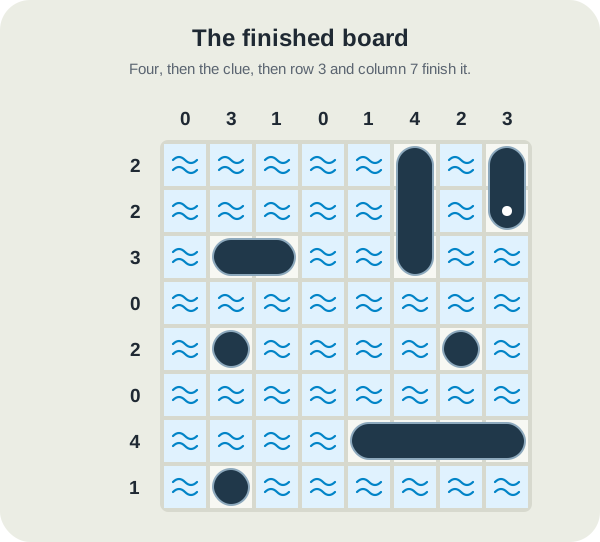
The four-square ship has already filled column 5, whose total is 1, so the rest of column 5 is sea. Now take the clue. A bottom end means the ship carries on upwards, so row 1, column 8 is a ship square. Row 1 is the top edge, which makes this a two-square ship, and the squares beside it in column 7 are sea, as is row 3, column 8 below it. Column 8's total of 3 is now met: rows 1, 2 and 7.
Row 3 needs three ship squares. Columns 1 and 4 are sea, column 5 is spent, and columns 7 and 8 both touch the clue's ship. That leaves columns 2, 3 and 6, exactly three, so all three are ships. Columns 2 and 3 form a two-square ship, with sea on both ends.
Both twos are now placed, and row 2 needs one more ship square besides its clue. Columns 2 and 3 of row 2 touch the new two-square ship, so apart from the clue, every square in row 2 is sea except column 6. Row 2, column 6 is a ship, joining row 3, column 6. The four and both twos are already down, so this has to be the three, and with row 4 below it sea, it runs up to row 1. Column 6's total of 4 is complete: rows 1, 2, 3 and 7, and row 1's total of 2 is met by columns 6 and 8, so the rest of row 1 is sea.
Three single squares remain. Column 7 needs one more ship, and the only blank square left in it is row 5. Column 2 needs two more beside row 3, and the only blank squares left in it are row 5 and row 8. That places all three singles and meets every total on the board.
The common mistake
The mistake is reading a total of 4 as a place for the four-square ship. A total counts ship squares, and several ships can share a line. Column 6 here has a total of 4 and ends up holding the three-square ship and one square of the four, lying across it.
Before you commit the four to a line, look along that line for the zeros that cross it. A single zero in the middle of a row splits it into two shorter rows as far as a long ship is concerned. The same two checks work for the three-square ship once the four is down: a total of at least 3, and three unbroken squares whose crossing lines are above zero.
How this example was checked
The board was made with the game's own generator and confirmed by its exhaustive solver to have exactly one answer. The game's step-by-step hints place the four-square ship in row 7 by the same fleet reasoning, and every step above was checked against the finished grid. It is an original practice example, not a current daily board.
Put it into practice
Try an Easy Battleships Library puzzle and look for one deduction from this guide.
Play a Battleships boardSign in or create an account to save your progress.