Hubbard
Where to find it
Sign in and open Board from the main navigation. On the Today or Yesterday tab, each game column has its logo at the top. Tap a logo and the page changes to that game's standings, headed Per-game standings with the game's name underneath.
There is a second way in from your Profile. In the By game part of Progress, each competitive game ends with a See standings link, for example See Bridges standings, which opens the same page.
Once you are there, the Game menu switches to another title without going back, and the Full board button returns you to the combined table. The game you picked stays in the page address, so a bookmark opens straight to it.
Two tabs: Today and All-time
The per-game page has only two tabs. Today is this London day's field for the game. All-time is every day the game has been scored. For yesterday's result in one game, or a week or month, use the matching tab on the full Board instead.
What the Today tab shows
Every player who has finished today's daily for this game appears, in place order. The columns are:
- Place: your finishing position in this game today. Exact ties share a place.
- Player: display name and animal, with You under your own row.
- Result: the time, guesses or swaps you actually used.
- Hints: how many hints you took, or a dash if none.
- Points: what that place is worth on the half-point ladder, 10 for first down to 0.5.
Why a better result can sit lower
On Five Letters, Equation, Colour Code and Lattice, the Result column shows the guesses or swaps you really spent, but the place is worked out with each hint counted as one more. A three-guess solve with one hint shows 3 guesses and 1 hint, and sits level with the four-guess solvers.
On the six timed games a hint puts ten seconds on your clock while you play, so the time in the Result column already includes it and the places follow the times.
Today's places and points are provisional. Anyone who finishes after you with a better result pushes you down, and the day only settles at the London midnight reset.
What the All-time tab shows
All-time has one row for every player who has ever scored the game. Its columns are:
- Place: your position on average points. This is the only column the order is built from.
- Played: how many of the game's dailies you finished on their own London day.
- Best and Worst: your fastest and slowest time, or your fewest and most guesses or swaps, across those days.
- Avg result: the mean of those results, in the game's own unit.
- 1sts and Top 3: how many of those days you placed first, or in the top three. A shared first counts as a first for everyone in it.
- Avg pts: your total points in this game divided by Played.
What it leaves out
Only a competitive daily finished on its own London day makes a row. A board you gave up on, or ran out of guesses on, is not in either tab. Neither is a past daily played later as catch-up, a replay, Practice or Just for fun.
That makes the per-game average kinder than the league one. A Bridges give-up simply is not there, so it cannot pull your Bridges average down. The league average on the full Board's All-time tab counts that same unfinished slot as zero on any day you entered.
Retired games keep their history. The Game menu lists Mini Sudoku and Cross Sums marked (history), and their All-time tabs still work: the page's own note says All-time includes retired seasons.
Four invented Bridges days
Three invented players, Ana, Ben and Cal, are the only Bridges finishers across four days. Cal is quick but patchy: fastest of anyone on Wednesday, slowest on Monday, a give-up on Tuesday and no board at all on Thursday. Ana and Ben finish in exactly the same time on Thursday, so they share first and split the points for first and second, 9.75 each.
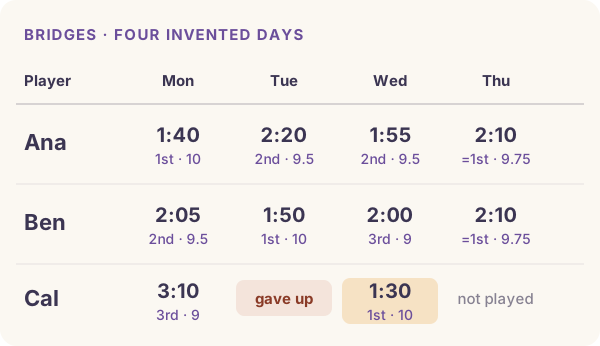
How the All-time tab reads after those days
Ana has 10, 9.5, 9.5 and 9.75, which is 38.75 points over four days, an average of 9.69. Ben has 9.5, 10, 9 and 9.75, which is 38.25 over four, or 9.56. Cal has 9 and 10 over two days, exactly 9.5.
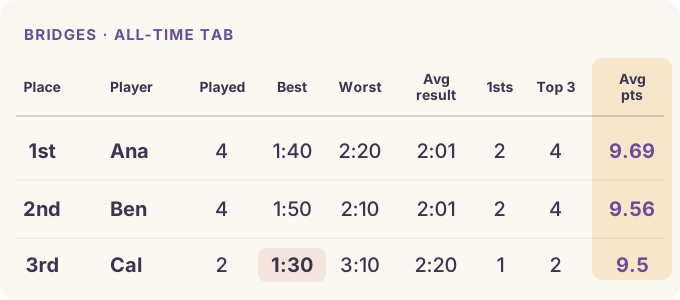
Why the table comes out that way
Ana and Ben have the same average result, 2:01, yet different places. The table does not rank on time. It ranks on the points each day paid. Both won one day outright and shared Thursday, so the gap is Wednesday, where Ana was second and Ben third. That half point is the whole difference between them.
Cal owns the best single time and still comes last. The 1:30 won Wednesday, but the 3:10 on Monday was a third place, and there are only two days to average. The Tuesday give-up does not appear, which is why the average is 9.5 rather than something much lower.
When two averages are equal
If two players finish on exactly the same average points, the one with more days played goes above. If that is also equal, the better personal best decides. Players only share a place when all three match.
So a player who has finished Bridges once and won it averages 10 and heads the table, above anyone who has won most days but not all of them. Treat a high place on a small Played count as a good start rather than a settled ranking.
A common mistake
Reading the Best or Avg result column as the ranking. They describe how you play the game in its own unit, and they are useful for tracking your own times, but the order comes from points alone. To climb a per-game table, what counts is beating the other finishers on the day, not your time against a previous day's different board.
Limits worth knowing
The per-game page is a view of the same league results as the full Board. It never changes anyone's points, and the combined table's order is unaffected by it. Places and points on the Today tab stay provisional until midnight, and the page refreshes by itself as other players finish.
Your Profile also shows a per-game place in By game, using the same average points per day finished. For how that average relates to your overall league average, see the guide on why your Profile averages disagree.
Put it into practice
Explore the league and find a puzzle that suits you.
Open the BoardSign in or create an account to save your progress.