Hubbard

The rules this uses
Every Storm row and column holds three bolts and three clouds. No row or column may have three of the same symbol in a line. An equals sign between two cells means they match; a cross means they differ. This guide only needs the first two rules.
Storm is a timed competitive daily, so a cell you can place by reasoning rather than by trying is time off your finish.
Why the second and fifth cells are clouds
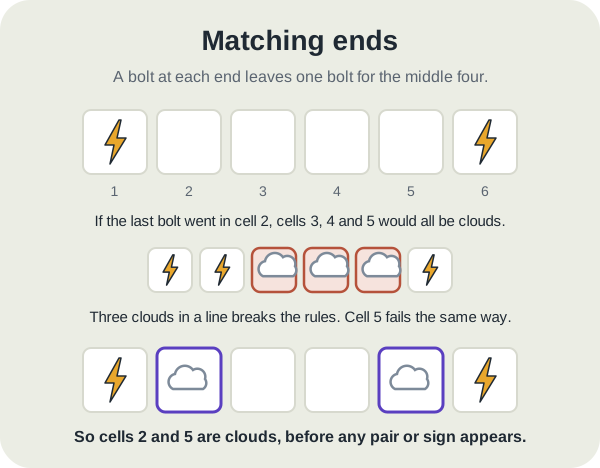
Take a row with a bolt in cell 1, a bolt in cell 6 and four blanks between. The row needs three bolts, so exactly one more bolt goes somewhere in cells 2 to 5. The other three middle cells are clouds.
Now try the last bolt in cell 2. That leaves cells 3, 4 and 5 as clouds, and three clouds in a line is not allowed. Try it in cell 5 instead and cells 2, 3 and 4 are the three clouds. Both fail for the same reason, so the bolt can only go in cell 3 or cell 4.
Whichever it is, cells 2 and 5 are clouds. You can place both before the row gives you a single pair or sign. The same reasoning works with a cloud at each end, where cells 2 and 5 become bolts, and it works down a column exactly as it does across a row.
How much the ends settle
A six-cell line can only be filled 14 ways that keep three of each and never three in a line. We listed all 14 and checked which of them fit each starting pattern.
With a bolt at both ends, only two fit: bolt, cloud, cloud, bolt, cloud, bolt, and bolt, cloud, bolt, cloud, cloud, bolt. Both have clouds in cells 2 and 5. The only question left is which way round the middle pair goes, and that has to come from somewhere else on the board.
A checked board where it starts row 2
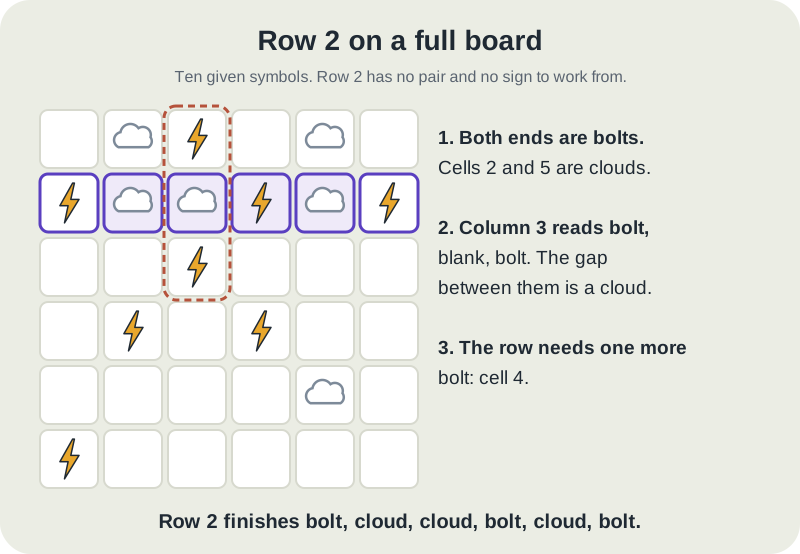
This board is one we built for the guide, not a current daily. It has ten given symbols and no signs, and the game's own solution counter finds exactly one way to finish it.
Row 2 has a bolt in its first cell and a bolt in its last, and nothing in between. No pair and no gap pattern touches it, so it is easy to leave for later. The matching ends settle cells 2 and 5 as clouds straight away.
The row is now bolt, cloud, blank, blank, cloud, bolt. One of the two blanks is a bolt, and the row cannot say which. Column 3 can. Its given cells in rows 1 and 3 are both bolts, so the cell between them in row 2 would make three bolts in a line. That cell is a cloud, and the row's last bolt goes in cell 4.
Row 2 finishes bolt, cloud, cloud, bolt, cloud, bolt, which is the row the board's one solution has. Those four new cells give columns 2 to 5 something fresh to work with, and the board carries on from there.
The near miss, and the mistake to avoid
The rule needs the same symbol at both ends. A bolt at one end and a cloud at the other settles nothing: five of the 14 legal lines fit that pattern, and every middle cell is a bolt in some of them and a cloud in others. Placing clouds in cells 2 and 5 there is a guess, and it is the one this pattern tempts.
There is a close cousin that does work. A bolt in cell 2 and a bolt in cell 6 still leave one bolt to place among cells 1, 3, 4 and 5. Put it in cell 1 and cells 3, 4 and 5 are three clouds together, so cell 1 is a cloud. Only three legal lines fit, and all three start with a cloud. The test is always the same: put the last bolt in a spot and see whether the clouds left over sit three in a line.
Try it on a fresh board
Open an Easy Storm board in the Library and scan each row and column for matching ends before you look anywhere else. When you find one, place the second and fifth cells, then check the columns through the two cells still open. Ends first, then the crossing lines, then the ordinary pair and gap checks.
Put it into practice
Try an Easy Storm Library puzzle and look for one deduction from this guide.
Play a Storm boardSign in or create an account to save your progress.