Hubbard

What an empty row actually says
The hidden code is four pegs from six colours, numbered 1 to 6 on the board, and a colour can appear twice. After each guess, a filled peg means one of your pegs is the right colour in the right slot. A hollow peg means a right colour in the wrong slot.
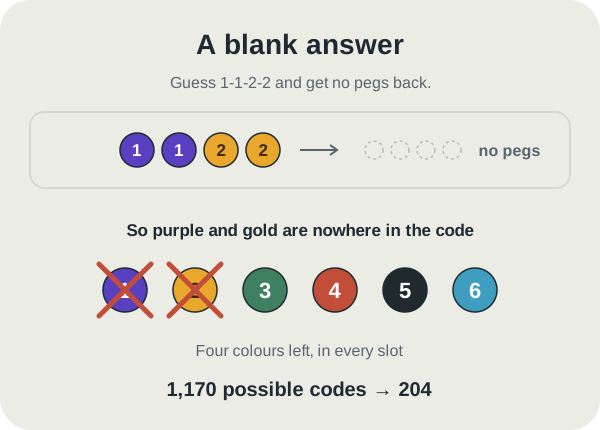
Every other answer is a count you have to untangle, because the board never says which of your pegs it means. A blank is different. No filled peg means none of your colours is in the slot you put it in. No hollow peg means none of them is anywhere else either. Put together, every colour you played is absent from the whole code.
Guess 1-1-2-2 and get nothing back, and purple and gold are gone from all four slots. You no longer have a six-colour puzzle. You have a four-colour one.
How much a blank is worth
The game can set 1,170 different codes. It builds each one from four different colours, one pair or two pairs, and never uses a colour three times. We scored the opener 1-1-2-2 against every one of those codes with the game's own peg rule.
It comes back blank on 204 of them, a little over one board in six. Those 204 codes are all the ones drawn only from green, red, slate and teal, and a blank leaves exactly those. For comparison, a single hollow peg leaves 240 codes, and so does a single filled peg. The row that looks empty narrows the field more than either of those, the two most common answers that opener gets.
A blank is also much rarer with four different colours. Open with 1-2-3-4 and only 6 of the 1,170 codes answer with nothing, because any code has to avoid four of the six colours to do it. The blank is a fair return on playing a repeat.
A board solved in four
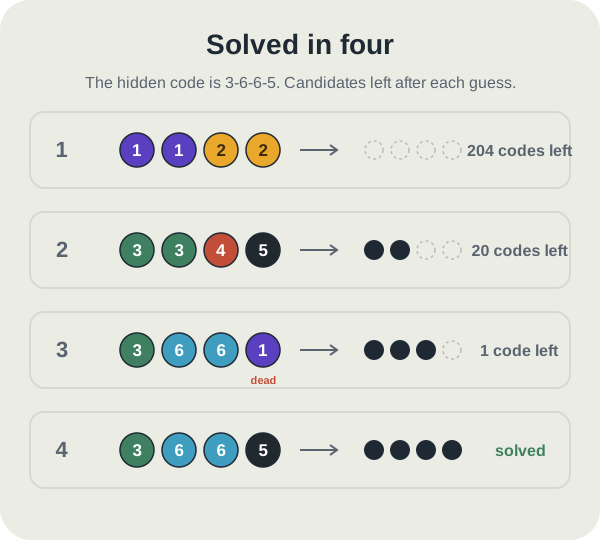
Take 3-6-6-5 as the hidden code: green, teal, teal, slate. This is an example we built for the guide, not a current daily.
Guess 1 is 1-1-2-2 and it scores nothing. Purple and gold are out, and 204 codes remain.
Guess 2 is 3-3-4-5, which uses only live colours. It scores two filled pegs and no hollow ones. Two of those pegs are in the right slots, and none of the others appears anywhere else in the code. Twenty codes still fit everything so far.
Guess 3 is where the blank pays off a second time: 3-6-6-1. The purple in the last slot is a dead colour, so it can never earn a peg. Whatever comes back is about the first three slots and nothing else. The answer is three filled pegs, so those slots are exactly green, teal, teal. Guess 2 had green right in the first slot, and it needed one more filled peg from its other three. Slots 2 and 3 are teal, so that peg was the slate in slot 4.
Guess 4 is 3-6-6-5, four filled pegs, and the board is solved. Of the twenty codes left before guess 3, only 3-6-6-5 answers three filled and no hollow to 3-6-6-1. We checked every one.
Why a dead colour is useful
Once a colour is known to be absent, a peg of it is a peg that will never score. That sounds useless, and it is exactly what makes it handy. It lets you ask about some slots while keeping the others quiet, so a count of pegs points at fewer places.
It is not a rule to play one every time. Guess 3 above could have been one of the still-possible codes instead, which at least has a chance of winning outright. On the twenty codes in that example, the best such guess could still leave four codes standing in the worst case, while 3-6-6-1 leaves at most three. The gap is small, and it shows up when you need to know which slot a peg belongs to, not what colours are in play.
The mistake: reading half a blank as a whole one
The common slip is treating no filled pegs as if it were no pegs. Guess 1-1-2-2 and get two hollow pegs back, and it is tempting to cross purple and gold off their slots and think you have learned the same thing. You have learned something narrower. Those colours are in the code, just not where you put them.
Only an answer with nothing filled and nothing hollow clears a colour from the whole board. When it happens, cross those colours off everywhere at once and stop spending pegs on them, unless you are using one on purpose to keep a slot quiet.
Put it into practice
Try an Easy Colour Code Library puzzle and look for one deduction from this guide.
Play a Colour Code boardSign in or create an account to save your progress.