Hubbard

What counts as a wall
A block grows one cell at a time, through the edges of the cells it already has. So the question to ask of an unfinished number is simple: which of its edges could the block still cross?
The edge of the board is a wall. So is any neighbour showing a different number. That second one is worth spelling out, because it looks like an ordinary clue rather than a barrier. Every cell in a block shows the block's size, so a cell printed 4 belongs to a block of four and can never be part of a block of three. The line between a 3 and a 4 is always a boundary between two blocks.
A neighbour showing the same number is the opposite of a wall: equal numbers that touch are always one block, which the earlier Patchwork guide covers. And a blank neighbour is an opening. Count the openings. If there is exactly one, and the block is still short of its size, that blank belongs to the block and takes its number.
- Board edge: wall.
- A different number: wall.
- The same number: already part of the block.
- A blank: an opening.
A board to work
Here is an original five by five board with fourteen printed numbers. It has exactly one answer, and the game's own deduction solver reaches that answer without guessing.
Reading across the rows: row 1 is 5, 4, 4, 4, blank. Row 2 is blank, blank, 2, 4, blank. Row 3 is blank, 5, 3, 1, 3. Row 4 is blank, blank, blank, 3, 1. Row 5 is 1, blank, blank, blank, 2.
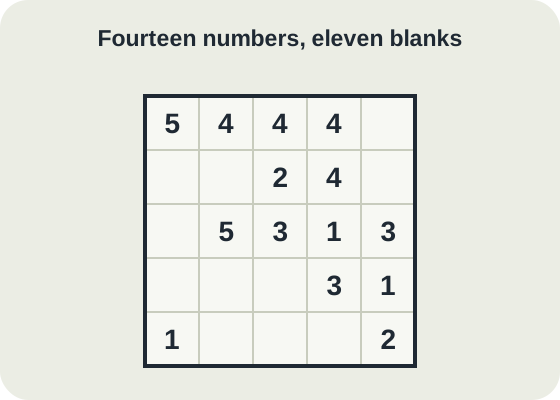
Five numbers with one opening each
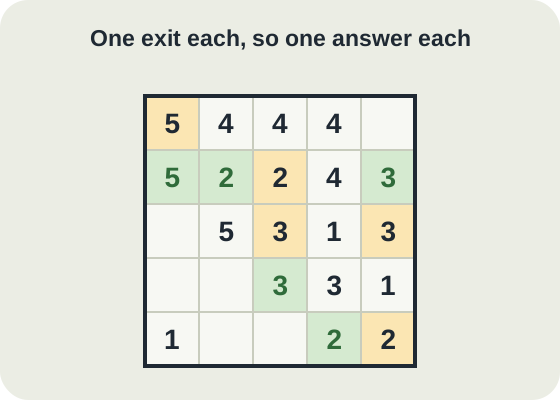
Take the 2 in row 2, column 3. Above it is a 4, below it a 3, to its right another 4. Three walls. Its only opening is to the left, row 2 column 2, so that cell is a 2. The block now has two cells and is finished.
The 5 in the top left corner has the board edge above and to its left and a 4 beside it. Its only opening is below, so row 2 column 1 is a 5.
The 3 in the middle of the board, row 3 column 3, has the printed 2 above it, a 5 to its left and a 1 to its right. Row 4 column 3 is its one opening, so that is a 3.
The 3 on the right edge, row 3 column 5, has the board edge to its right, a 1 to its left and a 1 below. Its opening is above, so row 2 column 5 is a 3.
The 2 in the bottom right corner has the edge on two sides and a 1 above it. Row 5 column 4 is a 2, and that block is done too.
I checked each of these five cells against the game's solver by writing every number from 1 to 5 into it in turn. Four of the five values left the board with no answer at all; only the value given here survived.
Then look again
Filling an opening changes the block, so ask the question again of the bigger block.
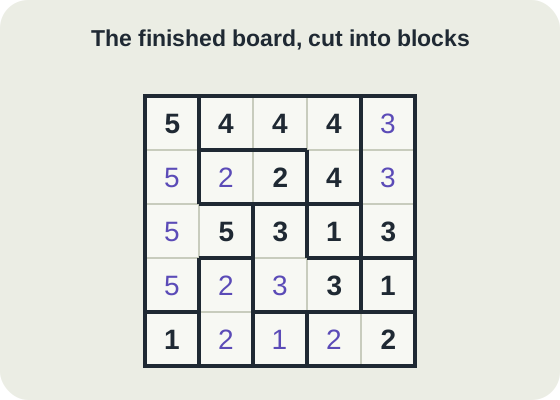
The new 3 in row 4 column 3 sits next to the printed 3 in row 4 column 4. Equal numbers that touch are one block, so those two join the 3 above: three cells, finished.
The 3 on the right edge now covers two cells, rows 2 and 3 of column 5. It needs one more. Between them those two cells touch a 4, a 1 and one blank, row 1 column 5. One opening again, so row 1 column 5 is a 3 and the block is complete.
The 5 in the corner now covers rows 1 and 2 of column 1. Its neighbours are the 4, the 2 you just placed, and row 3 column 1. One opening, so that is a 5 as well. It touches the printed 5 in row 3 column 2, which makes four cells of one block of five. That block has two openings, row 4 column 1 and row 4 column 2, so the one-opening rule has done its job here. Seven blanks are filled, and the remaining four need other reasoning.
The finished board
The last cell of the five goes down, to row 4 column 1. If it went to row 4 column 2 instead, row 4 column 1 would be sealed in by 5s and the 1 below it, so it would have to be a block of one on its own, touching another 1. That breaks the same-size rule. The last three blanks become a 2, a 2 and a 1.
The mistake to stop making
The usual mistake is stopping after one cell. On this board the 3 on the right edge takes two steps: the first opening gives it a second cell, and only then does the third cell become obvious. If you fill the gap and move on to another part of the board, you walk past the next forced cell.
The other trap is treating a different number as a possible continuation. A 3 next to a 1 cannot reach through it, however natural it looks to count the 1 as a spare cell. Read every different number as a wall and the boxed-in clues stand out quickly.
When you open a Patchwork board, scan the small numbers in corners and along the edges first. They have the fewest sides to begin with, so they are the ones most often left with a single way out.
Put it into practice
Try an Easy Patchwork Library puzzle and look for one deduction from this guide.
Play a Patchwork boardSign in or create an account to save your progress.