Hubbard

The total that every line shares
A Math Mosaic row on a five wide board contains 1, 2, 3, 4 and 5 in some order. However they are arranged, they add to 15. The same is true of every column. On a four wide board the total is 10, on a six wide board 21 and on a seven wide board 28.
That turns a row into a sum you already know. If addition cages sit entirely inside a row, their targets are part of that 15. Subtract them, and what is left belongs to whatever cells of the row they do not cover. When only one cell is left over, you have its value, even if the cage it belongs to could still be filled a dozen ways.
A board where one row does the work
Below is a five by five board built for this guide. Rows run r1 to r5 down the side and columns c1 to c5 along the top, and each cage prints its target in its top-left cell in the game's notation: 8+ is a sum, 8x a product, 2/ a quotient and 1- a difference. It has exactly one solution, and the game's own deduction solver finishes it without guessing.
Look at row 1. A 6+ cage covers r1c1 and r1c2, and a 5+ cage covers r1c3 and r1c4. Both sit wholly inside the row. The last cell, r1c5, belongs to a three-cell 8+ cage that bends down into row 2 at r2c4 and r2c5.
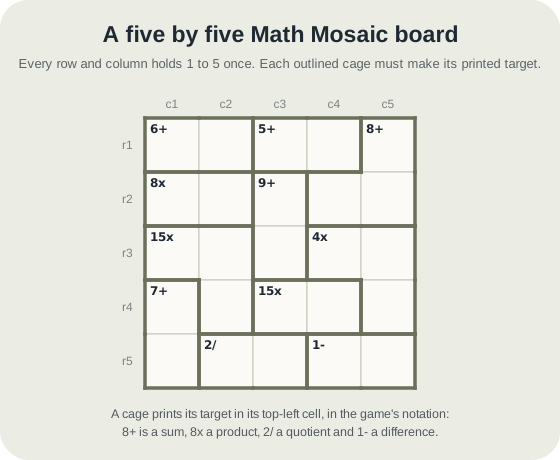
Subtract, and r1c5 is 4
Start with what each cage says on its own. The 6+ cage could be 1 and 5 or 2 and 4. The 5+ cage could be 1 and 4 or 2 and 3. Neither is settled. The 8+ cage is weaker still: three cells making 8 allows fourteen fillings on a blank board, and between them they put every number from 1 to 5 in r1c5.
Now add up the row. The two addition cages contribute 6 and 5, which is 11. The row must reach 15, so r1c5 is 15 - 11 = 4. There is no case to check and nothing to guess.
You can confirm it the long way. Of the four ways to pair up the two cages, three reuse a number in the row: 2 and 4 clashes with 1 and 4 and with 2 and 3, and 1 and 5 clashes with 1 and 4. Only 1 and 5 with 2 and 3 survives, and it leaves 4 for r1c5. Enumerating every legal filling of row 1 gives four, and all four put a 4 there. The total gets you to the same answer in one subtraction, without deciding which pair is which.
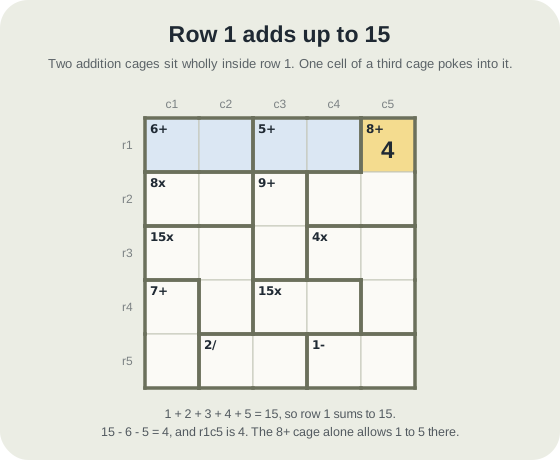
What the 4 unlocks
Go back to the 8+ cage. With 4 at r1c5, its other two cells, r2c4 and r2c5, must make 4 between them. They share row 2, so they cannot both be 2. That leaves 1 and 3, in an order still to find.
Row 2 can now take the same arithmetic, with one catch. Its first two cells are an 8x cage, not an addition cage. Two different numbers from 1 to 5 multiply to 8 only as 2 and 4, so those cells hold 2 and 4, and what matters for the row total is their sum, 6. The 8 printed on the cage plays no part.
So row 2 spends 6 on the 8x cage and 4 on r2c4 and r2c5, and 15 - 6 - 4 = 5 lands in r2c3. That cell's 9+ cage runs down into r3c3, which must therefore be 9 - 5 = 4. Four cells are fixed and two more narrowed to a pair, all from the fact that a row adds up to 15. From here the board solves cage by cage.
The mistake, and where this stops working
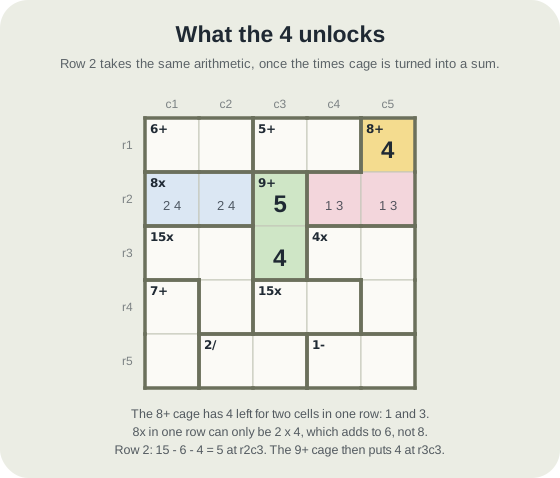
The error to watch for is subtracting a cage's printed target when the cage is not addition. In row 2, subtracting the 8 from the 8x cage gives 15 - 8 - 4 = 3 for r2c3. That 3 is wrong, and it will not show up as a clash until several moves later. A times, division or subtraction cage only enters a row total once you know which numbers it holds, and then you add those numbers, not the target.
The second error is counting a cage that leaves the row. The 8+ cage has one cell in row 1 and two in row 2, so its 8 cannot be spent on either row alone. Only the cells inside the line count.
The honest limit is that this is a shortcut, not a requirement. The game's own deduction solver never adds up a row: every published Math Mosaic board can be solved from cages, rows and columns alone, and this one was checked that way too. The row total is worth knowing because it can settle in one subtraction what the cage-by-cage route only reaches after checking cases, as row 1 shows. It works just as well on columns, and on the wider boards with totals of 21 and 28, where listing pairings by hand gets much slower.
Put it into practice
Try an Easy Math Mosaic Library puzzle and look for one deduction from this guide.
Play a Math Mosaic boardSign in or create an account to save your progress.