Hubbard
Where to find it
Open Profile from your avatar in the header and choose Progress. Along the top of Progress are four views: By game, Insights, Compare players and Records. Choose Compare players. You can also go straight there with /profile?view=progress&panel=compare.
The panel is headed Player comparison, with a small label above it that reads Settled league days only. Under that is one menu, Compare with. It lists every other league member by display name, in alphabetical order, and it is the whole league rather than only people you have played in Challenges. Pick a name and the comparison loads.
Loading a comparison only reads results that are already on the Board. It sends nothing to the other player and changes nothing for either of you, so you can look at anyone as often as you like.
Which days it counts
A shared day is a London date on which you each finished at least one competitive daily on that same date. It is the same test that puts you on that day's Board, so a board finished after midnight, a catch-up board from the Library, Practice, For You and Just for fun boards never make a shared day.
Three more rules decide what is left:
- A day only one of you played is left out altogether. It is not a win for the player who turned up and not a loss for the one who did not.
- Today is left out until midnight in London. Places on the current day can still move while other players finish, so the panel waits for the day to settle.
- League days from games that have since rotated out, such as Mini Sudoku and Kakuro, still count, because their points are still on the record.
How a day is won
Each shared day is decided by your total league points for that date against theirs: every competitive game you finished that day, added together. It is not settled game by game. If you finished two games and they finished all ten, you are comparing two games' points with ten games' points, and the panel does not adjust for it.
That is the difference from Rival Week. A Rival Week match locks eight agreed games for one week and awards wins game by game. Compare players uses whatever each of you actually played on every day you overlapped, over your whole history together.
A worked week
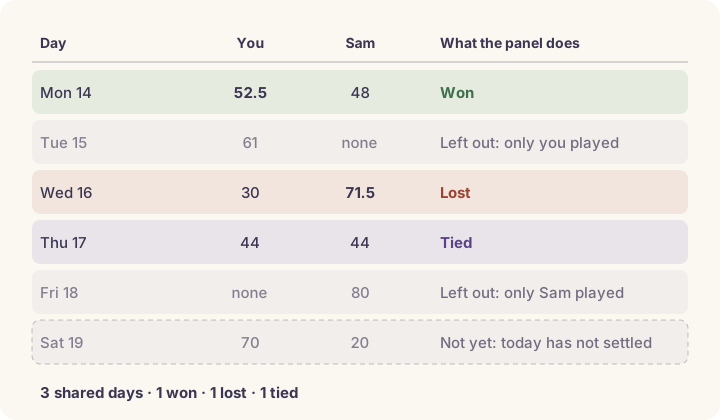
Suppose you open Compare players on Saturday 19 September and choose a member called Sam. These are your day totals and Sam's for that week:
What the panel shows for that week
Two cards sit side by side. Yours reads 42.17 points per shared day, from 126.5 points in total. Sam's reads 54.5 per shared day, from 163.5 in total. Underneath, four counters read Shared days 3, Won 1, Lost 1, Tied 1.
Your 61 on Tuesday and Sam's 80 on Friday appear nowhere. Neither does your 70 on Saturday, which would have been your best head-to-head result of the week.
Below the counters is Recent meetings, newest first, with the date, your points and theirs: 17 Sept, 44 and 44, then 16 Sept, 30 and 71.5, then 14 Sept, 52.5 and 48.
Open the panel again on Sunday and Saturday has settled. Shared days becomes 4, the record becomes 2 won, 1 lost and 1 tied, and the averages swap order: 49.13 for you against 45.88 for Sam. One settled day turned the comparison round. Both results were worked through the same head-to-head function the Profile uses.
A common misreading
The points per shared day here are not the same figure as your all-time average on the Board, and they are not meant to agree. The Board measures points per available competitive game on the dates you entered, which always sits between 0 and 10. Compare players adds up whole days, so with ten competitive games a day a single day can be worth up to 100 points, and it only looks at the days you and one other person have in common.
So a player can sit below you on the all-time Board and still lead you here, simply because the days you overlapped happened to be their good ones. Neither number is wrong. They answer different questions.
Limits worth knowing
The panel is deliberately small. A few things it does not do, and what it says when there is nothing to show:
- Recent meetings shows your ten latest shared days. The counters and averages cover every shared day, not only those ten.
- There is no game-by-game breakdown here. For your results in one game, use By game in the same Progress section.
- If you and the other player have never scored on the same settled day, the panel says You both need to score on the same settled league day before a comparison appears.
- A day that has just settled can take a minute or so to show, because league results are read in short cached batches.
- If the comparison fails to load, the panel says so and offers Try comparison again. A failed load changes nothing about either player's results.
Put it into practice
Explore the league and find a puzzle that suits you.
Open Compare playersSign in or create an account to save your progress.