Hubbard

Only columns 5, 6 and 7
Something has to come after the equals sign, so it can never be in the last column. It can never be in column 4 or earlier either. In column 4 the left side is three characters and the answer is four digits, so at least 1,000, and the biggest thing three characters can make is 999.
That leaves three columns, and each one sets the length of the answer. With the equals sign in column 5 the answer has three digits. In column 6 it has two. In column 7 it has one.
Those three columns are not equally common. Of the 65,704 true eight character equations, 1,318 have the equals sign in column 5, 10,891 in column 6 and 53,495 in column 7.
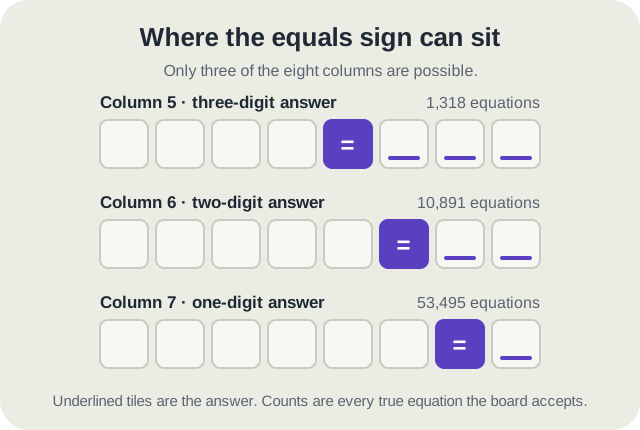
What each column forces
Column 7 means a six character left side that comes to a single digit, 0 to 9. A left side made only of plus signs cannot do that. Numbers and signs alternate, so single digits joined by plus signs always make an odd length: 1+2 is three characters, 1+2+3 is five. Six characters must therefore include a number of two digits or more, which is at least 10 because no number can start with a zero, and adding to it only makes it bigger. So a column 7 answer always has a minus, a times or a divide on the left. Not one of the 53,495 column 7 equations is a plain sum.
Column 5 means an answer of at least 100 from a left side of four characters: one number, one sign, another number, and one of those numbers is a single digit. A minus or a divide can only give something smaller than the bigger number, which is at most 99, so neither can appear. That leaves times, with 1,228 equations such as 7×85=595, and additions that only just clear 100, such as 9+91=100. There are only 90 of those, and none comes to more than 108.
Column 6 is the middle ground, a two digit answer, and it is the shape most real boards use. Across 4,200 boards from the game’s own generator, about two in three put the equals sign in column 6, most of the rest used column 7, and column 5 was rare. That is close to the reverse of the full list, where column 7 holds four equations in five. Thousands of those are oddities such as 0×5567=0, which the board accepts as a guess but the game never sets as an answer.
A gold equals sign rules out a third of the board
Your guess and the answer each contain exactly one equals sign, so that tile can never come back grey. Green gives you the column outright. Gold rules out one column, and with only three to start with, that leaves two.
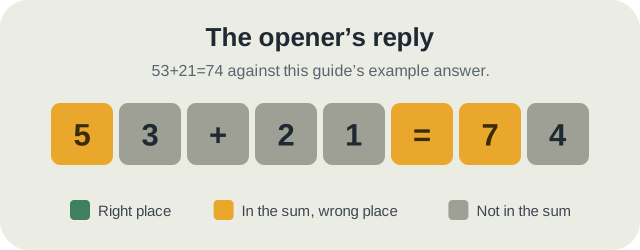
The opener recommended in the earlier Equation guide, 53+21=74, puts the equals sign in column 6, the most common place for it. So the useful question is what to do on the days it comes back gold. The answer is then in column 5 or column 7, and each of those has a tightly limited shape.
The board
Here is a board whose answer we will keep hidden until the end. It was chosen so that it cannot be one of the game’s real boards: it uses a number larger than the generator ever puts in a sum of this kind.
The opener 53+21=74 comes back with three gold tiles, the 5, the equals sign and the 7. Everything else is grey, including the plus.
Of the 65,704 legal equations, 1,169 give exactly that reply. Now apply the columns. Column 6 is gone. Column 5 would need a three digit answer from four characters, and with the plus grey it would have to be a times. Only 14 of the survivors fit, all of the kind 7×85=595. The other 1,155 put the equals sign in column 7. So the answer is almost certainly a single digit, and its left side must contain a minus, a times or a divide.
Guess two: build the shape you have found
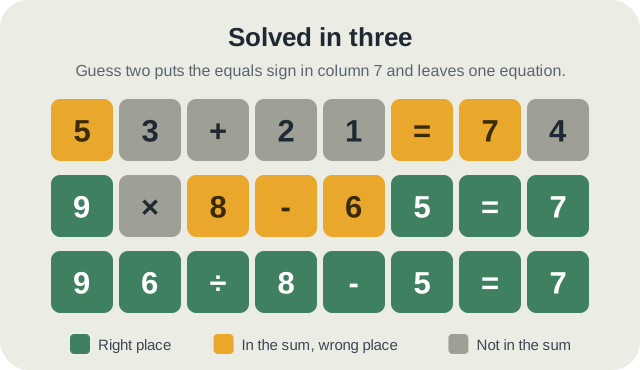
The second guess should put the equals sign in column 7 and test the signs that column needs. It should also move the other two gold tiles somewhere new. The 7 cannot go in column 7 any more, because the equals sign is sitting there, so try it as the one digit answer in column 8. The 5 was gold in column 1, so it goes elsewhere. Fill the rest with digits you have not tried yet, 9, 8 and 6.
That gives 9×8-65=7, which is true, since 72 minus 65 is 7. It tests a times and a minus at once and uses five digits.
The reply is four greens, for the 9, the 5, the equals sign and the 7, three golds, for the 8, the minus and the 6, and a grey times sign. Exactly one equation in the full list fits both replies.
Guess three
What you know now: the answer starts with 9, ends 5=7, and the four characters between hold an 8, a minus, a 6 and one more character. There is no times and no plus. The 8 is not in column 3, the minus is not in column 4 and the 6 is not in column 5.
Try the minus directly before the 5. The first four characters then have to come to 12, because 12-5=7. A 9 followed by the 6 makes 96, and 96÷8 is 12. So the answer is 96÷8-5=7, found on the third guess, and checking every legal equation confirms nothing else fits.
The mistake: moving the sign without changing the sum
After a gold equals sign, the tempting second guess slides the sign along a column and keeps the same kind of sum: another plain addition, just with the equals sign in column 7. That guess does not exist. With only plus signs, six characters can never come to one digit, so every attempt either fails to balance or comes out the wrong length, and the board refuses it.
Moving the equals sign is a change of shape, not a change of position. Column 7 means bringing in a minus, a times or a divide. Column 5 means a three digit answer, and almost always a times. Decide which shape you are testing first, then write the sum to fit it.
Where to practise it
Equation is one of the competitive dailies. It is untimed and scored on how many guesses you take, so a guess saved by reading the equals sign properly is worth points on the day.
Library boards are a cheaper place to build the habit. Open with a column 6 sum, and whenever the equals sign comes back gold, stop and ask which of the two remaining shapes your next guess is testing before you write it.
Put it into practice
Try an Easy Equation Library puzzle and look for one deduction from this guide.
Play an Equation boardSign in or create an account to save your progress.