
Battleships · Solving guide
A square middle clue tells you a ship runs straight through it and nothing about which way. The answer is almost never in the squares around it. Here is a full six by six board opened from one clue, with the reason behind every placement.
Read the guide →
Five Letters · Solving guide
Four green tiles and one open slot looks like a board you have already won. Sometimes five words still fit and you have four guesses left. Here is the arithmetic, a worked board, and the guess that cannot win but saves the solve.
Read the guide →HubbardGames guide
Two parts of HubbardGames sit outside the league table. An Expedition is a five stop journey with a choice of game at each stop; Coach is a small guided board with a three rung hint ladder. Where they are, what they save and what they never do to your score.
Read the guide →
Colour Code · Solving guide
Opening a Colour Code board with four different colours feels thorough and quietly wastes a guess. Here is the reason, two codes that prove it, a board solved in three, and the numbers across all 1,170 codes the game can set.
Read the guide →
Tents · Solving guide
One number on a Tents board can finish a whole line on its own, with no trees consulted and nothing guessed. Here is the arithmetic behind it, a five by five board solved from that single clue, and the board sizes where it does not work.
Read the guide →
Equation · Solving guide
Equation is scored on guesses, so the opener does most of the work. Six different digits and an ordinary sum beat a clever multiplication, and the numbers show by how much.
Read the guide →HubbardGames guide
The Appearance panel holds four choices, and only two of them follow you to another device. Where the panel is, how previewing differs from saving, and why your laptop can be dark while your phone is light.
Read the guide →
Lattice · Solving guide
A Lattice board is scored on swaps, so the first swap matters. Learn to read the gold tiles as a loop, spend the fewest swaps on it, and avoid the move that quietly costs you two.
Read the guide →HubbardGames guide
There are 149 achievements in HubbardGames, and some of them land the second you finish while others wait for midnight. Where the list lives, why the wait exists, and how the badge beside your name on the league tables gets chosen.
Read the guide →
Trail · Solving guide
Trail is timed, so the opening stare is the part that costs you. Four squares on every board are settled before you read a single number. Here is the rule, a full six by six board worked through, and the habit that throws the advantage away.
Read the guide →
Blooms · Solving guide
A Blooms board looks like it needs a guess to open. It does not. Every board hides a region small enough to settle on sight. Work a full seven by seven solve and see how far that one habit carries you.
Read the guide →
Light Up · Solving guide
A numbered wall in Light Up does not simply mean that many bulbs around it. Work through a complete seven by seven solve on HubbardGames and see how already-lit squares shrink a clue until it has only one answer.
Read the guide →HubbardGames guide
The competitive slate is not fixed. How the rotation vote works, what happened in the last one, and why a game leaving the league never costs you a point you have already earned.
Read the guide →
Pipes · Solving guide
The edge of a Pipes board is a rule, not a boundary. Three of the four tile shapes are settled by a wall on sight. Work a full four by four board and learn which ones, and which shape is the trap.
Read the guide →HubbardGames guide
Two ways to keep playing once the dailies are done. What the Library holds that For You will never show you, how For You paces its difficulty, and which one to open.
Read the guide →
Aquarium · Solving guide
In Aquarium, a zero clue empties every tank that reaches it. Work through a complete six by six solve on HubbardGames, one deduction at a time, and learn which way each mark travels.
Read the guide →HubbardGames guide
Nine competitive puzzles a day, one shared board per game, and points that come from where you finish against everyone else who played. The full scoring model, worked through with real numbers.
Read the guide →HubbardGames guide
Choose four games each, compete on the same daily puzzles and follow a week-long head-to-head contest. Learn how to set up Rival Week on HubbardGames.
Read the guide →
Rectangles · Solving guide
Solve a worked Rectangles example by listing factor-pair shapes, ruling out shapes that contain another clue, and using a forced rectangle to settle a 6.
Read the guide →
Storm · Solving guide
Learn a reliable Sun & Moon deduction: two matching neighbours force the opposite symbol at both open ends. Follow a six-cell row example, use an equals sign, and finish without guessing.
Read the guide →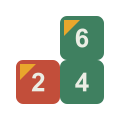
Cross Sums · Solving guide
Solve a small Kakuro example by combining two crossing sums. Learn which digit pairs make 3 and 4, why repeats are forbidden and how one answer unlocks the next.
Read the guide →
More or Less · Solving guide
Learn how inequality chains reduce candidates in Futoshiki, called More or Less on HubbardGames. Follow a 4×4 example and see when a chain forces every number.
Read the guide →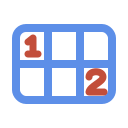
Mini Sudoku · Solving guide
Learn how to combine row and column clues in 6×6 Mini Sudoku. Follow a small worked example, cross out impossible candidates and make a move without guessing.
Read the guide →
Bridges · Solving guide
Learn Hashi (Bridges) with illustrated beginner strategies: neighbour capacity, forced single and double bridges, crossing limits and one connected network.
Read the guide → Hubbard