Hubbard

What you are actually drawing
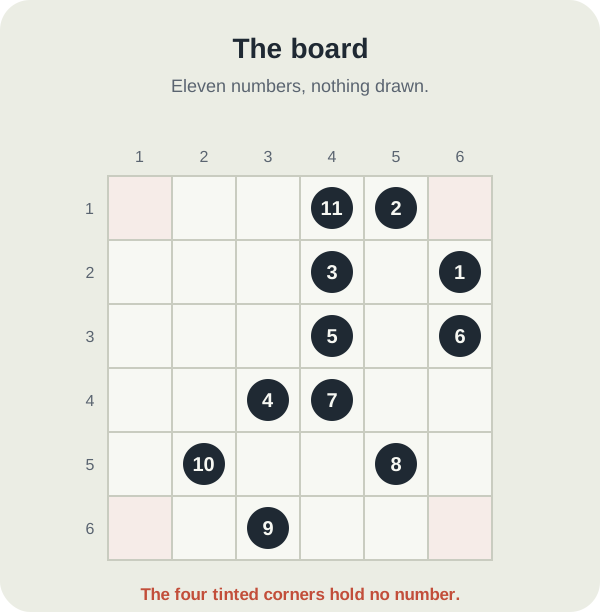
Trail gives you a six by six grid with numbered squares placed on it, eleven of them on the board below. You draw one unbroken line that steps between squares sharing an edge, visits every square exactly once, and meets the numbers in ascending order. The 1 is where the line starts. The highest number is where it stops.
Two conditions are doing the work there, and players tend to read only one of them. Meeting the numbers in order is the instruction on the tin. Covering all thirty-six squares is the condition that decides the route.
Trail is one of the nine games in the daily league and it is scored on time, so the seconds you spend deciding where to begin are points.
A corner has only two neighbours
Picture any single square in the middle of your finished line. The line arrives from one neighbour and leaves towards another, so that square carries two links. Only the two squares at the ends of the line carry one.
A corner square touches exactly two others. So if a corner is not one of the two ends, its two links have to be those two neighbours, because there is no other pair available. The line goes straight through it.
The ends of the line are the 1 and the highest number. Unless one of those sits in a corner, every corner on the board is a pass-through and you can draw both of its links immediately.
How often does that pay? We ran 360 boards through the game's own generator across the middle difficulty bands and counted. All four corners were free on 305 of them, and every single board had at least two. The corners alone settled an average of 7.7 links per board before a number had been read.
Eight links before you read a number
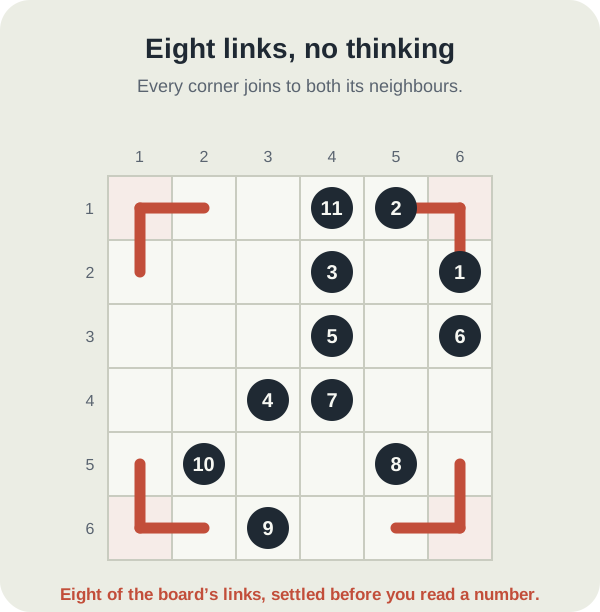
On the board above the 1 sits at row 2, column 6, and the 11 sits at row 1, column 4. Neither is a corner, so all four corners are pass-throughs and all eight of their links go in at once.
Top left joins row 1 column 2 and row 2 column 1. Top right joins row 1 column 5 and row 2 column 6. Bottom left joins row 6 column 2 and row 5 column 1. Bottom right joins row 6 column 5 and row 5 column 6.
None of that required looking at a number. It is the same eight-link opening on any board where the corners are empty, which is most of them.
The corner that hands you the opening leg
Now the corners start talking to the numbers.
The top-right corner joins to row 2 column 6, which holds the 1. The 1 is where the line begins, so it carries one link and only one, and that link is now taken: it runs up into the corner. Every other square touching the 1 is dead.
Out of the corner the line continues to row 1 column 5, which holds the 2. The leg from 1 to 2 is therefore drawn in full, and you have not made a choice yet.
The 2 is not an end, so it needs a second link. Its remaining neighbours are row 1 column 4 and row 2 column 5. Row 1 column 4 holds the 11, the last square on the board. If the 2 joined to it, the 11 would sit right next to the 2 on the line, a few steps in from the start, when it has to be the thirty-sixth and final square. So that link is out and the 2 runs down to row 2 column 5.
Four squares of the route are now fixed. The whole chain used three facts: a corner has two neighbours, an end of the line has one link, and the numbers come in order.
The mistake: joining the numbers up
The numbers are the thing you can see, so the instinct is to join them. Shortest route from 1 to 2, then push on to 3. It feels like progress, and it is the most common way a Trail solve quietly falls apart.
Covering every square is the binding condition, not the ordering. A neat, short route between two numbers usually walks past squares it can never come back for, and you find out eight or ten links later when a square along an edge has no free neighbour left and the whole middle section has to be unpicked.
Work from scarcity instead. Settle the squares with no choice first, corners before anything else, then edge squares whose neighbours are already spoken for. Let the numbers confirm a route you were forced into, rather than pick one you liked the look of.
The finished trail
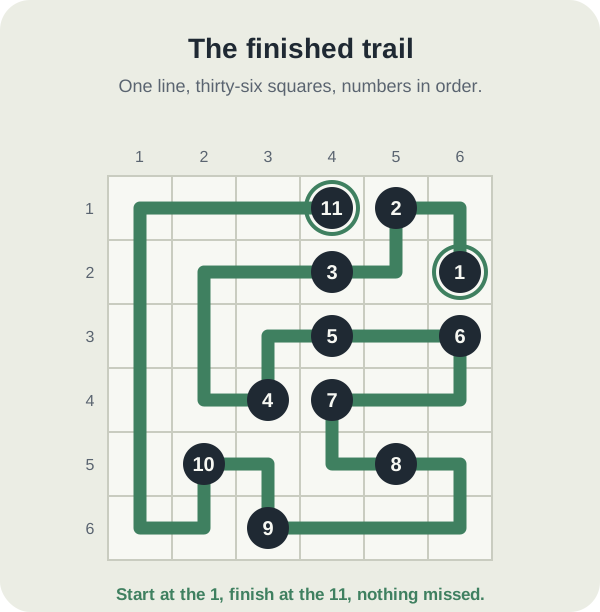
Here is the whole board. One line, thirty-six squares, the numbers met in order, nothing visited twice and nothing left out.
When the last square goes in and the order is right, Trail submits on its own and stops the clock, so there is no Check button to go hunting for. On a game scored to the second that is worth knowing before you start.
The corner habit takes about four seconds and works on every board. Try it on a Trail puzzle of your own, then look at where you are on the day's standings.
Put it into practice
Try an Easy Trail Library puzzle and look for one deduction from this guide.
Play a Trail boardSign in or create an account to save your progress.