Hubbard
The only rule that matters at the edge
A finished Pipes board is one single network. Every arm meets an arm on the neighbouring tile, every tile is joined to the whole, and there is no closed loop anywhere. A single arm left pointing at a wall, or at a tile with nothing to meet it, means the board is not finished.
Read that backwards at the edge of the grid and it becomes a constraint you can act on immediately. A tile on the top row cannot point upwards. A tile in the top-left corner cannot point upwards or left. So for each edge tile, throw away every rotation that puts an arm through a wall and see what survives.
How much that leaves depends entirely on the shape. A straight has two rotations, an elbow and a T-piece have four, and a dead end has four. Against a wall they behave very differently.
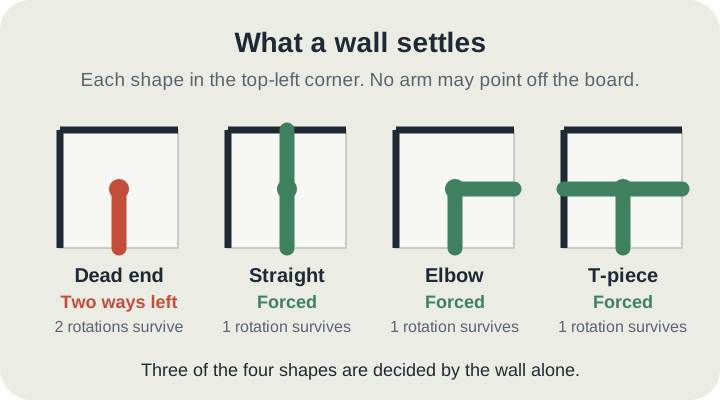
Three shapes a wall decides for you
A T-piece has three arms and only one gap. Put it anywhere on an edge and the gap has to face the wall, because any other rotation sends an arm through it. One wall settles a T-piece completely, wherever it sits along that edge.
A straight has only two rotations, across or down. On a side edge the across rotation runs into the wall, so it must lie vertically, along the edge. On the top or bottom edge the reverse holds. One wall settles it.
An elbow has two arms at a right angle. A single wall is not enough, since two of its four rotations keep both arms inboard. But a corner has two walls at a right angle, which is exactly the shape of the elbow, so in a corner it has one rotation and no choice at all.
The board
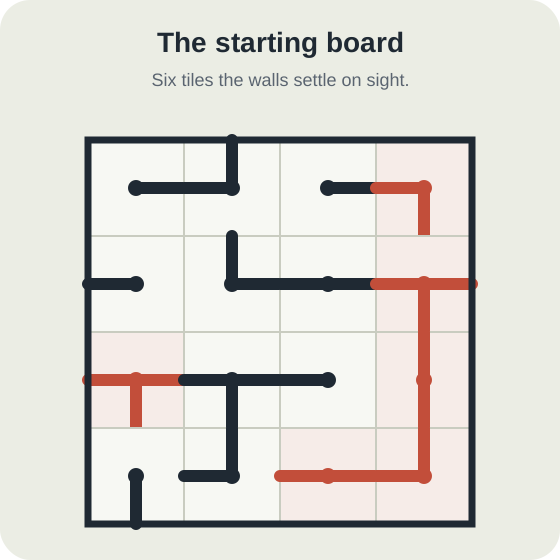
Four by four, sixteen tiles, shown scrambled. Six dead ends, four elbows, three straights and three T-pieces. This board has exactly one solution.
Go round the edge applying what we just established. The elbow in the top-right corner is trapped by two walls and must point down and left. The T-piece on the right edge of the second row must turn its gap to the wall, leaving arms up, down and left. The T-piece on the left edge of the third row is the mirror of it, with arms up, right and down. The straight on the right edge of the third row must stand vertically. On the bottom row, the straight must lie flat, and the elbow in the bottom-right corner must point up and left.
That is six of the sixteen tiles placed with certainty, before thinking about a single connection. On a four by four board, more than a third of the work is done by the walls alone.
The shape that is not settled, and the mistake it causes
The dead end is the exception, and it is the one players lock down anyway. It has a single arm, so a corner removes two of its four rotations and leaves two. The top-left tile on this board is a dead end: it can point right, or it can point down, and the walls have nothing more to say about it.
The common mistake is to treat it like the elbow, assume the corner has forced it, and turn it to whichever of the two looks right. Half the time that is wrong, and because a single dead end connects to only one neighbour, the contradiction does not show up where you made it. You discover it three or four tiles away, then re-turn the wrong region.
So leave it. A shape the walls have not settled is a shape you come back to.
Settling the corner properly
The top-left dead end can be resolved, just not by the wall on its own. Look at the tile directly below it, on the left edge. That tile is also a dead end.
Suppose the corner tile points down. Its arm now has to meet an arm on the tile below, so that tile must point up. But both are dead ends with one arm each, so they would join to each other and to nothing else: a closed pair of two tiles, sealed off from the other fourteen.
A finished board is one network containing every tile, so a sealed pair of two is impossible. The corner tile therefore points right, and the dead end below it points somewhere other than up. In the finished board it points down.
That argument generalises, and it is worth carrying: two dead ends next to each other never face each other. They are the only pair of shapes that can seal themselves off in a single move.
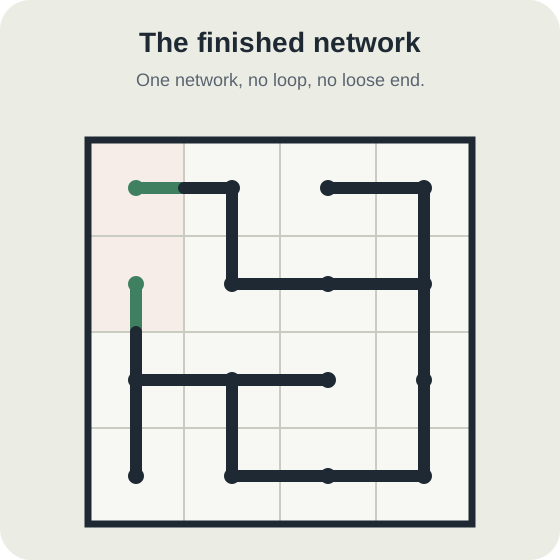
The finished network
Once the six wall-forced tiles and the corner are placed, the rest follows by matching arms: each settled tile tells its neighbours what they must offer it, and the neighbours pass that on.
Check the finished board against the three conditions. No arm points off the board. Every arm meets an arm. All sixteen tiles hang together as one network, with no closed loop anywhere in it.
The habit to take away is the order. Walk the edge first and turn everything the walls decide, skipping dead ends. Then use those tiles as the starting certainties for the middle. The board stops being sixteen independent choices and becomes a chain you can follow.
Where to practise it
Pipes is one of the competitive dailies, so the daily board is timed and your result counts towards the standings that day. The wall pass is worth drilling somewhere cheaper first.
Library boards let you pick a Pipes board and work it without a clock on your league result. Boards run from four by four upwards, and the edge rule gets more valuable as they grow: a bigger grid has a longer edge, so a larger share of the board is settled before you start on the middle.
Put it into practice
Try an Easy Pipes Library puzzle and look for one deduction from this guide.
Play a Pipes boardSign in or create an account to save your progress.