Hubbard
Count visible neighbours
From an island, look up, down, left and right. Only the next island in a direction can be a neighbour. You cannot jump over an island, draw a diagonal bridge or cross an existing bridge.
Each neighbour can usually supply at most two bridges. An island with two available neighbours therefore has a maximum capacity of four. Neighbours with little remaining capacity can reduce that maximum further.
Use islands that need their full capacity
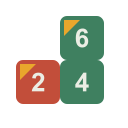
A 4 with exactly two available neighbours must take two bridges from each. If either connection supplied only one, the total could reach at most three. A 6 with three available neighbours and an 8 with four work the same way.
Before applying the rule, check that those connections really are available and that the neighbours can accept the bridges. Count the remaining capacity if you have already drawn some.
Find the forced single bridges too
A 3 with only two available neighbours needs at least one bridge to each. If you omitted one neighbour, the other could provide at most two, which is not enough.
Likewise, a 5 with three available neighbours must touch all three, and a 7 with four must touch all four. You have proved a minimum of one on each connection; you have not yet proved which ones will become doubles.
Keep the whole network connected
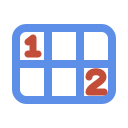
Matching every number is not enough. All islands must belong to one network. Two islands labelled 1 cannot connect only to each other if other islands remain, because both would be finished and their little component could never join the rest.
In the example, four 2s could form two separate double-bridge pairs. Every number would look satisfied, but the network would be split. A single bridge along each side of the square keeps all four islands connected. Unlike Slant, Hashi allows a loop.
Recount after every useful connection
A completed island cannot take more bridges. A new bridge can also block a crossing connection elsewhere. Both changes can reduce another island’s options, creating a move that was not forced before.
Scan for full-capacity islands, then forced singles, then groups that risk becoming cut off. When considering a tempting extra bridge, ask whether the islands it finishes could still connect to the rest of the puzzle.
- Two parallel lines count as two bridges, not one connection for the clue total.
- A bridge must stop at the next island in its direction.
- Use the Library for practice; its results do not add league points.
Put it into practice
Try an Easy Bridges Library puzzle and look for one deduction from this guide.
Play BridgesSign in or create an account to save your progress.