Hubbard

What a peg beside your guess means
The hidden code is four pegs long and drawn from six colours, numbered 1 to 6 on the board. A colour may appear more than once. You have eight guesses.
After each guess the board answers with small pegs. A filled peg means one of your pegs is the right colour in the right spot. A hollow peg means you have a right colour in the wrong spot. The answer never says which of your four pegs it is talking about, and it never points at a position.
Here is the part that decides the whole guide. A colour is credited only as many times as it genuinely appears in the code. Guess 1-1-2-2 against a code of 1-3-4-5 and you get a single filled peg, not two, because the code holds one purple and you asked about two. The count is capped by reality, which is exactly what makes a repeated peg a measuring instrument rather than a wasted slot.
Four different colours only ask what is present
An opener of 1-2-3-4 asks four yes-or-no questions: is purple in the code, is gold, is green, is red. It cannot ask how many. Whether the code holds one purple or two, that opener returns the same peg for purple either way.
That matters because repeats are the normal case, not the exception. The generator builds a code as four different colours, or as one pair, or as two pairs, and it never uses the same colour three times. Of the 1,170 codes it can produce, 810 contain a repeated colour. That is 69 of every 100 boards. It gets worse as the board gets harder: the two easiest difficulty bands always give you four different colours, while the two hardest always give you two pairs.
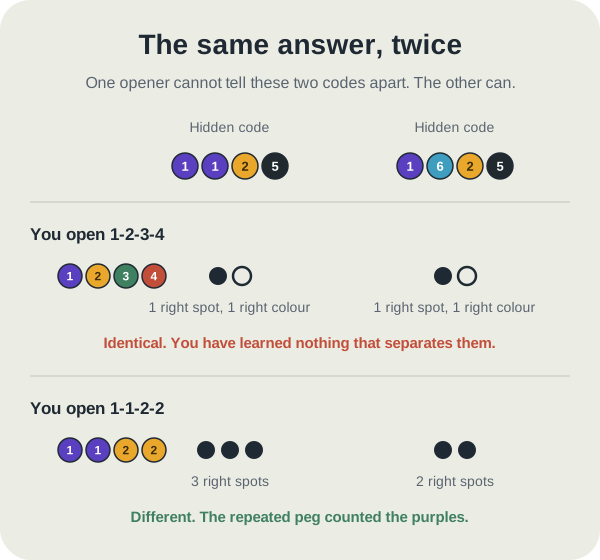
The picture below is the whole argument in one frame. The codes 1-1-2-5 and 1-6-2-5 are both codes the game can set. Open with 1-2-3-4 and both answer with one filled peg and one hollow peg. You cannot tell them apart, and you have spent a guess finding that out. Open with 1-1-2-2 and the first answers with three filled pegs while the second answers with two. The doubled purple counted the purples for you.
A board solved in three
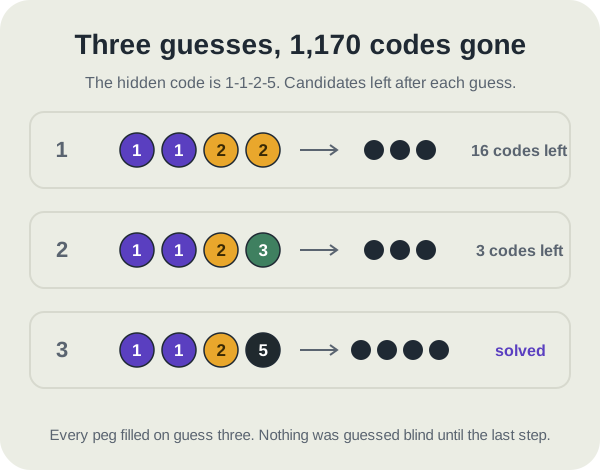
Take 1-1-2-5 as the hidden code and open with 1-1-2-2. The answer is three filled pegs and no hollow ones. Three of your pegs are right and in place, and nothing you played is merely sitting in the wrong slot. Of the 1,170 codes the game could have set, 16 survive that.
The second guess changes one peg and leaves the rest alone: 1-1-2-3. The answer is three filled pegs again. Nothing improved and nothing broke, so the peg you moved is not the one that was wrong before, and green is not the missing colour. Sixteen candidates fall to three, and those three are 1-1-2-4, 1-1-2-5 and 1-1-2-6. The first three pegs are settled and the last one is red, slate or teal.
Now pick one. Guess 1-1-2-5 and the board fills every peg. That last step is a one-in-three choice rather than a deduction, and it is worth being honest about which is which: the first two guesses did the work, and the worst case from three candidates is two more guesses, not five.
The habit to copy is the second guess, not the third. Changing a single peg while holding the others still turns a vague answer into a positional one, because any change in the pegs can only have come from the peg you moved.
What the repeat is worth across every board
One example proves the idea but not the size of it, so I ran every code. For each of the 1,170 codes the generator can set, a simulated player opened with a fixed guess and then played any code still consistent with every answer so far. That is roughly what a careful person does by hand, and it is the same rule for each opener, so the openers can be compared fairly.
Opening 1-2-3-4 takes 4.76 guesses on average, and 34 codes drag it out to seven. Opening 1-1-2-3 takes 4.64, with 9 codes reaching seven. Opening 1-1-2-2 takes 4.59, with 6. Two pairs is the best of them, one pair is nearly as good, and four different colours is the worst of the three on both counts.
The average gap looks small at about a sixth of a guess. The tail is where it is felt. Against four different colours you are more than five times as likely to land in a seven-guess board, and on a game where your points come from placing against everyone else who played that day, the seven-guess days are the ones that cost you.
The mistake that feels systematic
If a repeated peg measures a colour, the tempting next thought is to measure them all: guess 1-1-1-1, then 2-2-2-2, and read off the count of each colour in turn. It is clean, it is guess-free, and it is the slowest thing you can do. Run it through the same simulation and it needs 5.12 guesses on average, with 46 codes reaching seven. You spend your guesses buying information you never get to use.
The other common slip is in the reading rather than the play. A hollow peg does not name a colour. If you play 1-1-2-2 and get one hollow peg back, that is one colour of yours sitting in the wrong place, and it might be a purple, a gold, or the second copy of either. Write down what an answer rules out rather than what it seems to suggest, and the ambiguity stops costing you a guess.
Open your next Colour Code board with 1-1-2-2. Then change one peg at a time and watch what moves.
Put it into practice
Try an Easy Colour Code Library puzzle and look for one deduction from this guide.
Play a Colour Code boardSign in or create an account to save your progress.