Hubbard

The position that looks won
Open with CRANE and suppose every tile comes back stone grey. No C, no R, no A, no N, no E. That is a poor-looking result and a genuinely useful one: it removes five common letters and leaves 263 of the game's 2,315 answers standing.
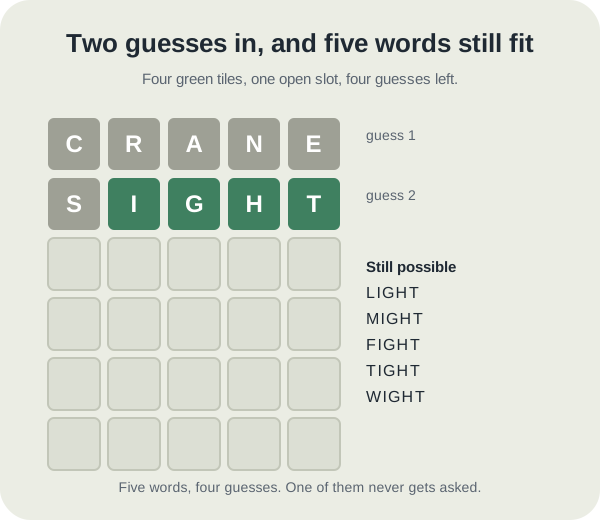
Play SIGHT next. The S is grey, and I, G, H and T all come back fern green in their own positions. The answer ends in IGHT and the first letter is not S.
Now count what is left. LIGHT, MIGHT, FIGHT, TIGHT and WIGHT all fit. RIGHT, NIGHT and EIGHT were removed by CRANE, since each carries an R, an N or an E, and SIGHT ruled itself out. Five words remain, and you have used two of six guesses.
Why guessing them in turn loses one board in five
The instinct is to work through the list: LIGHT, then MIGHT, then FIGHT, and so on until one of them turns green. It is a reasonable-looking plan, and the arithmetic quietly kills it. Five candidates, four guesses.
Play them in order and you solve on guess 3 if the answer happens to be first, guess 4 if it is second, guess 5 if it is third and guess 6 if it is fourth. If it is the fifth, the board is over before you ask. You know the answer and cannot play it.
So each of the five words is equally likely and one of them, once in five boards, is a failed solve rather than a slow one. The order you happen to pick does not change that; it only changes which word is unlucky. The cost is not a guess or two, it is the whole board.
Spend a guess that cannot win
The move is to give up on winning with guess 3 and use it to ask about several candidates at once. The candidates differ only in their first letter: L, M, F, T, W. A word carrying three or four of those letters, anywhere in it, sorts the list in a single row.
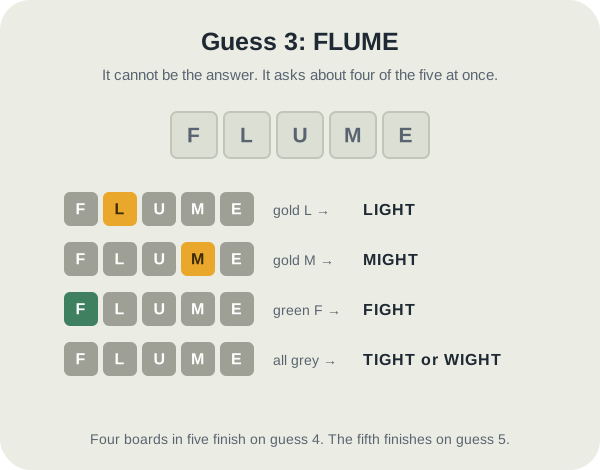
FLUME does the job. It is a legal guess, it cannot be the answer, and it holds F, L and M. Against LIGHT the L comes back gold. Against MIGHT the M comes back gold. Against FIGHT the F comes back green in the first position. Against TIGHT and WIGHT nothing comes back at all, because neither word contains F, L, U, M or E.
Three of the five are named outright, and the remaining pair is a coin flip you can afford: you still have guesses 4, 5 and 6 for two words. The board now finishes on guess 4 four times in five, and on guess 5 the other time. It never fails.
No single legal word separates all five, because no five-letter word carries L, M, F and W together. Forty-eight of the game's 14,855 legal guesses cut the list to two, which is the best any one word can do here. FLUME, FLAWS, WOLFS and MEWLS are among them.
How often the board does this to you
Often enough to be worth a habit. Of the 2,315 answers the game draws from, 417 sit in a family of four or more words that share four letters in the same positions. That is 18 per cent, close to one board in five.
The largest is the IGHT ending, with nine answers. OUND has eight. Seven answers end in OWER, seven end in ATCH, and seven more begin SHA and end in E. Thirty of these families hold five words or more, which is where the count can outrun your remaining guesses.
Not every one of these boards is dangerous. If your earlier guesses have already eliminated most of a family, four greens really is nearly a win. The number that matters is not the size of the family, it is how many words are still standing when you look.
The habit worth building
Before you play guess 3 on a board like this, do one count: how many words fit, and how many guesses do you have left. If the candidates outnumber the guesses, stop trying to win this turn and play a word that splits them instead.
The common mistake is treating a green tile as progress in itself. It is not. Progress is the number of words still standing, and a guess that removes three candidates without winning is worth more than a guess that removes one and might.
This is also why an opener is worth keeping fixed. CRANE did nothing visible on the board above and did most of the work, because clearing five common letters is what left the IGHT family down to five rather than eight.
Put it into practice
Try an Easy Five Letters Library puzzle and look for one deduction from this guide.
Play a Five Letters boardSign in or create an account to save your progress.