Hubbard
Nine puzzles a day, one board each
The competitive slate is shared. Everyone sees the same board for the same game on the same London date, so the comparison is fair by construction.
Five of the nine are timed and rank on your finishing time. The other four rank on how economical your solution was.
- Timed, ranked fastest first: Pipes, Bridges, Sun & Moon, Blooms and Trail.
- Ranked on fewest guesses: Five Letters, Equation and Colour Code.
- Ranked on fewest swaps: Lattice.
- The slate changes only when the league votes. Colour Code rejoined as the ninth competitive game on 14 September 2026.
Where you finish decides your points
Points are not a fixed ladder. Each day the league works out its field: everyone who completed at least one competitive puzzle that day. Your place in every game is then measured against that same field.
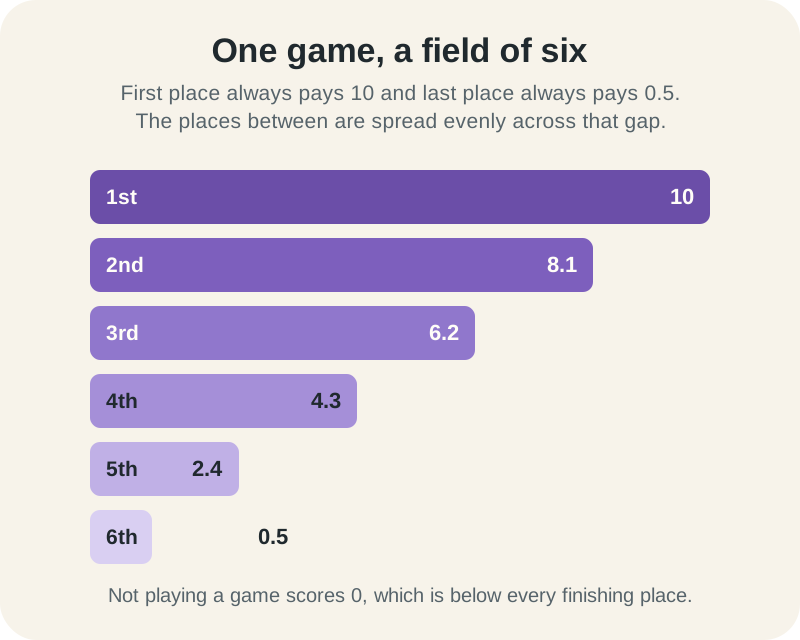
Three anchors set the scale. First place in an isolated field pays 10, the last place in the field pays 0.5, and a game you did not play or did not finish scores 0. Every place in between is spread evenly across that gap, so a bigger field puts more distance between neighbouring places.
Take a day where six players finish at least one competitive puzzle. In each game the six places pay 10, 8.1, 6.2, 4.3, 2.4 and 0.5. Finish fourth in Trail and you bank 4.3 for it; skip Lattice entirely and that game contributes 0.
Ties share the places they cover
Exact ties do not both take the higher place. The tied players average the points across every place their group occupies, and the next player takes the place below the whole group.
In that six-player field, suppose two players post the identical time in Sun & Moon and finish level behind the first two. They cover third and fourth, so each takes the average of 6.2 and 4.3, which is 5.25. The next finisher is fifth on 2.4, not third.
This is why a shared result is worth having rather than something to avoid. Both players end up ahead of where either would have been in fourth alone.
What the league counts
Only today's live daily scores. Playing a past daily as catch-up is worth doing and it still records your result, but it cannot earn league points after its day has closed.
The Just for fun dailies sit alongside the competitive nine and carry no league points. Practice boards from the Library are not scored at all. Both are labelled that way on the board and in the result, so you always know which kind of play you are in.
Today's points stay provisional until the London midnight reset, because the field is still growing while people play.
- Counts: a competitive daily completed on its own London date.
- Does not count: catch-up on a past daily, Just for fun boards, Library practice.
Reading the Board
The Board has five views: Today, Yesterday, This week, This month and All-time. The dated views show a grid of players against the day's games, with your finishing position in each cell and the points it paid underneath.
All-time ranks on league average rather than on total points. That is your points divided by every competitive game available on the days you entered, on a scale of 0 to 10. Days you missed completely are left out of the sum, so someone who joined last month is not buried under a season of absences. Equal averages break on days played.
The habit that costs the most points
On a day you have entered, a competitive game you leave unplayed counts as zero in your league average. It does not quietly drop out of the calculation the way a missed day does.
So the arithmetic rewards finishing the slate over perfecting one board. On a six-player day, a ninth game you skip costs you the 0.5 you would have had for finishing last in it, and it drags the average across all nine. Playing it badly beats not playing it.
Put it into practice
Explore the league and find a puzzle that suits you.
Open the BoardSign in or create an account to save your progress.