Hubbard
Read each sign from small to large
More or Less is our Futoshiki game. On a 4×4 board, each row and column contains 1, 2, 3 and 4 once each. There are no Sudoku boxes. Every inequality must also hold: the pointed end of the sign faces the smaller number.
For example, A < B means A is smaller than B. If another sign tells you B < C, you can read the two together as A < B < C. The three values must strictly increase, even before you know any of them.
Count the room a three-cell chain needs
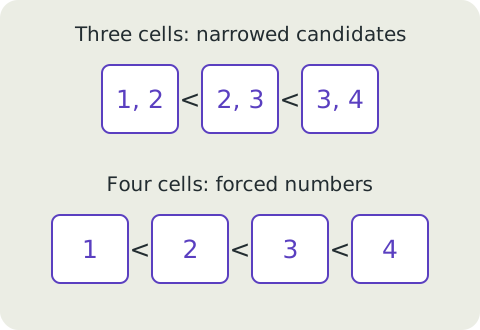
Consider three neighbouring squares in one row of a 4×4 board, joined by A < B < C. A cannot be 3 or 4: there would not be two larger values left for B and C. So A is either 1 or 2.
B needs a smaller value before it and a larger one after it. That rules out both extremes, leaving 2 or 3. C needs two smaller values before it, so C is either 3 or 4.
The chain has narrowed every square, but it has not fixed any single value. Its possible triples are 1–2–3, 1–2–4, 1–3–4 and 2–3–4. Notice that an inequality does not mean “exactly one more”: skipping a number can be legal.
A full-length chain fixes the whole row
Now extend the example to four squares: A < B < C < D. There are only four available values on a 4×4 board, and the chain needs four different values in increasing order. The only possibility is 1 < 2 < 3 < 4.
You can also reason from the ends. D needs three smaller values, so D must be 4. A needs three larger values, so A must be 1. That leaves 2 and 3 in their forced order in the middle.
This is an original teaching strip, not a full puzzle or a current daily answer. A real board may show shorter chains, bends or additional given numbers.
Combine the bounds with a crossing column
Return to the three-cell chain, where A can be 1 or 2. If A’s column already contains a 1, A must be 2. Then B must be larger than 2 while still leaving room for C, so B is 3 and C is 4.
That extra column clue turns a range into a placement. After each confirmed entry, check the affected row, column and connected signs again: an earlier possibility may now be ruled out.
On a larger board, use that board’s number range. Four increasing squares force 1, 2, 3, 4 on a 4×4 board, but not on a 5×5 board, where more values are available.
Watch for a change of direction
You can follow a chain around a corner, provided every comparison continues from smaller to larger. The chain’s logical direction matters more than its shape.
A < B > C is different: B is larger than both neighbours, but this gives no ordering between A and C. Do not treat it as three increasing values. Row and column restrictions still apply separately.
- Check the board’s allowed numbers first.
- Follow only comparisons that keep increasing in the same logical direction.
- Count how many smaller and larger values each square needs.
- Use crossing row or column clues to remove the remaining candidates.
- Place a number only when one candidate remains.
Try one chain before scanning the whole board
Open an Easy More or Less puzzle and find two linked inequalities. Identify the smallest end and the largest end, then work out which extremes each square cannot contain.
You do not need a long chain to make progress. Removing one impossible candidate may be enough to resolve a nearby row or column. Aim to explain why a value cannot fit before making your next move.
Put it into practice
Try an Easy More or Less Library puzzle and look for one deduction from this guide.
Play More or LessSign in or create an account to save your progress.