Hubbard

What the clue actually says
Two shapes appear as fixed clues. A rounded one is the end of a ship or a single-square submarine. A square one is a middle: the ship carries on straight through, in both directions, so there is a ship square on each side of it. Both carry a small white dot to mark them as given rather than placed.
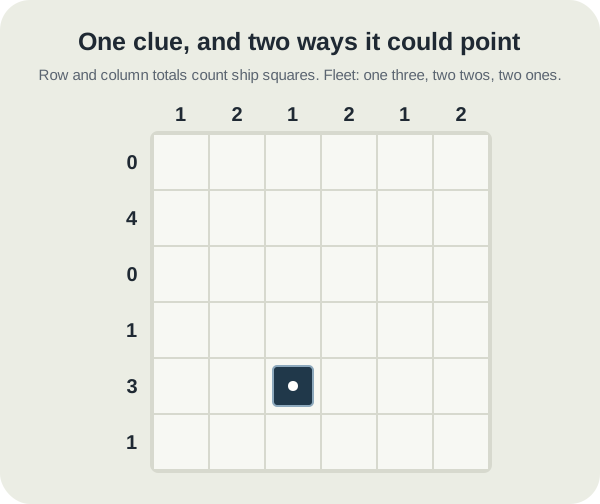
The board below is six by six. The fleet is one three-square ship, two twos and two ones, nine ship squares in all. The totals outside the grid count ship squares in each row and column, and the only clue is a middle at row 5, column 3.
So there is a ship square either side of it: row 5 columns 2 and 4, or row 4 and row 6 in column 3. Nothing else on the board points either way, and the squares next to the clue are all blank.
Read the total that crosses the clue
Start with the free work. Rows 1 and 3 have a total of 0, so all twelve of those squares are sea. Tapping a satisfied total fills its remaining blanks with water for you, which is worth knowing on a timed board.
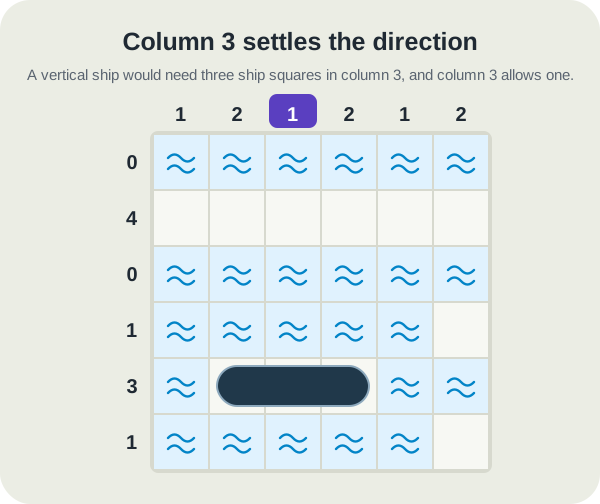
Now the clue. If the ship ran down the column, it would occupy rows 4, 5 and 6 of column 3, which is three ship squares in that column. Column 3's total is 1. One is not three, so the vertical reading is dead, and the ship runs across row 5: columns 2 and 4 are ship squares.
Row 5's total is 3, and those three squares are now placed at columns 2, 3 and 4. The rest of row 5 is sea, which also fixes the ship's length at exactly three. That is the fleet's only three-square ship, accounted for on the second deduction of the board.
What one ship gives away
Ships never touch, corners included, so every square around the three-ship is sea. That covers columns 1 to 5 of row 4 and of row 6. Column 6 is two columns clear of the ship's right-hand end, so it survives.
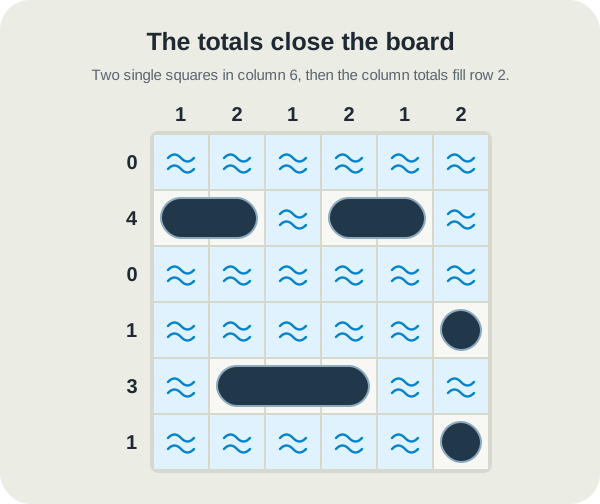
Rows 4 and 6 each have a total of 1, and in each of them exactly one square is still blank. Row 4 column 6 and row 6 column 6 are ship squares, and both are single submarines, because everything touching them is already sea. Two ones, placed without a choice.
That leaves the two two-square ships, four squares, and row 2 needs exactly four. Every remaining ship square is in row 2.
The column totals finish it
Work along the top row of numbers. Column 1 has a total of 1 and only row 2 is still blank in it, so row 2 column 1 is a ship. Column 2 has a total of 2 with one already placed in row 5, and again only row 2 is free, so row 2 column 2 is a ship. Column 3's single square is spent on the clue, so row 2 column 3 is sea.
Column 4 has a total of 2 with one in row 5, giving row 2 column 4. Column 5 has a total of 1 and nothing placed, giving row 2 column 5. Column 6 has a total of 2 and both are already down, in rows 4 and 6, so row 2 column 6 is sea.
Row 2 reads ship, ship, sea, ship, ship, sea: two separate two-square ships with a gap between them. The fleet is complete and the board is finished, with no square ever guessed at.
The mistake that looks like reasoning
There is a tempting shortcut on this board that gives the right answer for the wrong reason. Row 5 has a total of 3, the fleet's longest ship is 3, so the three-ship must lie along row 5 through the clue. It fits, and on this board it happens to be correct.
It is not a proof. A row total of 3 says that row holds three ship squares, not that they sit together, and not that they sit next to the clue. A vertical ship through the clue would use one of row 5's three squares and leave the other two to be found elsewhere in the row; the row total alone cannot rule that out. Carry the habit to a board where the numbers differ slightly and it will place a ship the wrong way round.
The column total is the proof, because it counts the squares the vertical reading would have to use. So when a middle clue stops you, do not study the squares around it. Look at the line running the other way and ask whether it has room for three.
The habit worth keeping
Clear the zero rows and columns first, since they cost nothing and often decide the next step. Then take each fixed clue and check the total of the line crossing it before the line along it.
After every ship you place, fill the sea around it straight away, diagonals included. On this board that single habit handed over both submarines: rows 4 and 6 each dropped to one blank square the moment the three-ship was surrounded.
Battleships is timed and sits in Just for fun and Practice, with no league points, so the cost of a stall is on the clock rather than the table. Reading one number in the right direction is worth more than a careful look at six blank squares.
Put it into practice
Try an Easy Battleships Library puzzle and look for one deduction from this guide.
Play a Battleships boardSign in or create an account to save your progress.