Hubbard

Your guess has to be a real equation
Every guess is exactly eight characters, contains exactly one equals sign, and has to be arithmetically true. Division must come out exactly at every step, and no number may start with a spare zero, so 05+3=8 is refused.
That length rule catches people out more than the arithmetic does. 12*3=36 is perfectly true, and the board will not take it, because it is seven characters. The same goes for 4*15=60 and 5*11=55. If your favourite sum is short, it is not an opener.
Work through the eight character shapes that satisfy all of that and there are 65,704 of them. The opener's whole job is to cut that number down before you have spent a second guess.
Repeat a digit and you waste a tile
You get eight tiles of feedback, and each one reports on the character you put there. Spend two tiles on the same digit and the second one tells you something you already knew.
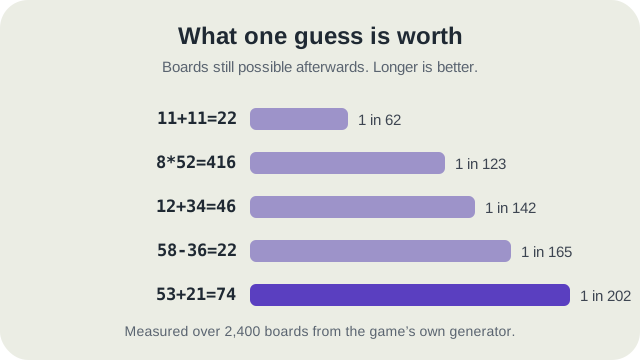
11+11=22 is the extreme case. It is legal, it is true, and it asks about three symbols in eight slots. Open with it and roughly one board in 62 is still possible afterwards.
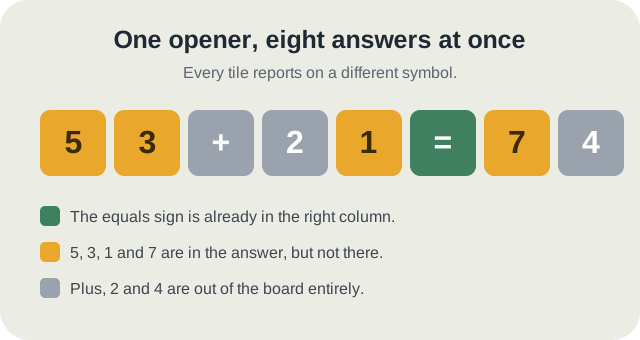
53+21=74 asks about six different digits, a plus and an equals sign. Open with that instead and about one board in 202 survives. Same six guesses, a starting position three times tighter.
The tile that does the most reliable work is the equals sign. Both your guess and the answer contain exactly one, so it can never come back grey. It is either green, and you know the shape of the sum, or gold, and you have ruled out its column.
Open the way the boards are actually written
Here is where the intuitive answer fails. If you rank every legal opener by how much it narrows the full set of 65,704, multiplication wins comfortably: 8*52=416 comes out on top.
But the game does not pick uniformly from all 65,704. Across 2,400 boards from its own generator, 63 per cent of the answers use nothing but addition and subtraction. A multiplication opener spends two of its tiles asking about symbols that are usually not there.
Rank the same openers against the boards the game actually sets and the order inverts. 8*52=416 leaves about one board in 123. The plain 53+21=74 leaves about one in 202. The clever guess is the weaker one.
What that makes a good opener
Three things, in order. Use six different digits, because repeats buy nothing. Use a plus or a minus rather than a times or a divide, because that is what most answers are built from. Keep both sides plain, two digits on the left and two on the right, so the equals sign lands in a common column.
53+21=74 fits all three, and so do plenty of others. You are not looking for the single best string. Any two digit sum with no repeated digit puts you within a few per cent of the best available, which is close enough that picking one and learning its replies is worth more than hunting for a better one.
One digit is worth a thought of its own. Zero appears less often than you would expect and it cannot start a number, so an opener that spends a tile on it is asking a narrower question than it looks.
The mistake that costs a guess
The common error is treating the second guess like the first: reaching for another wide, digit spreading equation when the reply to the opener has already told you something specific.
If the opener returned a green equals sign, the structure is settled and your next guess should respect it. If four digits came back gold, they are all in the answer, and a guess that leaves one of them out is throwing away a fact you have paid for. Equation is untimed, so there is nothing to gain by moving before you have read the row.
The other error is arithmetic, not strategy. Your second guess still has to be true and still has to be eight characters. A guess that uses everything you have learned but does not balance is simply refused, and on a bad day you can lose several minutes to it. Check the sum before you submit.
Put it into practice
Try an Easy Equation Library puzzle and look for one deduction from this guide.
Explore EquationSign in or create an account to save your progress.