Hubbard

What the numbers along the edge mean
A Tents board is a grid with trees scattered through it and a number beside every row and above every column. Each number is the exact count of tents in that line. It says nothing about trees.
Three rules govern where the tents go. Every tree is paired with one tent directly above, below, left or right of it, and no tent serves two trees. Tents never touch another tent, not even at a corner. The edge numbers must come out exactly.
The second rule is the one that does the arithmetic in this guide. Because tents cannot sit side by side, a line of five cells holds at most three of them, and a line of seven holds at most four. When the number on the edge equals that ceiling, the line has run out of room to be arranged.
Tents is a Practice and Just for fun game rather than one of the nine daily league games, so nothing here affects your standings. It is timed, so the opening still costs you seconds.
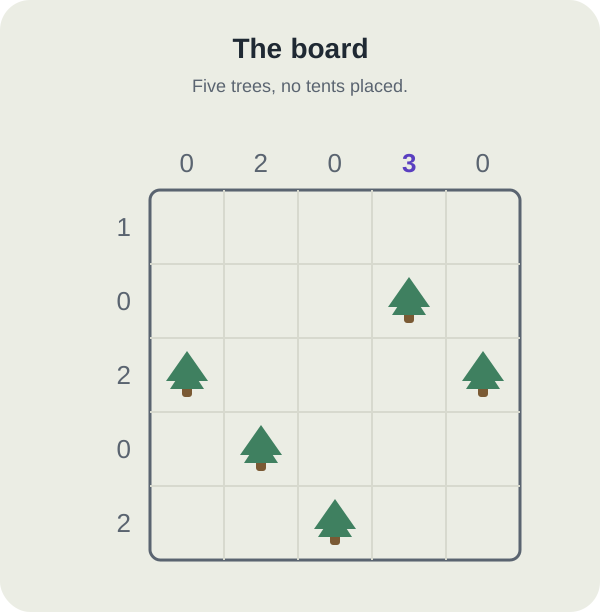
Three tents in five cells have one home
Look at the fourth column. It is five cells tall and the number above it is 3. Put a tent in the top cell and the second cell is dead, because tents cannot touch. Put the next one in the third cell and the fourth is dead too. The third tent has nowhere left but the bottom cell.
Try starting anywhere else and you run out of column. Begin in the second cell and the three tents need rows 2, 4 and 6, and there is no row 6. There is exactly one arrangement of three non-touching tents in five cells: the top, the middle and the bottom.
That gives you three tents for free, in rows 1, 3 and 5 of the fourth column, and it also settles the one cell left over. Row 4 has a total of 0, which the arrangement already respects, so the fourth cell of that column is grass.
Note what you did not need. You did not look at a tree, and you did not check which tree would claim which tent. The count alone closed the line.
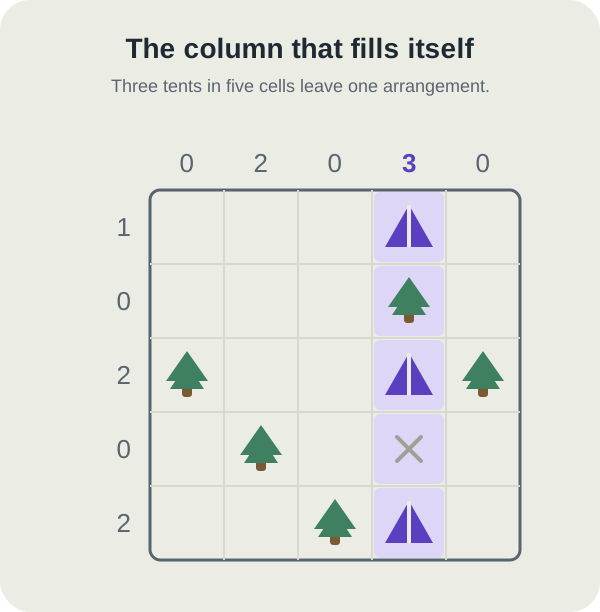
The rest of the board falls out of it
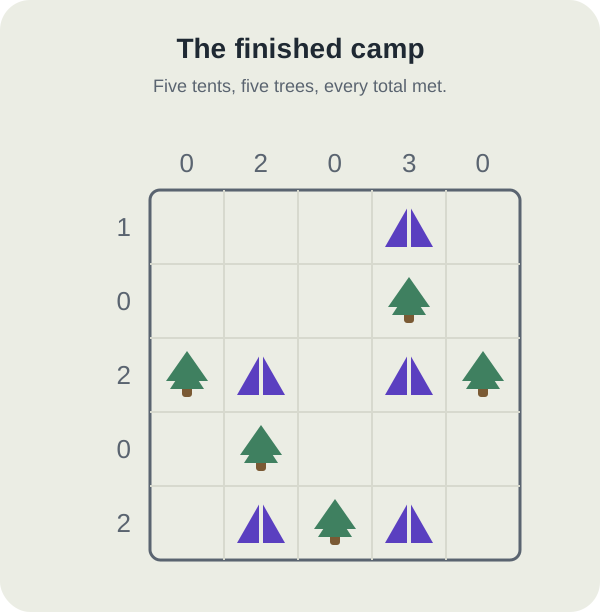
Row 1 has a total of 1 and the tent you just placed at row 1, column 4 is it, so the rest of that row is grass. Rows 2 and 4 read 0, so they are grass end to end. Columns 1, 3 and 5 read 0 as well, which clears most of what is left.
That leaves the second column, which needs 2 tents. Row 1 is already full and rows 2 and 4 are empty by their own totals, so the only cells still available are rows 3 and 5. Both take a tent, and the board is finished.
Now run the pairing check, which is the part that confirms rather than discovers. The tree at row 3, column 5 touches only one tent, at row 3, column 4, so it takes it. The tree at row 3, column 1 likewise takes the tent at row 3, column 2. The tree at row 2, column 4 had two candidates, but one is now spoken for, so it takes the tent at row 1, column 4. The tree at row 4, column 2 takes row 5, column 2, and the tree at row 5, column 3 takes row 5, column 4.
Five trees, five tents, one each, no two tents touching and every edge number exact. We checked this board against the game's own solver and by listing every legal tent layout for it: there is one, and it is this.
Where the trick stops working
The forcing depends on the line having an odd length. In five cells, three non-touching tents have one arrangement. In seven cells, four tents have one arrangement. Both are full lines with no slack.
Even lengths are different. Three tents in a six cell line can be arranged four ways, and four tents in an eight cell line can be arranged five ways. The number is still at the ceiling, but the line has a spare cell to slide into, so it settles nothing on its own.
Tents boards run from five up to eight cells a side. So a maxed-out count is a free line on the five and seven boards, and only a strong hint on the six and eight ones. On an even board, treat a maxed count as a shortlist and look for a zero line or a tree with a single open side to break the tie.
The common mistake is the opposite habit: starting at a tree and picking a side for its tent. A tree with two or three open neighbours tells you nothing on its own, and a tent placed on a hunch will usually survive several more moves before it contradicts something, by which point you have built on it. The counts never do that to you.
Two habits worth keeping
Read the edge numbers before the grid. Zeroes first, because they cost nothing, then any count that fills its line. On a board with a maxed-out odd line you can often place a third of the tents before making a real decision.
Use the marking. When a line's total is satisfied, the number turns green, and tapping it fills every remaining cell in that line with an X. On a timed game that is faster than crossing them off one at a time, and the crossed cells are what make the next tree's single open side obvious.
Open a Tents board in the Library and look at the edge numbers first. If one of them fills its line, the puzzle has already given you three tents.
Put it into practice
Try an Easy Tents Library puzzle and look for one deduction from this guide.
Play a Tents boardSign in or create an account to save your progress.