Hubbard
Read a pair as a boundary
Every Sun & Moon row and column has three suns and three moons. It may never contain three identical symbols consecutively, horizontally or vertically. An equals sign connects matching symbols; a cross connects opposite symbols.
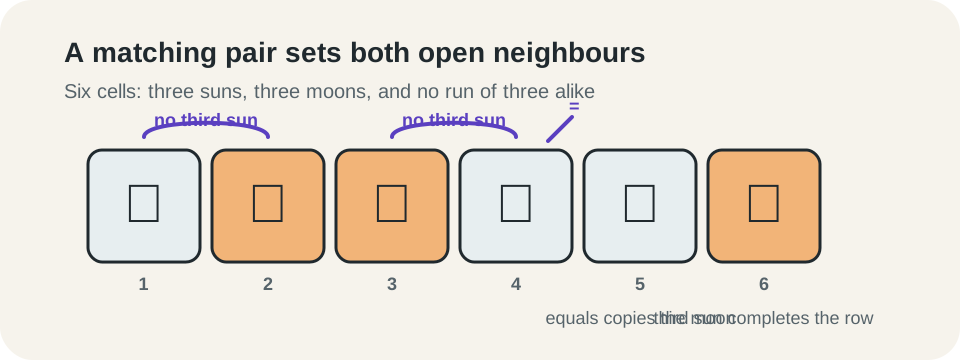
In our original six-cell row, cells 2 and 3 are both suns. If cell 1 were also a sun, cells 1–3 would make three suns in a row. If cell 4 were a sun, cells 2–4 would do the same. Both open neighbours must therefore be moons.
This works in a column too. Whenever two identical symbols are adjacent, check the cell immediately before and after the pair when those cells exist. Each open end must be the other symbol. At an edge, there is only one open end to check.
Carry the result through an equals sign
Our demonstration also has an equals sign between cells 4 and 5. We have just proved that cell 4 is a moon, so cell 5 must be a moon as well. The sign does not mean two more suns or two more moons; it simply makes its two endpoints match.
The row now contains two suns and three moons: moon, sun, sun, moon, moon, blank. A six-cell line needs exactly three of each symbol, so its final cell must be a sun. The completed row is moon, sun, sun, moon, moon, sun.
Each move uses a visible rule. The pair prevents a triple, the equals sign requires a match, and the balance rule supplies the last symbol. No hidden answer or current puzzle is involved in this teaching example.
Why the first move is forced
It can help to test the only alternative. Keeping the two middle suns, making cell 1 a sun would create sun–sun–sun. Making cell 4 a sun would also create sun–sun–sun. Both alternatives break the same no-three rule, leaving moon as the only legal symbol at either end.
The worked row has exactly one legal completion when you apply its two given suns, the equals sign, three suns and three moons, and the no-three rule. That is stronger than a pattern that merely looks likely: every other completion fails at least one rule.
A cross sign is the companion rule. If one endpoint of a cross is a sun, the other must be a moon, and vice versa. Do not treat equals and cross as decorative markers; they are direct deductions once either endpoint is known.
Avoid a familiar overreach
Two matching symbols separated by one gap also give a deduction, but in a different place. Sun, blank, sun forces a moon into the middle to avoid three suns. It does not by itself force the cells outside that three-cell pattern. Keep the adjacent-pair rule and this gap rule distinct.
Likewise, a pair at the left edge forces the cell to its right, but has no cell beyond the edge to settle. Check the shape of the line before assuming that a pair produces two moves.
After placing a forced symbol, inspect its column as well as its row and any signs touching it. One short pair can trigger a chain somewhere else on the board.
- Find two adjacent matching suns or moons.
- Put the opposite symbol in each existing open neighbour.
- Follow any equals or cross signs attached to the new symbols.
- Count each affected row and column: once one symbol appears three times, every remaining blank in that line must be the other symbol.
- Stop if more than one symbol remains legal; that square is not ready yet.
Try the pair scan on a fresh board
Open an Easy Sun & Moon puzzle and scan rows and columns for adjacent equal symbols before filling isolated blanks. Mark the open neighbours first, then look for signs and three-of-each totals that use those marks.
The rhythm is simple: pair, forced opposite, sign, balance, then scan again. Explaining which rule rules out the alternative is a good way to keep the move logical rather than turning it into a guess.
Put it into practice
Try an Easy Sun & Moon Library puzzle and look for one deduction from this guide.
Play Sun & MoonSign in or create an account to save your progress.