Hubbard
Start with the numbers that are missing
In HubbardGames Mini Sudoku, every row, column and 2×3 box contains the numbers 1 to 6 once each. A candidate is simply a number that has not yet been ruled out for an empty square.
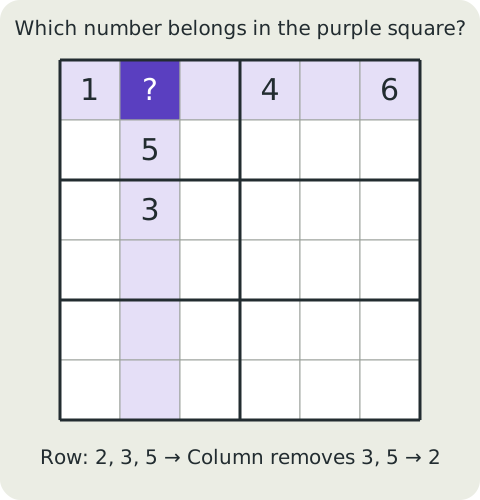
Look at the top row of our demonstration: 1, blank, blank, 4, blank, 6. The missing numbers are 2, 3 and 5. Those three numbers must fill its three empty squares, but the row alone does not tell you their order.
This is a small teaching position, not a complete puzzle to solve. We will focus only on the highlighted square in the top row, second column.
Let the column remove two choices
The highlighted square is also in the second column. That column already contains a 5 and a 3, so putting either number in our square would create a repeat.
Start with the row’s candidates {2, 3, 5}. Remove 5 because it is in the column, then remove 3 for the same reason. Only 2 remains. The highlighted square must be 2.
Notice why this is a deduction: we did not choose the number that looked most promising. We ruled out every other number that the row could accept.
Check the box before placing the number
Every square belongs to three overlapping groups: its row, its column and its box. Our highlighted square is in the top-left 2×3 box. That box already contains 1 and 5, so it does not rule out 2. The move satisfies all three groups.
On another board, the box may be the group that removes the final alternative. Use whichever group is easiest to read first, but include all three before deciding.
- List the numbers missing from the row.
- Cross out any of those already in the column.
- Cross out any already in the 2×3 box.
- If exactly one candidate remains, place it. If two or more remain, leave the square for now.
Avoid turning a candidate into a guess
A common mistake is to see that a row needs a 2 and immediately put it in the first empty square. “This row needs a 2” and “this square must be 2” are different claims. You need the column or box restrictions to justify the second.
Another trap is overlooking the box shape. This Mini Sudoku uses boxes two rows tall and three columns wide. Follow the heavier grid lines rather than imagining the 3×3 boxes of a standard 9×9 Sudoku.
If your checks remove every candidate, pause. An earlier entry may be wrong, or you may have included a number from outside the square’s row, column or box. Do not fill an empty candidate list by guessing.
Use each confirmed number to look again
After writing 2 in the highlighted square, the top row needs only 3 and 5. Our teaching position does not yet force their order, so stop there rather than inventing the next move.
In a full puzzle, scan the remaining empty squares in that row, then the column and box affected by your new number. One confirmed entry can remove a candidate elsewhere and create another forced move.
Try this routine on an Easy Mini Sudoku: pick a nearly filled row, choose one empty square and explain out loud why each rejected candidate cannot go there. When just one survives, you have a reason for your move.
Put it into practice
Try an Easy Mini Sudoku Library puzzle and look for one deduction from this guide.
Play Mini SudokuSign in or create an account to save your progress.