Hubbard

Green is finished, gold is not
A green tile holds the right letter in the right place. Once a tile is green you have no reason to touch it again, and touching it makes the board worse rather than better.
A gold tile holds a letter that belongs somewhere else in one of the words crossing that tile. Gold is an instruction to move, but it does not say where to. Working that out is the whole game.
Take one row of a board that has to end up reading PLANT. It currently reads P, N, L, A, T. The P and the T are already home, so they show green. The three letters between them show gold.
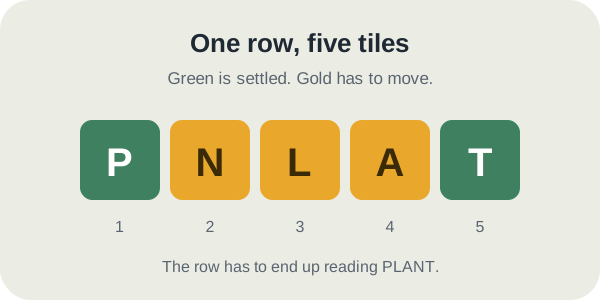
Follow each gold letter home
Work along the row and ask where each gold letter actually needs to sit. The N in position 2 belongs in position 4. The A in position 4 belongs in position 3. The L in position 3 belongs in position 2.
Notice what those three answers do. They join up. N points at the cell the A is sitting in, A points at the cell the L is sitting in, and L points back at the cell the N came from. The letters form a closed loop.
This is the reading that tells you what to do next. When two letters point at each other, one swap sends both of them home. When they form a longer loop, no single swap can finish two tiles, and you need to know what the loop is going to cost you.
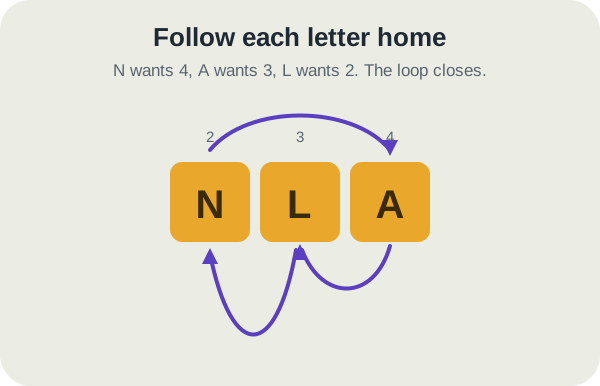
A loop of three costs two swaps
The cost of a loop is one less than the number of letters in it. A loop of two costs one swap, a loop of three costs two, a loop of four costs three. A row full of gold is not necessarily expensive, and a row with only a few gold tiles is not necessarily cheap. What matters is how the loops are shaped.
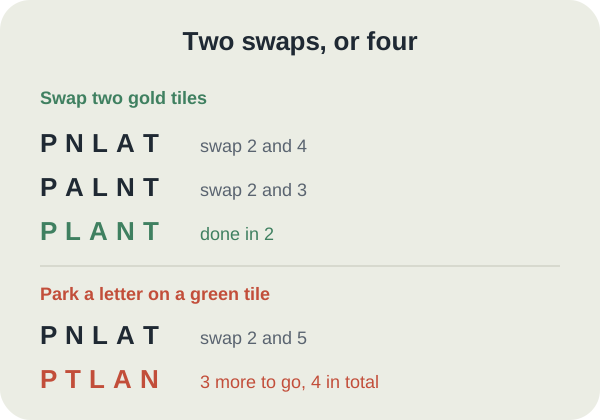
The useful part is that any swap between two tiles inside the loop keeps you on that minimum. Swap positions 2 and 4 and the row reads P, A, L, N, T, with the N now home. What is left is a loop of two, the A and the L, which one more swap closes. Two swaps, which is the best this row allows.
So you do not have to find a clever first move. You only have to find the loop and stay inside it.
The move that costs you two
The common mistake is to treat a gold letter as something to get out of the way. You see the N, you know it does not belong in position 2, so you move it somewhere and plan to sort the rest out afterwards.
Suppose you move it onto the T. The row now reads P, T, L, A, N. You have spent a swap, and the T that was already green is now out of place, so you have added a letter to the problem instead of removing one. From there the row needs three more swaps: four in total, against the two it should have taken.
The rule that avoids this is short. Never move a letter into a cell where it does not belong, and never touch a green tile. If you cannot see a swap that puts at least one letter home, you have not finished reading the loop yet.
Reading a whole board this way
A full Lattice board is three words across and three down, crossing on twenty one tiles, and it is built to come apart within fifteen swaps. The loops on a real board run between words rather than along a single row, which is why a letter can look stranded until you notice the tile it points at.
The method does not change. Find a pair of tiles that want each other's cells and swap them, and when nothing pairs up, follow the loop until it closes and start anywhere inside it. Lattice is untimed, so there is no reason to move before you have read the board.
Fewer swaps places you higher in the day's field, and the board keeps working after fifteen, so a slow, careful start costs nothing.
Put it into practice
Try an Easy Lattice Library puzzle and look for one deduction from this guide.
Explore LatticeSign in or create an account to save your progress.