Hubbard
A short sum gives you a short list
Fill white squares with digits 1 to 9. Each uninterrupted run of white squares must add to its clue, and no digit may repeat within that run. On the game board, an across clue sits to the left of its run and a down clue sits above it.
For a two-square run totalling 3, the only pair is 1 and 2. Zero is not allowed, so 0 and 3 is not an option. The pair could appear as 1 then 2 or 2 then 1: the sum alone cannot choose the order.
A two-square run totalling 4 must contain 1 and 3. Although 2 plus 2 also equals 4, it repeats a digit, so it is forbidden. Keeping the no-repeat rule in mind makes short totals especially useful.
Look at the square where two runs cross
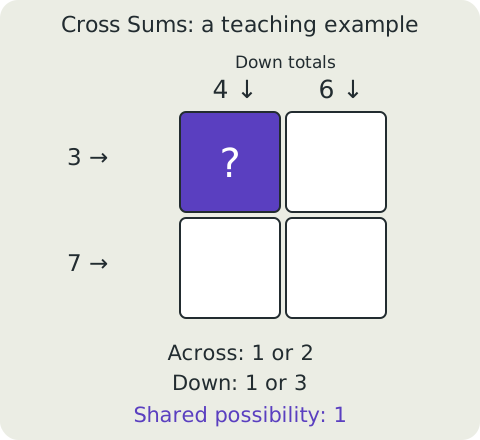
Our original example has four white squares. The top row totals 3 and the left column totals 4. The highlighted top-left square belongs to both runs.
From the across sum, that square can be 1 or 2. From the down sum, it can be 1 or 3. The only digit in both lists is 1, so the highlighted square must be 1.
This is the intersection of two candidate lists. A candidate is a digit that is still possible; here, checking both directions leaves just one.
Let the first digit finish the other runs
Once the top-left square is 1, the top-right must be 2 to complete the across total of 3. The bottom-left must be 3 to complete the down total of 4.
The bottom row totals 7. Its first digit is now 3, so the bottom-right must be 4. Check the right column: 2 plus 4 equals its clue of 6, with no repeated digit.
The completed example is therefore top row 1, 2 and bottom row 3, 4. Every sum and no-repeat rule agrees. These four squares are an original teaching example, not a current daily board or answer.
A pair is not the same thing as an ordered answer
Seeing a two-cell total of 3 does not mean you should always write 1 first and 2 second. Both orders meet that clue. In our example, the crossing total of 4 is what fixes the 1 at the left.
Longer runs need the same care. A total can have several possible digit combinations, and each combination may fit in several orders. Start with the run length and total, then use each crossing to rule out digits square by square.
Do not apply the no-repeat rule to a whole visual row across black blocks. A block ends the run. The restriction belongs to each separate run, so the same digit may appear elsewhere in that row if a block separates it.
Check the remaining sum as you go
After placing a confirmed digit, subtract it from the clue to find the total still needed. Also remember which digits the run has already used: the remaining squares cannot repeat them.
For example, a three-cell run totalling 7 with a confirmed 1 still needs 6 across two cells. The remaining pair cannot be 1 and 5 because the run already contains 1, and it cannot be 3 and 3 because those digits repeat. That leaves 2 and 4, with their order still decided by crossings.
If no legal combination remains, stop and revisit the entries or the clue you read. An impossible remainder is a reason to check your work, not to break the no-repeat rule.
Try the crossing-list routine
Choose a short run in an Easy Cross Sums puzzle and list its possible digits. Pick one square, inspect its crossing run, and keep only the digits that work in both directions.
- Count the white squares in each run before listing combinations.
- Use digits 1 to 9, with no repeats inside a run.
- Compare the across and down possibilities for the same square.
- Place a digit only when the combined list leaves one option.
- After a placement, recheck both affected sums and the digits already used.
Put it into practice
Try an Easy Cross Sums Library puzzle and look for one deduction from this guide.
Play Cross SumsSign in or create an account to save your progress.