Hubbard
Four rules, and the one that does the work
A bulb lights its own square and shines along its row and column until a wall stops it. Every open square has to end up lit. A numbered wall touches exactly that many bulbs on its four sides. And no two bulbs may see each other along a clear row or column.
That last rule is the one to read twice, because it works backwards as well as forwards. If a square is already lit, some bulb can see it. Putting a second bulb there would put two bulbs in view of each other, so a lit square is permanently out of the running.
So light is not just progress towards the finish. It is an elimination tool. Place a bulb, follow its two lines to the walls, and every square they touch becomes a square no clue can ever use.
The board
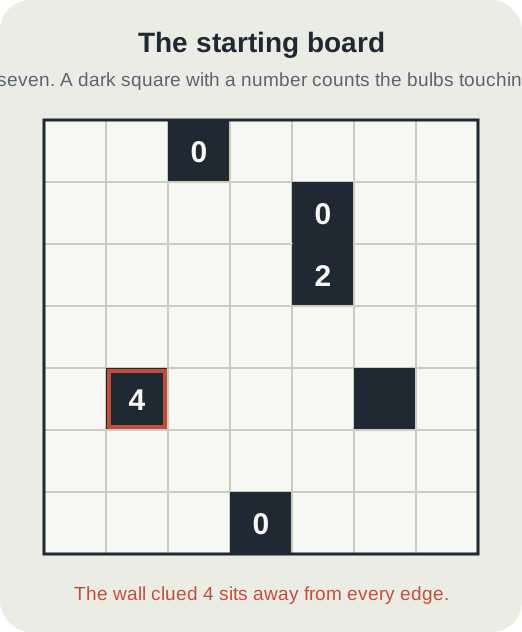
Seven by seven, six walls. There is a wall clued 4 at row 5, column 2, a wall clued 2 at row 3, column 5, walls clued 0 at row 1 column 3, row 2 column 5 and row 7 column 4, and one plain unnumbered wall at row 5, column 6.
Rows are counted from the top, columns from the left. Nothing is marked yet, and the whole board resolves without a single guess.
Start where the count leaves no choice
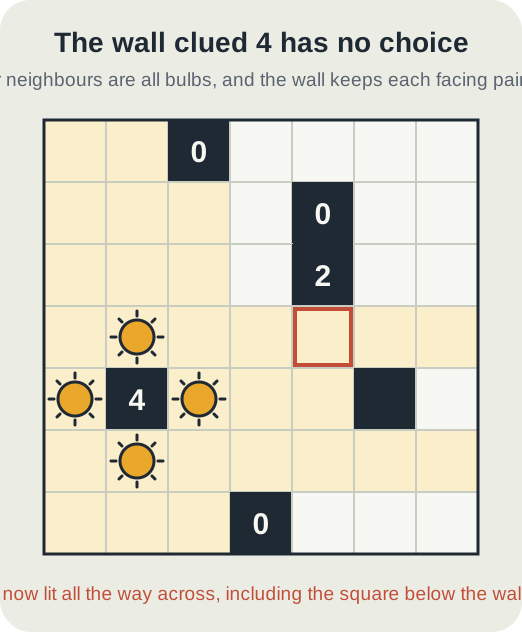
The wall clued 4 at row 5, column 2 has four open squares touching it: row 4 column 2, row 6 column 2, row 5 column 1 and row 5 column 3. It needs four bulbs and there are four places, so all four are bulbs.
They do not break the sight rule, because the wall itself sits between each facing pair. The bulb above and the bulb below are in the same column with the wall between them, and the same is true left and right.
Now follow the light instead of moving straight to the next clue. The bulb at row 4, column 2 shines right along row 4 with nothing in its way, so every square from column 3 to column 7 of that row is lit.
The clue that only looks like it has a choice
The wall clued 2 at row 3, column 5 needs two bulbs beside it. Count its neighbours honestly: above it, row 2 column 5, is another wall, so it is out. That leaves three open squares, at row 3 column 4, row 3 column 6 and row 4 column 5.
Three places for two bulbs looks like a choice. It is not. Row 4, column 5 was lit a moment ago by the bulb at row 4, column 2, so a bulb there would shine straight back along row 4 into it. Cross it off.
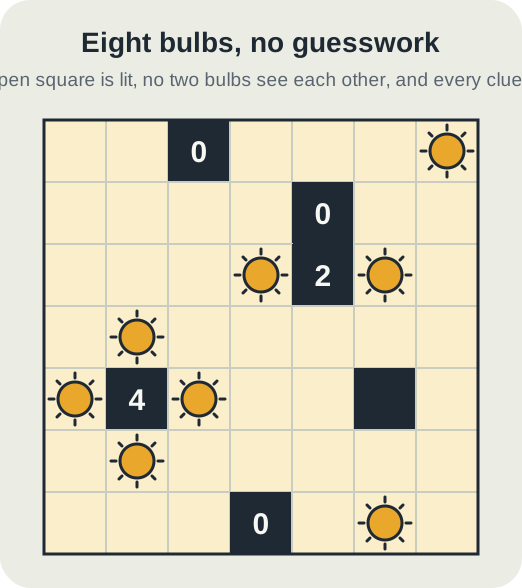
Two squares remain and the clue asks for two, so row 3 column 4 and row 3 column 6 are both bulbs. Nothing about the clue changed. The light changed what the clue could mean.
The zeros finish it
Two squares are still dark, and both are solved the same way. Row 1, column 5 can only be reached from its own row, because the wall clued 0 directly below it at row 2, column 5 blocks the column. To its left, the wall clued 0 at row 1, column 3 blocks the rest of the row.
That leaves row 1 columns 4 to 7 as the squares that could light it. Columns 4 and 6 are already lit, so they are out. Column 5 is itself touching a wall clued 0, which allows no bulbs beside it at all. Only row 1, column 7 is left, so the bulb goes there.
The bottom repeats the pattern. Row 7, column 5 is dark, the wall clued 0 at row 7 column 4 blocks the row to its left and bars a bulb beside it, the column above is already lit, and the new bulb at row 1, column 7 has just lit all of column 7. Row 7, column 6 is the only square left. Eight bulbs, every square lit, every clue satisfied.
The mistake to avoid
The common error is reading a clue as a number out of four and stopping there. A wall clued 2 does not mean two of four. It means two of whatever is genuinely still available, and three things shrink that pool: neighbouring walls, squares beside a wall clued 0, and squares that are already lit.
On this board that difference is the whole puzzle. Counted lazily, the clue of 2 had four sides and looked like a choice between three squares. Counted properly, it had two, and it was forced.
So before you treat a clue as ambiguous, recount its neighbours with the light you have already placed. A board that seems to need a guess often only needs a recount.
Put it into practice
Try an Easy Light Up Library puzzle and look for one deduction from this guide.
Play a Light Up boardSign in or create an account to save your progress.