Hubbard
Where the list lives
Open Profile and choose Collection. The panel opens with your count and percentage across the top, a progress bar under it, and then two rows of filters.
The first row is To earn, Completed and All. It opens on To earn, which is the useful default: locked achievements keep their full description, so the list reads as a to-do list rather than a trophy cabinet you cannot get into. The second row is the four tiers, each showing how many of that tier you hold out of its total, so you can see at a glance that bronze is nearly done and legendary has barely started.
Achievements are worked out from your play history every time the panel loads rather than written down when you earn them. That is why the panel can take a moment on a long history, and it is also why a corrected result quietly corrects the badge that depended on it.
What the four tiers hold
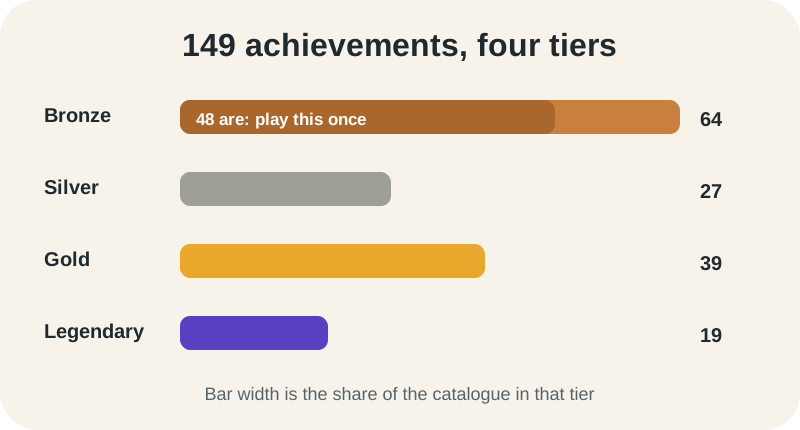
Bronze is the biggest tier at 64, and 48 of those ask only that you complete one puzzle of a given type, once. Finish a Light Up in the Library and Bright Spark is yours. Finish a Slant and you have A New Angle. There are 40 games on the site and only nine of them are in the competitive league, so a wander through the Library is worth a surprising amount of bronze.
Silver holds 27 and gold 39, which is the wrong way round from what people expect. The catalogue simply has a lot of gold-weight targets in the middle of it: Hat-trick for winning three games in one day, Pure Logic for a full competitive card without a hint, Centurion for 100 league completions.
Legendary holds 19, and they are what they sound like. Hole in One is Five Letters solved in a single guess. Perfect Week is every daily game, every day, for seven days straight. Diamond Streak is sixty consecutive days. Nobody is collecting those by accident.
A first day, worked through
Take a new player who finishes three competitive dailies on their first day: Five Letters in four guesses, then Storm, then Blooms. Suppose they end up top of the field in all three.
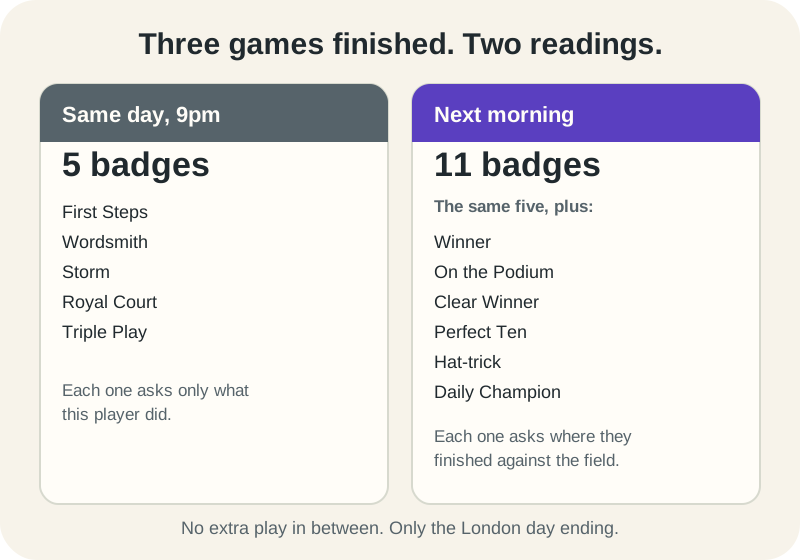
Check the Collection panel that evening and it shows five: First Steps for the first puzzle, Wordsmith, Storm and Royal Court for the three game types, and Triple Play for three games in one day.
Open the same panel the next morning, without playing anything else at all, and it shows eleven. The six that appeared overnight are Winner, On the Podium, Clear Winner, Perfect Ten, Hat-trick and Daily Champion.
Why those six waited
Look at what separates the two groups. The first five ask only what that player did. The six that waited all ask where they finished against everybody else, and during the day that question has no honest answer.
Finish Storm at eight in the morning and you are first, because nobody else has played it. You would be handed Winner, Clear Winner, Perfect Ten and a share of Hat-trick on the strength of an empty field, and by teatime three faster players would have pushed you to fourth. So anything built on rank or points reads only dates before the current London day. It settles when the day does, at the midnight reset.
Everything else lands the moment you finish, because none of it depends on anyone else: completions, variety, the speed thresholds like Blink and Lightning Reflexes, your streaks, and the whole Practice and Just for fun ladder.
The practical version is short. Do not refresh the Collection panel after a strong morning. Look tomorrow.
The badge showcase is a separate, smaller set
The 149 achievements are yours to collect. What other players see is a much smaller list of 26 showcase badges, and it works differently.
Seventeen of them are tied to a named achievement, so earning the achievement gives you the badge. Seven are community awards that an admin gives for things the achievement engine cannot measure, such as Bug Hunter or Puzzle Scout. The remaining two are Founding Player and Puzzle Pal.
In Profile, Choose your badge showcase lets you display up to three. The first one in your showcase is your main badge, and it is the one that appears beside your avatar on the league tables, with its name. Tap any badge already in your showcase to promote it to the front.
You can only select a badge you hold, and the selection is rechecked rather than trusted. If a settled result or a rule correction means you no longer hold a badge you had chosen, it stops appearing on public rows without waiting for you to open the dialog again.
Seven achievements also unlock a look
There are 12 whole-site editions in Profile under Appearance. Five are there for everyone from the start: Classic, Puzzle Bloom, Puzzle Book, Pathfinder and Glass Lab. The other seven are attached to a specific badge.
- Word Tiles unlocks with Specialist, for playing the same competitive game ten times.
- Crown & Quill unlocks with Monthly Champion.
- Folded Paper unlocks with Gallery Tour, for completing every game in the original Puzzle Gallery collection.
- Signal Box unlocks with Lightning Reflexes, for a timed league puzzle under 20 seconds.
- Night Logic unlocks with Diamond Streak, for 60 consecutive days.
- Seasonal Garden unlocks with Weekly Warrior, for seven consecutive days.
- Minimal Focus unlocks with Pure Logic, for a full competitive card without a hint.
Two things that catch people out
Practice and the competitive dailies are counted in different places. The volume badges, Getting Stuck In at 10, Regular at 50, Centurion at 100 and Marathon at 200, count competitive completions only. Practice has its own ladder running from Warmed Up through Keen Bean to Dedicated, so a heavy Practice session moves one set of numbers and not the other.
The no-hint badges are the exception, and in your favour. Sharp Mind at 50 and Iron Will at 150 add your hint-free league results and your hint-free Practice completions together. Using a hint is itself a bronze badge, Back on Track, but that puzzle no longer counts towards either of those two, and it also costs you Pure Logic for the day.
Put it into practice
Explore the league and find a puzzle that suits you.
Open your CollectionSign in or create an account to save your progress.