Hubbard
The same button, two different prices
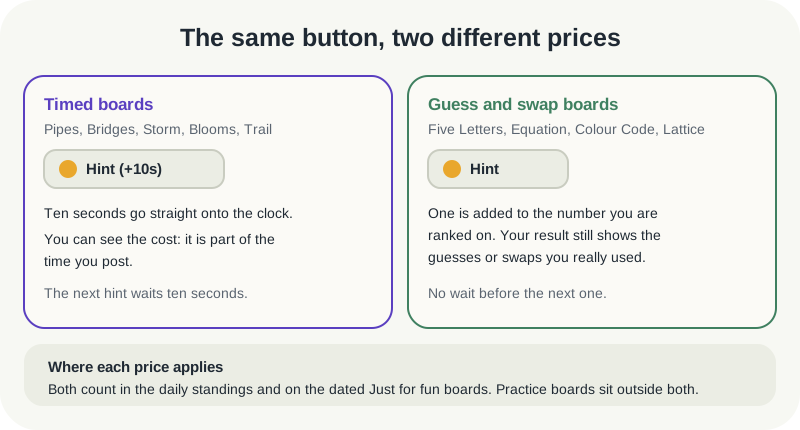
Nine competitive puzzles run each day, and they fall into two groups that pay for a hint in different currencies.
Five are timed: Pipes, Bridges, Storm, Blooms and Trail. A hint on one of those puts ten seconds onto the clock you are ranked on, and the button tells you before you press it, because it reads Hint (+10s) rather than Hint.
The other four are counted. Five Letters, Equation and Colour Code rank you on guesses, and Lattice ranks you on swaps. On those, a hint adds one to the number the ranking uses. Your own result still shows the guesses or swaps you really spent, and on a competitive board a short dialogue warns you first: finish in three guesses with a hint and you rank level with a four guess solve.
That second case is the one worth knowing, because nothing in your finished board shows it. The number you look at afterwards is honest about what you did. The placing beside it was worked out from a different number.
What one hint does to your points
Points come from where you finish against the day's field, not from a fixed table, so the price of a hint changes with the day. First place pays 10, the last place in the field pays 0.5, and the places in between are spread evenly. The field is every member who completed at least one competitive board that day.
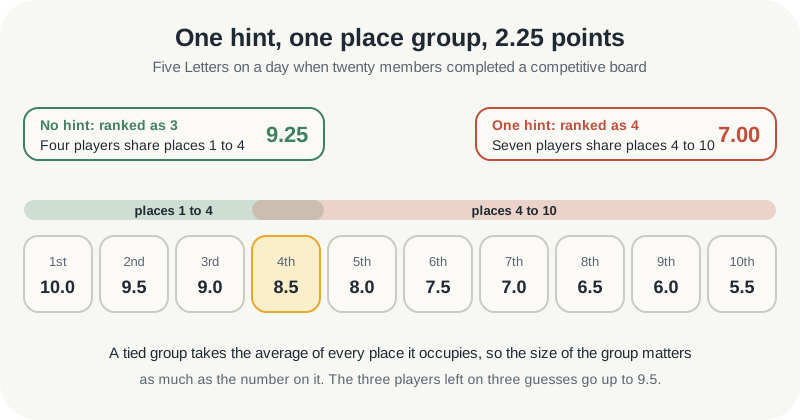
Take a day with twenty in the field. Twenty places spread between 10 and 0.5 means each place is worth exactly half a point: 10, 9.5, 9, and so on.
Four players solve Five Letters in three guesses. A tied group shares the average of the places it occupies, so those four sit across places one to four and take 9.25 each. Now suppose one of them used a hint on the way. That player is ranked as a four guess solve, and joins six other people on four. The three clean solvers move up to places one to three and take 9.5. The group of seven occupies places four to ten and shares 7 points each.
So the hint cost that player 2.25 points out of a possible 10, on a puzzle they finished in three guesses. It also handed a quarter of a point to everyone who solved it without one.
The size of the loss depends entirely on how crowded the numbers are that day. Move from three guesses to four on a board where nobody else is near you and it may cost nothing at all. On Five Letters, where most of the field lands on three or four, it usually costs a place group.
On a timed board you watch it happen
Take a hint on Storm and the ten seconds land on the live clock immediately, so the timer you are looking at jumps forward. There is nothing hidden about it. Whatever the clock reads when you finish is what goes to the standings, penalty included.
There is also a ten second wait before the next hint, and the button counts it down for you rather than letting you spend a press finding out. The wait costs nothing by itself. It stops a board being bought in one burst.
The arithmetic is easy to do in your head, which is the point. If a hint saves you more than ten seconds of staring, it has paid for itself. Most of the time, on a board you can read, it does not.
Ask on a clean board, not a wrong one
A hint does one of two things, and you do not get to choose which.
If anything already on your board disagrees with the solution, the hint spends itself on that. It marks the entry and tells you it does not match. Only when nothing is wrong will it give you the next move.
How much it will mark depends on your clock: one wrong entry for every ten seconds elapsed, and never fewer than one. Half a minute into a board you get at most three. This is deliberate. In a two state game like Storm or Blooms, being told a cell is wrong is the same as being told what it should be, so the width of that reveal is bought with the one thing the standings measure.
The practical version: if you suspect you have put something down on a guess, take it back before you press the button. Otherwise your ten seconds buys a correction you could have found on your own, and you still have not been told what to do next.
When the button will not help you yet
Hints on Five Letters and Equation unlock after two guesses. On Colour Code they unlock after three. Every other daily has the button live from the first move.
Press it early and it says so, rather than charging you for nothing.
Where hints are close to free
Practice boards in the Library carry no date, and they sit outside the daily standings and outside the Just for fun standings. Hints there never reach your league record or your all time average. If you are learning a game you have never played, that is the place to do it, with the button pressed as often as you like.
One small exception is worth knowing. The panel beside a Practice board that shows other members who have finished it ranks people by the same rule, so a hint still counts against you in that one comparison. Nothing that comes out of it is scored.
Dated Just for fun boards are different. They are not competitive and they pay no league points, but they do keep their own daily standings, and hints count there exactly as they do in the league.
The short version
On a timed daily, a hint is ten seconds you can see. On a counted one it is a guess or a swap you cannot see, worth a place group on a busy day.
Clean your board before you ask, because a hint pays for the first wrong thing on it before it pays for progress.
And if the point of the session is learning the game rather than the standings, open it in the Library instead.
Put it into practice
Explore the league and find a puzzle that suits you.
Play today's boardsSign in or create an account to save your progress.