Hubbard

Two questions, and only one of them is useful
There are two ways to look at a Pairs board. You can point at a cell and ask which of its neighbours it could pair with. Or you can name a domino, say the 0-3, and ask where on the whole grid it could possibly sit.
The first question is the one people ask, because the cells are what you are looking at. It is also the weaker one. A cell in the middle of a board has four neighbours, and it takes a lot of placed dominoes before three of them are ruled out. Early on, that question almost always comes back with two or three answers, which is no answer at all.
The second question is stronger for a reason you can count. There are only ten dominoes on a small board, and each one is a specific pair of digits. To place the 0-3 you need a 0 and a 3 that are actually touching, and only a handful of cells on the grid carry either digit. So the set of legal homes for a named domino starts out small, and sometimes it starts out as one.
A board where no cell is forced
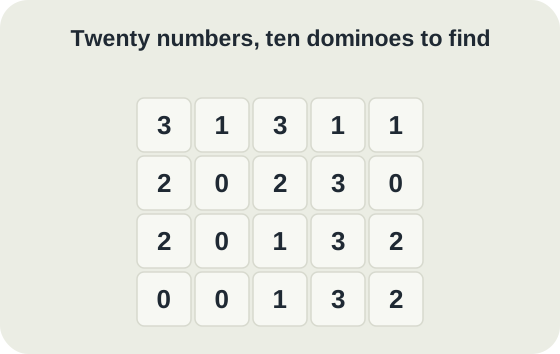
Here is the smallest Pairs board, four rows by five columns, with numbers running from 0 to 3. Twenty cells, ten dominoes, and ten pairs to place: 0-0, 0-1, 0-2, 0-3, 1-1, 1-2, 1-3, 2-2, 2-3 and 3-3.
Reading across the rows: 3, 1, 3, 1, 1; then 2, 0, 2, 3, 0; then 2, 0, 1, 3, 2; then 0, 0, 1, 3, 2.
Now do the thing most players do and go looking for a cell with only one free neighbour. There is not one. Every cell on this board, including all four corners, touches at least two cells it could legally pair with. Cell-hunting gets you nothing here, and a board that gives you nothing is where guessing starts.
Ask about the domino instead
Take the 0-3 and go looking for it. It needs a 0 and a 3 sharing an edge.
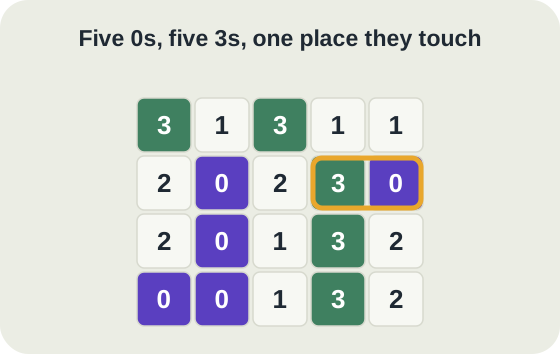
There are five 0s on this board: row 2 column 2, row 2 column 5, row 3 column 2, row 4 column 1 and row 4 column 2. There are five 3s: row 1 column 1, row 1 column 3, row 2 column 4, row 3 column 4 and row 4 column 4. Ten cells, and you can check every neighbour of all five 0s in about the time it takes to read this sentence.
The 0 at row 2 column 2 is surrounded by 1, 2, 2 and 0. The 0 at row 3 column 2 is surrounded by 0, 2, 1 and 0. The 0 at row 4 column 1 touches a 2 and a 0. The 0 at row 4 column 2 touches a 0, a 0 and a 1. Four of the five 0s have no 3 anywhere beside them.
The fifth is the 0 at row 2 column 5. Its neighbours are the 1 above it, the 2 below it, and the 3 to its left at row 2 column 4. That is the only place on this board where a 0 and a 3 touch, so the 0-3 domino goes there. Nothing was assumed and nothing was tried and rejected: the pair had one home from the moment the board was drawn.
The same scan finds a second one
Before playing anything on, run the scan again on another pair. The 1-2 wants a 1 beside a 2. The board holds five 1s and five 2s, and they touch in exactly one place: the 2 at row 2 column 3 sits directly above the 1 at row 3 column 3. That domino is forced too, and it was forced before you placed the 0-3.
Two free dominoes from a board that looked blank, and neither of them cost a guess. Both came from the same thirty seconds of looking at digits rather than at cells.
What the two openings leave behind
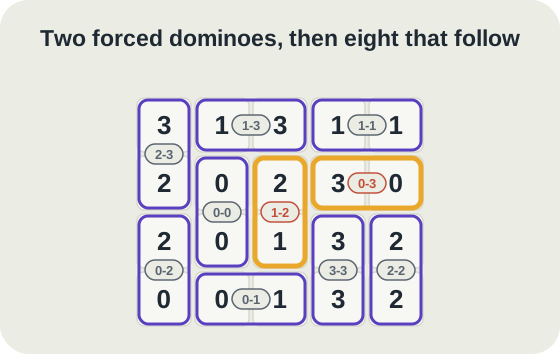
Place the 0-3 and the board starts to move. The 1 at row 1 column 5 now has one neighbour left. Its only other option was the 0 below it, which the 0-3 just took, so it pairs left with the 1 at row 1 column 4 and gives you the 1-1.
That in turn boxes in the 3 at row 1 column 3. Its neighbours are the 1 to its left, the 1 to its right now inside the 1-1, and the 2 below it now inside the 1-2. One option left, so the 1-3 goes across row 1. Which leaves the 3 at row 1 column 1 with nothing but the 2 beneath it: the 2-3.
From there it falls out in order. The 0 at row 2 column 2 is hemmed in on three sides and pairs downward for the 0-0. The 2 at row 3 column 1 pairs downward for the 0-2. The 3 at row 3 column 4 could in principle pair right with the 2 beside it, but the 2-3 is already on the board and no pair may appear twice, so it pairs down instead for the 3-3. The 2 at row 3 column 5 pairs down for the 2-2, and the last two cells in row 4 are a 0 and a 1 with nowhere else to be.
Ten dominoes, no guesses, and the two that unlocked it were both visible before the first move.
Scan the doubles first
You do not have to check every domino, and on a large board you would not want to. There is one group that pays far better than the rest, and it is not the one intuition suggests.
Scan the doubles: 0-0, 1-1, 2-2 and so on. A double needs two copies of the same digit sharing an edge, and grids rarely lay the same digit side by side more than once or twice. Across 300 generated Pairs boards, spanning every size the game produces, a double had an average of 1.9 legal homes against 4.0 for an ordinary pair, and two in five doubles had exactly one home before a single domino was placed. Scan four doubles and you will usually have found a free move.
The tempting alternative is to hunt for pairs whose digits are far apart in value, on the theory that a 0 and a 6 rarely end up neighbours. Measured on the same 300 boards, that is backwards: the widest-apart pairs had more legal homes than the average, not fewer. There are simply more ways to put two different digits together than two of the same one.
Non-doubles are still worth a look once the doubles are exhausted, and both openings on the board above happened to be non-doubles. But if you only have time for one sweep, sweep the doubles.
Pairs boards run from the four by five above up to eight rows by nine columns with numbers to 7, which is thirty-six dominoes and eight doubles. The scan does not get harder as the board grows. It gets more valuable, because there are more doubles to test and each one is a separate chance at a free move.
The mistake to stop making
The mistake is not that cell-hunting is wrong. It is a real deduction and it does most of the work once a board is half full, as it did for eight of the ten dominoes above. The mistake is opening with it.
On an empty board, cells are the least constrained thing on the grid and pairs are the most constrained. Asking the weak question first produces a board that appears to need a guess, and a guess on a timed board usually costs more than the scan would have.
So spend the first half minute naming dominoes rather than pointing at squares. Run through the doubles, find every copy of the digit, and look for the place two of them touch. If there is exactly one, you have a free domino, and on a board like this one that free domino is the whole solve.
Pairs is timed and appears in Practice and in the Just for fun dailies. It is not one of the nine competitive league games, so nothing you do on a Pairs board affects your standings.
Put it into practice
Try an Easy Pairs Library puzzle and look for one deduction from this guide.
Play a Pairs boardSign in or create an account to save your progress.