Hubbard
The rule that does the work
Of the three rules, the one about same-sized blocks not touching sounds like a restriction on your answer. It is more useful read backwards, as a statement about the clues you were given.
Suppose two 3s are printed in cells that share an edge. Either they belong to two different blocks, or to one. Two different blocks would both be size three and they would be sharing an edge, which the rule forbids outright. So they belong to one block, and there is nothing to decide about it.
Now extend that. Take any group of equal numbers that are joined to each other edge to edge. The same argument applies to every pair in the group, so the whole group sits inside a single block. If the group has N cells in it and the number printed is N, that block is not partly done. It is done. Every cell touching it belongs to something else, and in particular none of them can hold an N.
Note that the reverse does not hold. Two 4s with a gap between them may end up in the same block or in two separate blocks, and which one it is has to be worked out. Only touching is decisive.
A board to work
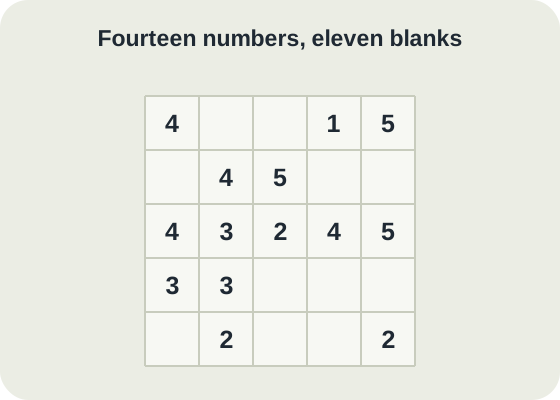
Here is a five by five board with fourteen numbers on it. It has exactly one answer, and the game's own solver reaches that answer by deduction, so nothing below rests on a guess.
Reading across the rows: row 1 is 4, blank, blank, 1, 5. Row 2 is blank, 4, 5, blank, blank. Row 3 is 4, 3, 2, 4, 5. Row 4 is 3, 3, blank, blank, blank. Row 5 is blank, 2, blank, blank, 2.
The three that is already whole
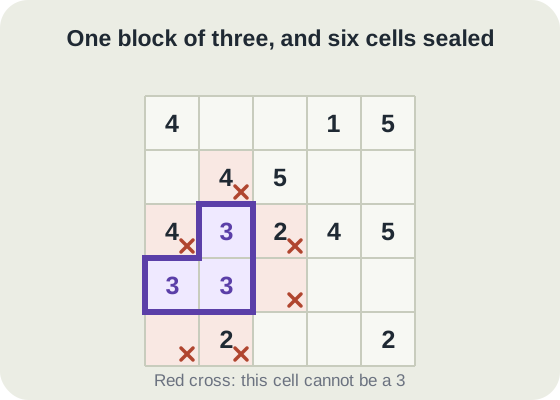
There are three 3s on this board: row 3 column 2, row 4 column 1 and row 4 column 2. The first is directly above the third, and the second is directly beside it. They are joined, in an L.
By the rule above they are one block. That block is size three and it already contains three cells, so it is complete as printed. You have not deduced a single number yet and one of the ten blocks on this board is finished.
The payoff is what happens outside it. Six cells touch that L: row 2 column 2, row 3 column 1, row 3 column 3, row 4 column 3, row 5 column 1 and row 5 column 2. Each of them belongs to some other block, and that block cannot be a three, because a second three-block would be sharing an edge with this one. So six of the board's eleven blanks lose a candidate before you start.
I checked all six against the game's solver by writing a 3 into each in turn and asking how many answers survived. Every one of them came back with none.
The same rule in miniature
Look at the 1 at row 1 column 4 and the rule turns up again in its smallest form. A block holding a 1 is one cell. It is a group of equal touching numbers with one member and the number one printed in it, so it is finished the instant you read it, and neither of its neighbours can be a 1 either.
Every 1 on every Patchwork board works this way. It is the only number that seals itself with no reasoning at all, which makes the 1s worth reading before anything else.
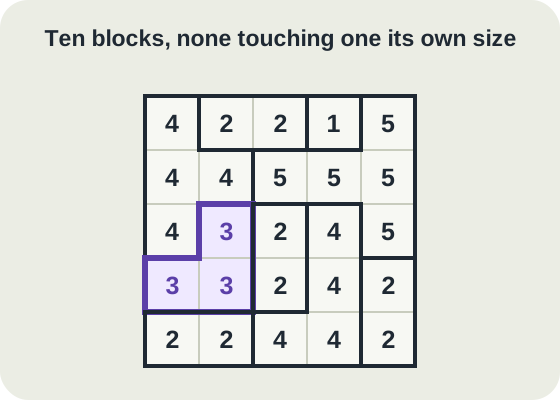
Below is the finished board, cut into its ten blocks. The L of threes is exactly where it was. Notice row 1 column 1 and row 3 column 1, two 4s with a blank between them, which do turn out to share a block. That was not free: it had to be worked out, and it is the case the touching rule says nothing about.
The mistake to stop making
Three 3s on the board looks like three jobs to do. The instinct is to treat each printed number as the seed of its own block and start growing all three, which on this board means finding nine cells of threes where there are only ever going to be three.
It is worth being precise about where the error creeps in, because it is not really a misreading of the rules. It is arithmetic done on the wrong unit. A clue of 3 does not ask for three more cells, it says the block is three cells including this one, and when three clued cells are already joined the counting is over. People who get stuck here are usually counting outwards from each number separately and never once looking at whether the numbers are touching.
So before growing anything, sweep the board for equal numbers sitting next to each other and ring them as one block. Where the group is already as big as its number, cross a candidate off every cell around it. Where it is smaller, you still know those cells share a block and have to grow together, which is worth more than either clue alone.
Patchwork boards run from five by five up to eight by eight. It is timed, appears in the Library and as a Just for fun daily, and awards no league points, so the sweep costs you a few seconds of clock and no standing at all.
Put it into practice
Try an Easy Patchwork Library puzzle and look for one deduction from this guide.
Play a Patchwork boardSign in or create an account to save your progress.