Hubbard
Two ways to create an account
Press Sign in at the top of any page, then switch to Create an account. You can either press Continue with Google, or enter an email address and a password of at least eight characters, twice.
The email route sends a confirmation link from noreply@hubbardgames.com. Tap it, come back and sign in. If it has not arrived within a minute or so, look in your junk folder. The Google route skips that step and fills in your first name as a starting display name, which you can change on the next screen.
If you arrived from a game's own page by pressing its Play button, the site remembers where you were going for half an hour. Once you have finished setting up, it takes you straight to that game in the Puzzle Library rather than to Today.
One screen of setup
The next screen is headed Welcome in and sets up how you show on the board. Other members see your display name and animal beside your results on the Board, in Challenges and in Compare players, so pick a name people will recognise. It can be up to 20 characters.
Below the name are 50 animals to choose from. All 50 are available from the start, and you can swap to another whenever you like.
Two ticks are required: that you are at least 13, and that you accept the Terms of Use and acknowledge the Privacy Policy. A third tick, for occasional league news by email, is optional and starts off. Nothing is sent unless you tick it, and you can change it later in Profile.
Press Start playing and you are in. Both the name and the animal can be changed later from Profile, which you reach through your avatar in the header.
What Today is showing you
Today opens with the date and a greeting, then four small counters. Played today counts the competitive dailies you have finished out of the day's total. Day streak counts consecutive London dates with a qualifying finish. Today so far adds up your provisional league points, and Rank today is your place among everyone who has played so far.
Under the counters are the ten competitive dailies. Everyone in the league gets the same board for each game on the same London date, and these are the only boards that pay league points. Six are timed and rank on your finishing time. Four rank on how few guesses or swaps you needed.
Further down, under Just for fun, are more dated boards from other games. They rank everyone who finished them that day, but pay no league points. Past those, the Library and For You in the main navigation hold unscored practice boards you can play at any time.
- Timed: Pipes, Bridges, Storm, Blooms, Trail and Traffic.
- Fewest guesses: Five Letters, Equation and Colour Code.
- Fewest swaps: Lattice.
Your first go at a game opens the rules for you
The first time you open any game, its How to play screen appears on its own before you touch the board. On a timed game the clock does not run while the rules are open, so reading them costs you nothing on a competitive daily. Close them when you are ready and the clock starts from where it was.
After that first time the rules stay closed, but the question mark on the play screen reopens them whenever you want, with the same pause on the clock.
A Library practice board counts as your first go. If you try a game in the Library first, the rules open there, and the competitive daily for that game will not open them again.
One first evening, worked through
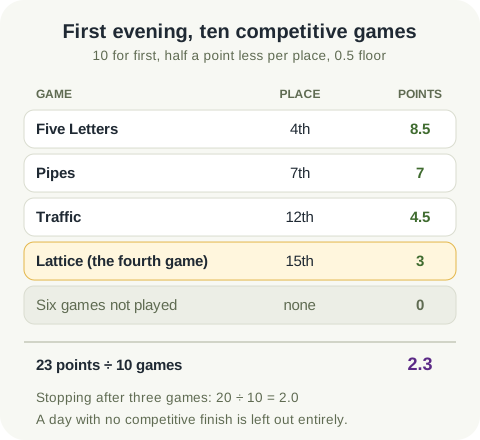
Take a new player who signs up at twenty to eight in the evening. They finish Five Letters in 4th place, Pipes in 7th and Traffic in 12th. Since 23 September every competitive daily pays the same ladder: 10 for first, half a point less for each place below, and 0.5 from 20th down. That makes 8.5, 7 and 4.5, which is 20 points.
The league average divides those points by every competitive game available on a day you entered, so the seven games they did not play count as zero. 20 divided by 10 is 2.0 for the day. If they also finish Lattice, even in 15th for 3 points, the day becomes 23 divided by 10, or 2.3. A fourth finish lifted the average even though it was their weakest place.
Two things about this evening are worth knowing. The days before they joined do not count against them at all, because a day with no competitive finish is left out of the average rather than scored as zero. And the places are provisional until midnight in London: anyone who finishes later with a better result pushes them down a place, and Rank today moves with it.
The mistake to avoid: learning on the competitive board
It is tempting to open an unfamiliar timed game straight from Today and work it out as you go. The rules screen stops the clock while you read, but it does not stop it while you experiment, and a first solve that takes six minutes goes into the day's standings as six minutes.
If a game is new to you, open it in the Library first. Practice boards are unscored, the rules open there on your first go, and a board or two there is usually enough to learn how the pieces move before you try the day's board. For the guess and swap games the cost of learning is smaller, since they rank on how few moves you needed rather than on time, but a practice round still helps.
Where to go on day two
Open the Board to see where you finished once the day has settled. Its Yesterday view shows final places, and All-time ranks everyone by league average across the days they entered.
If you would rather have one friend to beat than a whole table, Challenges holds Rival Week, where two players each choose four games for a week-long match on the same daily boards. And if ten boards is more than you want most days, one finished board of any dated kind keeps your streak going, while the league average only ever looks at the competitive ten.
Put it into practice
Explore the league and find a puzzle that suits you.
See today's boardsSign in or create an account to save your progress.