Hubbard
The ladder
Each competitive game ranks its own finishers for the day. Five Letters, Equation, Colour Code and Lattice rank by guesses or swaps, fewest first. Pipes, Bridges, Storm, Blooms, Trail and Traffic are timed and rank by the clock, fastest first. Your place in that game then reads straight off one table:
- 1st: 10 points.
- 2nd: 9.5, 3rd: 9, 4th: 8.5, and so on, half a point per place.
- 19th: 1 point.
- 20th and every place below it: 0.5.
- Gave up, ran out of guesses, or did not play: 0.
Where you see it
Open the Board. On the Today tab each cell shows your finishing place in that game with its points underneath, and the daily total adds the ten together, so a perfect day is 100. The legend under the table repeats the ladder: 1st is 10, 2nd is 9.5 then half-point steps, 20th and below is 0.5, and DNP is 0.
Only a daily finished on its own London date earns a place. Catch-up, Practice, For You and Just for fun boards never reach this table.
Ties share the places they fill
Two players with exactly the same result take the same place, and between them they fill two rungs of the ladder. They split those rungs evenly. A tie for first fills first and second, worth 10 and 9.5, so each player gets 9.75. Joint first is therefore worth a quarter of a point less than first on your own.
The player after a tie skips the places it used. After two players tie for first, the next result is third, not second, and pays 9.
The floor applies inside a tie as well. Two players tied at 19th fill 19th and 20th, worth 1 and 0.5, and take 0.75 each.
One Equation day, worked twice
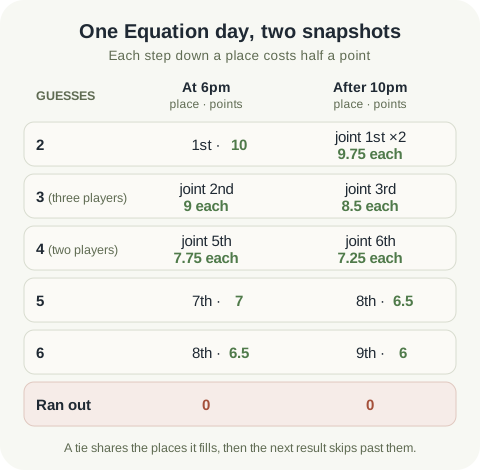
Here is an invented Equation day with eight finishers and one player who ran out of guesses. At 6pm one player has solved it in 2 guesses, three in 3, two in 4, one in 5 and one in 6.
The 2-guess player is alone in first and takes 10. The three on 3 guesses fill second, third and fourth, worth 9.5, 9 and 8.5, and share them at 9 each. The two on 4 guesses fill fifth and sixth, 8 and 7.5, for 7.75 each. The 5-guess player is seventh on 7, the 6-guess player eighth on 6.5, and the player who ran out scores 0.
At 10pm a ninth player solves it in 2 guesses. Every player below first moves down a place. The two on 2 guesses now share 9.75 each. The three on 3 guesses fill third to fifth and drop to 8.5 each. The pair on 4 guesses move to 7.25 each, the 5-guess player to 6.5 and the 6-guess player to 6. Nobody played worse, yet the first player lost a quarter of a point and every finisher below lost half a point.
Why today's points keep moving
The worked day shows the one thing that surprises people most. Your points depend on how many players beat or tie you, and players keep finishing until midnight. A score on the Today tab is provisional until the London midnight reset, and the Board says so under the legend.
Finishing early does not protect a place. The ladder ranks the result, not the time of day you posted it, so a better result at 11:50pm still goes above yours.
What changed on 23 September
Before 23 September the scale stretched to fit the day. First paid 10, the last place in that day's field paid 0.5, and the places between were spread evenly, so the value of second depended on how many members played that day. In a five-player day second was worth 7.625. Under the ladder it is worth 9.5 whatever the size of the field.
Every past date was recalculated with the ladder from the same stored results. Your guesses, times and places did not change, only the points attached to them, so your totals and league average on the Board may read differently from last week.
The mistake to avoid
Skipping a game because you expect to finish low. On the ladder the difference between tenth and not playing is 5.5 points, and even 40th is worth 0.5 more than a blank. The all-time table divides your points by every competitive game available on the days you played, so a game you skip on a day you entered counts as a zero in that average.
Giving up has the same cost as not starting: both score 0. If you are stuck, a hint costs you some of your result, and a finished board almost always beats a given-up one.
Put it into practice
Explore the league and find a puzzle that suits you.
Open the BoardSign in or create an account to save your progress.