Hubbard

Read two clues together
A number counts the mines in the eight cells touching it, and a numbered cell is never a mine itself. So each clue really says: among my unresolved neighbours, exactly this many are mines.
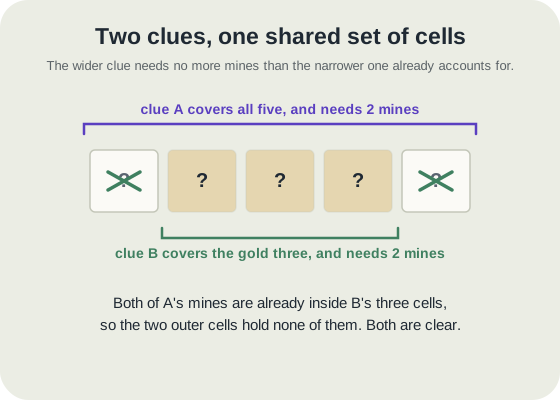
When two clues sit near each other, their neighbour lists overlap. Suppose clue A's unresolved cells are clue B's three cells plus two more, and both clues need two mines. B's three cells already account for two mines, which is A's whole quota. The two extra cells therefore hold none, and both are clear.
Nothing about that argument needs you to know which of the shared cells are mined. That is the part people skip, and it is the part that does the work.
A board where no single number helps
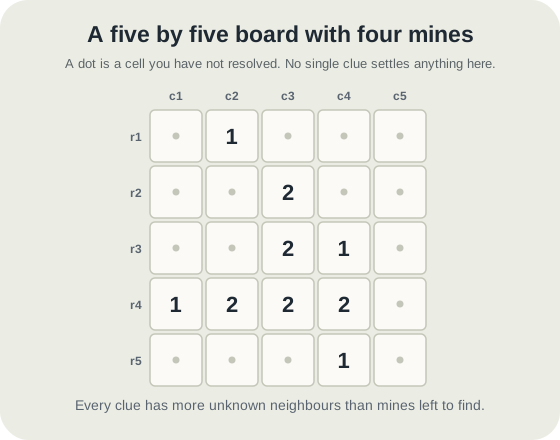
Here is a five by five board with four mines. Rows run r1 to r5 down the side, columns c1 to c5 along the top, and a dot marks a cell you have not resolved yet.
Try the usual openings and every one fails. A clue only decides cells on its own in two cases: it has no mines left to find, so the rest are clear, or it has exactly as many unknown neighbours as mines to find, so all of them are mined. Work through the clues and neither case appears. The 1 at r1c2 has four unknown neighbours for one mine. The 2 at r3c3 has three for two. The 1 at r5c4 has three for one. The four-mine total spread over sixteen unknown cells decides nothing either.
This is a real board from the game, not a contrived one, and it is rated at the easier end. Boards like it are common, which is why the habit below is worth having.
The 2 above the 2
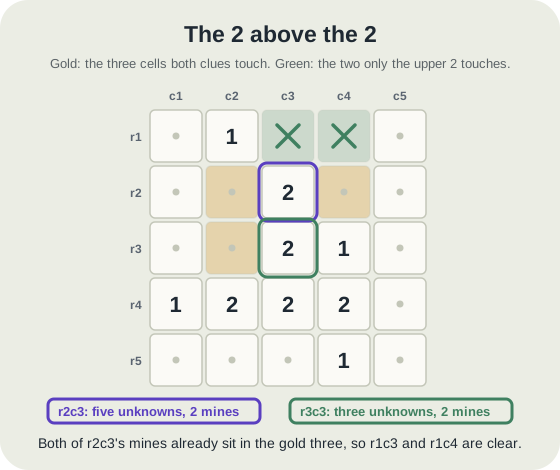
Take the 2 at r3c3 first. Its eight neighbours are r2c2, r2c3, r2c4, r3c2, r3c4, r4c2, r4c3 and r4c4. Five of those already carry numbers, and a numbered cell is never a mine, so only r2c2, r2c4 and r3c2 are in play. Both of its mines are among those three.
Now the 2 at r2c3, directly above it. Its unresolved neighbours are r1c3, r1c4, r2c2, r2c4 and r3c2: the same three cells, plus the two in the top row. It needs two mines across all five.
The three shared cells already hold two mines. That is everything the upper 2 is looking for, so r1c3 and r1c4 hold none. Mark both clear. You still have no idea which of the three shared cells are mined, and you did not need to.
The same handle turns again two rows down. The 1 at r4c1 has four unresolved neighbours, r3c1, r3c2, r5c1 and r5c2, holding one mine between them. The 2 at r4c2 has those four plus r5c3, holding two. One extra cell, one extra mine: r5c3 is a mine, and you can flag it.
The mistake this avoids
The common error is not misreading a clue. It is deciding, after a minute of finding no forced move, that the board must want a guess and clicking something plausible. Every Sweep board is generated so that forced deductions alone finish it, and a separate check proves the mine layout is the only one the clues allow, so a guess is never the intended move.
The other error is subtler and costs more. Having spotted that r2c2, r2c4 and r3c2 hold two mines between them, it is tempting to flag two of them. The overlap argument says nothing about which two. On this board those three cells stay unresolved for several more moves, and a flag placed there on a hunch will read as correct for a while before the rest of the board contradicts it.
So the routine is: when no clue moves on its own, find two that touch the same cells and compare what each still needs. The difference in their totals, set against the cells they do not share, is usually where the next move is.
Put it into practice
Try an Easy Sweep Library puzzle and look for one deduction from this guide.
Play a Sweep boardSign in or create an account to save your progress.