Hubbard
You can see the field before you finish
This is the biggest practical difference from the competitive slate. On a competitive daily, the day's field only appears once you have finished, in the result screen. On a dated Just for fun board, the field is already on the play screen, underneath the board, headed with the game's name and the words just for fun. You can see how many people have finished and what times they posted before you place a single piece.
The Today card gives a smaller version of the same thing. Under each fun card, Played today shows how many players have finished that board so far. It counts finishers rather than people who have the board open, and it updates when you come back to Today, which is how your own finish gets added.
When you finish, the result screen says Just for fun, no league points, and shows the field again with your row in it.
How a place is decided
Each fun board ranks its own finishers on the game's usual measure. Timed games rank on the clock, fastest first, and a hint on a timed board adds ten seconds to that clock, so the time you are ranked on already includes it. Boards ranked by guesses count each hint as one more guess.
Equal results share the higher place, and the next result skips the places they used. If two players finish Aquarium in exactly 1:42 and nobody was faster, both are 1st and the next finisher is 3rd. There are no points to split, so nothing gets averaged.
A result has to meet all of these to take a place:
- It is a completed board. Giving up or running out of guesses leaves you out of the field.
- It was submitted on the board's own London date. A fun board finished after midnight, or played later as catch-up, is saved but not placed.
- It is your first attempt. Replays never enter the field.
- It belongs to a real player. Test accounts are left out.
Your standing across many days
Open Profile from the avatar in the header, choose Progress, then Records. The last section is Your Just for fun standings. Each card is one fun game, with your number of dailies, your average place, and a standing such as #2/3, meaning second of the three players who qualify in that game.
It ranks on average place rather than best time because fun boards change size and difficulty from day to day, so a time from one date says little about a time from another. A place is always measured against the same board.
Two rules decide the order. You need at least three completed fun dailies of a game before you appear in it, so one lucky morning cannot top the table. Among the players who qualify, the lower average place ranks higher, and an equal average goes to whoever has finished more dailies. The history runs back to 26 July, when the fun dailies began, and every qualifying finish since then counts.
One Aquarium standing, worked through
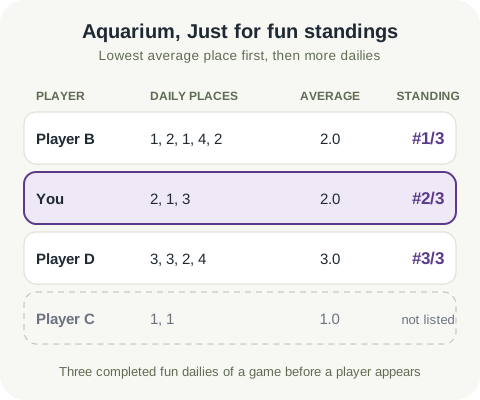
Here are four invented players and their Aquarium fun dailies. Player B has finished five, in places 1, 2, 1, 4 and 2. That is 10 place-points over 5 dailies, an average of 2.0. You have finished three, in places 2, 1 and 3, which is 6 over 3, also 2.0. Player D has four, in places 3, 3, 2 and 4, which is 12 over 4, or 3.0. Player C has won both of their two Aquarium dailies.
Player C is not listed at all. Two dailies is one short of the minimum, so their perfect record does not count yet. That leaves three qualifying players. You and Player B are level on 2.0, and Player B has more dailies, so Player B is #1/3 and your card reads 3 dailies, avg 2.0 place, #2/3. Player D is #3/3.
One more Aquarium finish changes things. A 1st on your fourth daily makes your average 1.75 and moves you to the top. A 3rd would make it 2.25, which still puts you second. Player C's third finish, whatever the place, puts them on the table.
What a fun place does not do
It never reaches the league. Fun results have no row on the Board, add nothing to your league average and take nothing away from it. Only a competitive daily finished on its own date does that.
Nor does the standing weigh how many people played. A 1st out of two finishers counts exactly the same as a 1st out of twenty. It measures how you usually finish against whoever turned up, which is fairest in the games you play often.
The fun achievements read your finishes rather than your places. Just for Fun is your first same-day fun finish, Fun and Games is ten and Serious About Fun is fifty, and Fun Week is a fun daily on seven dates in a row. None of them asks for a 1st. Your Profile's Progress view does list your recent dated results under each game, with a line such as 3rd of 7 finishers, no league points, so your place is recorded even when nothing is awarded for it.
The mistake to avoid
Leaving a fun board until the next day. The Library keeps yesterday's fun boards under Catch-up, and they play exactly the same, so it feels like the result should land in the same place. It will not. The finish is saved and it counts towards your Profile totals, but it takes no place on the board, it does not move your Just for fun standing, and it fills no streak day.
If a game's standing matters to you, finish its fun board on the day, even slowly. A last place still adds a daily to your count, and the count is what gets you onto the table in the first place.
Put it into practice
Explore the league and find a puzzle that suits you.
See today's fun boardsSign in or create an account to save your progress.