Hubbard

The rule, stated as a deduction
Water may never fill a solid two by two block. Turn that around: if three squares of any two by two block are water, the fourth cannot be water. It is land, and you knew it without consulting a single number.
That is worth saying plainly because it is the one deduction in Islands that runs the other way. Every other technique starts from a number and works outwards: this island is finished, so ring it with water; nothing can reach that square, so it is water. Those find water. The two by two rule finds land, which is the thing you actually need to make progress.
It also tells you nothing about which island the new land square belongs to. Every land square is part of some numbered island, so once you have one, the question is which number can reach it and still afford the square. Usually only one can.
A board that stops dead
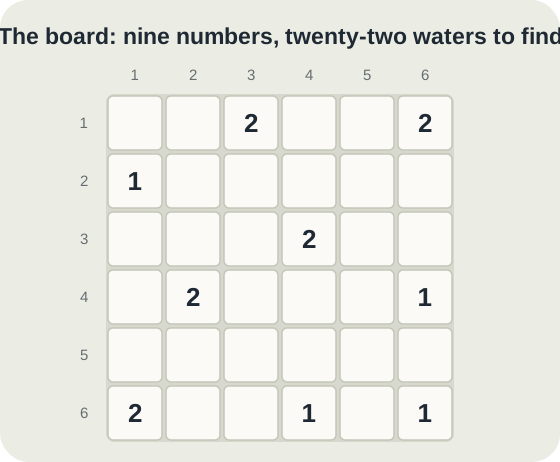
Here is a six by six board with nine numbers. Reading across the rows: a 2 at row 1 column 3 and a 2 at row 1 column 6, a 1 at row 2 column 1, a 2 at row 3 column 4, a 2 at row 4 column 2 and a 1 at row 4 column 6, then a 2 at row 6 column 1 and 1s at row 6 column 4 and row 6 column 6.
Start with the count, which is free. The numbers add up to fourteen, so fourteen of the thirty-six squares are land and the other twenty-two are water. More than half the board is water, which is worth knowing before you start hesitating over shading anything.
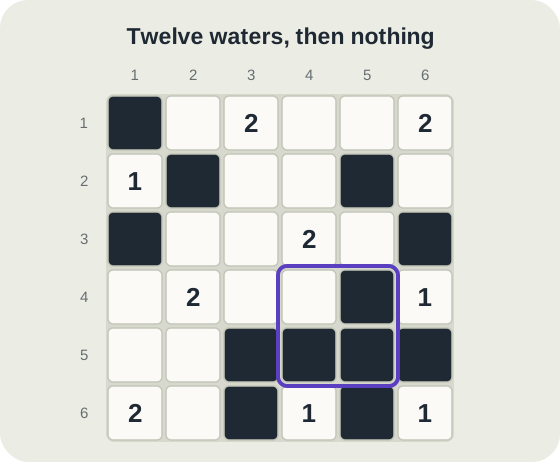
Then take the four 1s. A 1 is an island that is already the right size, so every square beside it is water. That settles nine squares: row 1 column 1, row 3 column 1 and row 2 column 2 around the 1 at row 2 column 1; row 3 column 6, row 5 column 6 and row 4 column 5 around the 1 at row 4 column 6; and row 5 column 4, row 6 column 3 and row 6 column 5 around the two 1s along the bottom.
Three more squares nothing can reach
Next comes the other technique that pays early. A number of n can only reach squares within n minus 1 steps of itself, counting steps along rows and columns. A 1 reaches nothing. A 2 reaches one step. So any square that no number can reach within its own allowance is water.
Three squares here fail that test. Row 2 column 5 is two steps from the 2 at row 1 column 6 and two steps from the 2 at row 3 column 4, and further from everything else. Row 5 column 3 is two steps from the 2 at row 4 column 2 and two from the 1 at row 6 column 4. Row 5 column 5 is two steps from all three of the 1s near it. None of those numbers can stretch that far, so all three squares are water.
That is twelve waters found, and now the board stops. No island is finished, so there is no ring to draw. No square sits between two different numbers. No number is down to exactly the room it needs. Nothing else is out of reach. Every technique that starts from a number has run out.
The first square, and what it starts
Look at the two by two block covering rows 4 and 5, columns 4 and 5. Row 4 column 5 was shaded beside a 1. Row 5 column 4 was shaded beside a different 1. Row 5 column 5 was shaded because nothing could reach it. Three waters in one block, so row 4 column 4 is land.
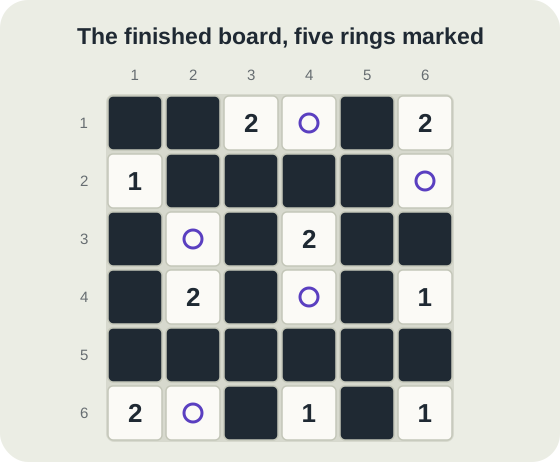
Which island? The only number that can reach it is the 2 at row 3 column 4, directly above, and that 2 needs exactly one more square. So the island is settled: row 3 column 4 and row 4 column 4, complete. Ring it. Row 2 column 4, row 3 column 3, row 3 column 5 and row 4 column 3 all become water.
Those four new waters are the point. One land square bought four waters, and the waters build the next block.
Four more times, and the board is done
Rows 2 and 3, columns 5 and 6. Row 2 column 5 was unreachable, row 3 column 6 was beside a 1, row 3 column 5 came from the ring you just drew. Three waters, so row 2 column 6 is land, and it finishes the 2 above it at row 1 column 6. Ring that, and row 1 column 5 becomes water.
Rows 1 and 2, columns 4 and 5. Row 1 column 5 is the water you just found, row 2 column 4 came from the first ring, row 2 column 5 was unreachable. So row 1 column 4 is land, finishing the 2 at row 1 column 3. Ring it: row 1 column 2 and row 2 column 3 become water.
Rows 2 and 3, columns 2 and 3. Row 2 column 2 was beside the first 1, row 2 column 3 you just shaded, row 3 column 3 came from the first ring. So row 3 column 2 is land, finishing the 2 at row 4 column 2. Ring it: row 5 column 2 and row 4 column 1 become water.
Rows 5 and 6, columns 2 and 3. Row 5 column 2 you just shaded, row 5 column 3 was unreachable, row 6 column 3 was beside a 1. So row 6 column 2 is land, finishing the 2 at row 6 column 1, and row 5 column 1 is the last water. The board is complete, with fourteen land squares and twenty-two waters, and nothing was guessed.
Why the chain works
Read the five deductions in order and the shape is clear. Each two by two square hands you one land square. That land square completes a 2. Completing a 2 forces a ring of water around it. The ring supplies the third water for the next two by two square. Then it repeats.
This is not a quirk of one board. Small numbers, two by two blocks and rings of water feed each other, so on a board full of 1s and 2s the rule tends to fire in a chain rather than once. If it works once, look for the next block straight away, along the ring you have just drawn.
The board above was checked twice over: the game's own solver finishes it with no trial and error, and an independent brute-force search over every legal arrangement of the nine islands finds exactly one solution, the one shown. The solver also reaches for the two by two rule only after the number-based techniques have nothing left, which is why it appears at exactly the five points described.
The mistake to stop making
The common error is to shade first and check the two by two rule last. Players fill in every water they are sure of, submit, get refused, then hunt for the offending block and unpick a corner of the board. All of that work was available as deductions on the way in.
The habit that fixes it is small. Every time you shade a square, glance at the four two by two blocks it belongs to. If any of them now holds three waters, you have just found a land square, and land squares are what finish boards.
The second mistake is subtler: finding the forced land square and then leaving it floating because you do not know which island it joins. You do not have to decide immediately. Mark it as land, then ask which numbers can still reach it and afford it. On a board of 1s and 2s that answer is usually a single number sitting right beside it.
Islands is timed, so this matters for your result as well as your sanity. It is not one of the nine competitive dailies: you will find it as a Just for fun board and in the Library, at sizes from six by six up to nine by nine as the tier climbs. The bigger boards have longer chains, not different ones.
Put it into practice
Try an Easy Islands Library puzzle and look for one deduction from this guide.
Play an Islands boardSign in or create an account to save your progress.