Hubbard

Every square belongs to two runs
A square sits in a horizontal run and a vertical run at the same time. It has to satisfy both. So the largest number it can ever hold is the length of the shorter of the two.
A square in a horizontal run of six and a vertical run of two can only be a 1 or a 2. Not because of anything else on the board, and not because of what is already filled in. The walls alone decide it, and the walls are there before you make your first move.
That is the ceiling. Read it off every square you care about and most boards open themselves.
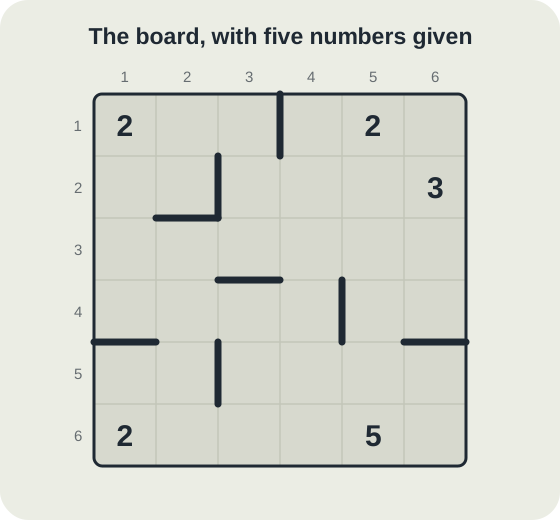
Where the 6s have to go
Row 6 runs the full width of the board with no wall in it, so it is a run of six and it needs a 6 somewhere. Ask the ceiling question of each square in turn.
Column 1 is cut by a wall below row 4, so the bottom part is a run of two: row 6 column 1 caps at 2. Column 2 is cut below row 2, leaving a run of four: caps at 4. Column 3 is cut below row 3, giving a run of three: caps at 3. Column 5 already holds the given 5. Column 6 is cut below row 4, so it caps at 2.
Column 4 has no wall anywhere down its length. It is a run of six, and it is the only square in row 6 with a ceiling of 6. The 6 goes at row 6, column 4.
Column 5 is a full run of six as well, so it needs its own 6. A 6 there can only sit in a row that is itself a run of six, and only rows 3 and 6 qualify. Row 6 column 5 is already a 5. So the second 6 goes at row 3, column 5.
Two more, from the same question
Column 6 is cut below row 4, so rows 1 to 4 form a run of four and need a 4. Row 1 column 6 sits in a horizontal run of three, so it caps at 3. Row 2 column 6 is the given 3. Row 4 column 6 is in a horizontal run of two, capped at 2. Row 3 is a full run of six. The 4 goes at row 3, column 6.
The top left is quicker still. A wall to the right of row 1 column 3 makes a run of three across columns 1 to 3, so it holds 1, 2 and 3. Column 1 is the given 2. Column 2 is cut below row 2, so that square sits in a vertical run of two and caps at 2. The 3 has nowhere else to go but row 1, column 3.
Four squares, and not one of them needed a number anywhere else on the board to be read first.
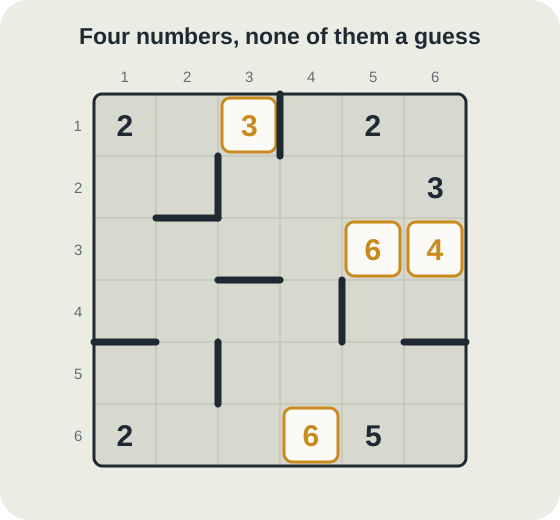
Checked, not asserted
This board was built with the game's own generator and it has exactly one solution. Each of the four placements was then tested by brute force: put any other number in that square, and the board has no solution at all. Not a harder solution, or an ambiguous one. None.
So the reasoning above is not a heuristic that usually works. On this board those four squares are pinned by the wall layout, and nothing else could ever go in them.
The mistake that costs the most time
The habit people bring from Mini Sudoku is that a row holds each number once. In Number Runs a row holds each number once per run, which is a different thing entirely.
Row 2 on this board is split by a wall after column 2. The left side is a run of two and holds 1 and 2. The right side is a run of four and holds 1, 2, 3 and 4. So row 2 contains two 1s and two 2s, legally, and a solver who crosses off a number for the whole row will wreck the board.
The same trap runs the other way. Seeing a 2 near the top of column 1 does not rule out a 2 further down, because the wall below row 4 starts a fresh run with its own 1 and 2.
Count walls before you count numbers.
Where to try it
Number Runs is timed, so the opening is worth more than it is in a game scored on guesses. Before filling anything in, trace the walls and note which rows and columns are full length. Those are where the big numbers live, and there are rarely many candidates.
Then work the ceiling in the other direction. The short runs, the twos and threes tucked into a corner, can only ever hold small numbers, which is often what pins a large number somewhere else.
Number Runs is not one of the scored competitive dailies. It turns up as a Just for fun board, and it is in the Library and the For You feed, so you can take one at your own pace and replay it.
Put it into practice
Try an Easy Number Runs Library puzzle and look for one deduction from this guide.
Play a Number Runs boardSign in or create an account to save your progress.