Hubbard
The boundary is midnight in London, wherever you are
The reset is midnight on the Europe/London wall clock, not your local midnight and not a rolling twenty four hours since you last played. If you are in Madrid, today's boards arrive at one in the morning your time. If you are in New York, they arrive at seven in the evening the day before.
British Summer Time is handled by the calendar rather than a fixed offset, so the boundary follows the clocks in March and October without a day going missing or being counted twice.
At the boundary the site publishes a fresh set: the nine competitive dailies, currently Five Letters, Equation, Colour Code, Lattice, Bridges, Pipes, Storm, Blooms and Trail, plus that date's Just for fun boards. A board is not playable before its own date, so there is nothing to find by looking early.
The one rule that catches people out
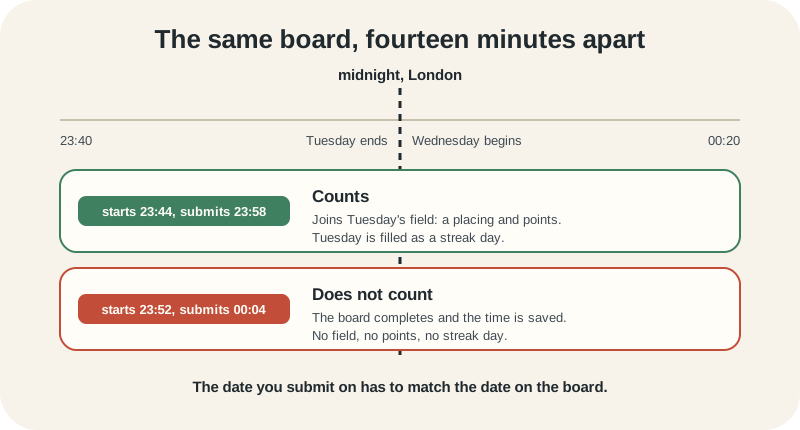
A competitive result counts for the day only if you submit it on that day. Not started on it, submitted on it. The check is a plain comparison: the London date you pressed submit on has to equal the date printed on the board.
So an evening finish is safe and a late one is not, and the gap between them can be very small. Open Tuesday's Bridges at 23:52, take twelve minutes over it and submit at 00:04, and the board is genuinely complete. Your time is saved. Your attempt is on your record. But Tuesday's field has already closed, and you are not in it: no placing, no points, and Tuesday is not filled as a streak day.
The same rule governs the Just for fun standings, which also need a same-day submission before they will show you against everyone else who played that board that day.
The practical version is short. If you start a competitive board after about half eleven, assume you are playing it for the pleasure of it.
An unfinished board is still waiting for you
Nothing is thrown away at midnight. Leave a board part way through and it keeps your entries exactly as you left them, with the clock on a timed game holding where it stopped rather than running through the night. Come back and the card reads Resume rather than Play, and you pick up at the same point.
That is true whether you come back in ten minutes or next week. What changes is only whether the finish still counts for the day, which the previous section covers.
It is worth knowing that resuming is treated differently from starting. Carrying on with a board you have already opened does not spend a new-puzzle allowance, so an unfinished board is never something you have to pay to go back to.
Where yesterday's boards go
A daily does not disappear when its date ends. It moves into the Puzzle Library under a section called Catch-up, which is where every past dated board lives, sorted by date rather than by difficulty.
You can play any of them, and they behave like ordinary boards: full rules, hints, the usual result screen. What they no longer do is score. A catch-up board earns no league points and fills no streak day, by exactly the same date rule as before. It is the board, without the competition attached.
This is the right place to go if you want to try a game you have never played without the day's field watching, or to finish something you missed while you were away.
What actually fills a streak day
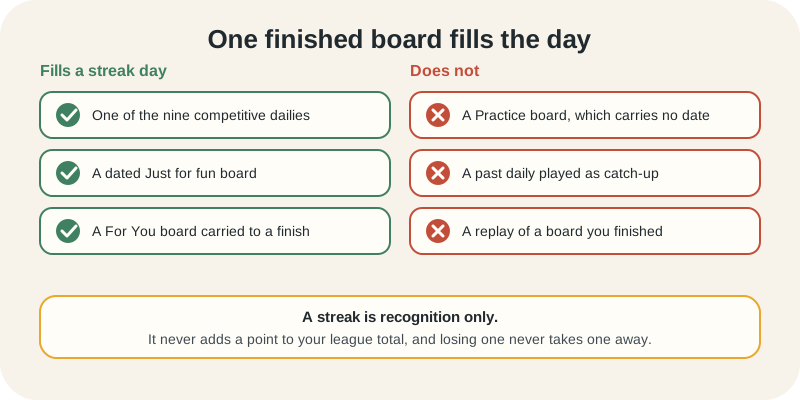
A streak day is filled by finishing any one dated board on its own London date. One is enough. It does not have to be a competitive game: a Just for fun board counts the same, and so does a board you carry to a finish in For You.
Three things do not fill a day. A Practice board from the Library has no date at all, so it has no day to fill. A past daily played as catch-up misses the date rule. A replay of a board you have already finished does not count a second time. A board you gave up on or failed does not count either, because the day is filled by a completed board rather than an opened one.
Streaks are recognition and nothing else. They never add a point to your league total and losing one never takes a point away. That is deliberate, so that a week away costs you nothing but the flame.
A streak gets one day of grace
The counter does not drop the moment a day turns over with nothing played. A current streak is one whose most recent day is either today or yesterday, which gives you a full day to notice and put it right.
Worked through: finish something on Monday and Tuesday and your streak reads two. Wake up on Wednesday having played nothing yet and it still reads two, because the run ends yesterday. Finish anything before midnight on Wednesday and it becomes three. Let Wednesday pass empty and on Thursday it reads zero, because the run now ends two days back.
Your longest run is kept separately and is never lost, so a broken streak takes away the current number and leaves the best one alone.
Picking a routine you can keep
Nine competitive boards a day is a lot, and nothing asks you to play all nine. The standings rank by points per available competitive game on the dates you entered, so a day you play at all is a day every game counts, whether you opened it or not. Playing three games well on five days is a different bet from playing nine games badly on two, and both are legitimate.
If the league is not what you are here for, the Just for fun boards under the competitive boards fill a streak day just as well and never touch the table. For You will hand you one board after another without you choosing, and those finishes count for the streak too.
The simplest routine that works: one board you like, some time before half eleven in the evening, on most days. Everything else on the site is optional.
Put it into practice
Explore the league and find a puzzle that suits you.
See today's boardsSign in or create an account to save your progress.