Hubbard
Two sets of dailies, and only one of them is a league
Just for fun boards work like the competitive ones in every way but the scoring. One board per game per London date, published the same for everyone, playable until midnight and then moved to catch-up. What they never carry is league points. Finishing one adds nothing to your standing and failing one takes nothing away.
That does not make them idle play. Every fun board keeps its own standings panel, so you can still see your result against everyone else who played that exact board. Finishing one also fills a streak day on the same footing as a competitive daily, which is worth knowing on an evening when the ranked slate is more than you fancy.
Today shows eight of them
The fun catalogue is much larger than the competitive one and Today does not try to put all of it in front of you. Eight cards are laid out under the Just for fun heading. Everything else sits behind the Play more button, which tells you how many are underneath it before you open it.
Those eight are not alphabetical and they are not drawn at random. The page sorts the whole of the day's fun catalogue into one order for your account and takes the first eight. Play more is the rest of that same order, so every board on the page appears exactly once and nothing is hidden from you permanently.
A game you play beats a game the league plays
The first rule outranks everything after it. A game you have played recently goes above a game you have not, however busy the second one is. Within the games you have played, more of your own play days comes higher.
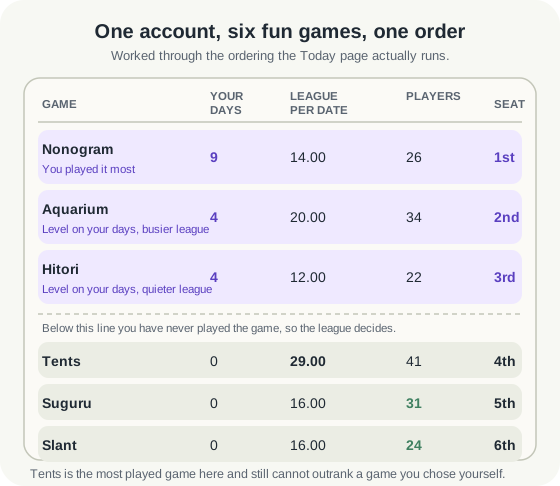
Below is one account's numbers on 21 September, put through the ordering the page runs. Nonogram takes the first seat on nine of your play days. Aquarium and Hitori are level with you on four each, so the tie drops to the league and the busier of the two goes above.
Look at where Tents lands. It is the most played game in the table by a distance, at 29 plays for every date it ran, and it is still only fourth, behind a game you opened four times last month on a quieter board. The ordering is not trying to tell you what is popular. It is trying to put what you keep choosing where your thumb already is.
Popularity is counted per date published, not in total
Under that line, where you have no history to go on, the league decides. Not by raw plays, though. A game is judged on its plays divided by the number of dates it was actually published in the window, so a game that joined the catalogue a fortnight ago is measured against the fortnight it has existed rather than buried under games that have been there all month.
Slant is the example. Its 96 plays over six published dates come to exactly the same 16 a date as Suguru's 448 over 28, and the two land level. When a rate ties like that, the number of distinct players settles it, and Suguru's 31 goes above Slant's 24. Anything still level after that falls to a fixed shuffle tied to your account and the date, so reloading the page cannot reroll it into a different answer.
What counts as having played a game
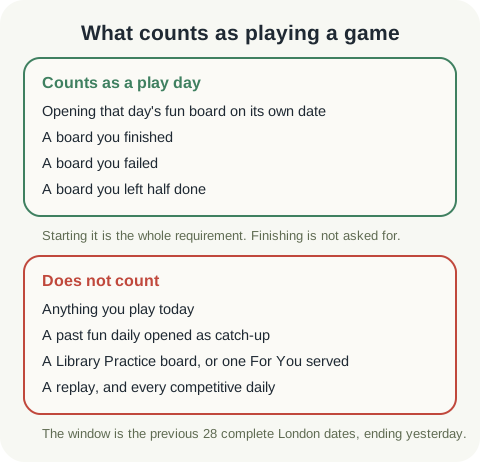
Played means started. Opening that day's fun board on its own London date is the whole requirement, and how it went afterwards makes no difference. A board you finished, a board you failed and a board you left half done all count once each, because the signal is a record of what you chose to open rather than how good you are at it.
The exclusions are worth reading, because a few of them catch people out. A fun daily you come back to as catch-up is outside the window by definition, so clearing last week's boards does not shape today's list. Library Practice boards and boards served by For You are not part of it either, nor are replays, nor anything on the competitive slate. Only dated fun boards, opened on their own date, count.
Nothing you do today moves today's list
The window is the previous 28 complete London dates, and today is deliberately left out of it. Play Aquarium over breakfast and Aquarium will not have climbed by the evening. It counts from tomorrow.
Because every number feeding the order comes from days that have already closed, the eight cards are fixed for the whole London day. Reopening the page, switching device or pulling to refresh gets you the same eight until midnight, when the window rolls forward a day and the list is worked out again.
A new account, and a slow one
With no play days at all, the first rule has nothing to work with and everything falls through to the league ordering, which is the same for everyone in that position. That is the intended starting point rather than a gap: you get the boards most people are actually playing, and a handful of your own sessions is enough for the first rule to start taking over.
The personalised order needs a signed-in account and one small summary request. If that request has not come back, Today keeps the shared rotation for that visit, which gives everyone the same eight for a date, reshuffled weekly and stepped on through the week so the catalogue comes round before it starts repeating. Nothing is lost when that happens. The next visit sorts it out.
Put it into practice
Explore the league and find a puzzle that suits you.
See today's fun boardsSign in or create an account to save your progress.