Hubbard

Why the square has to be water
Islands is our Nurikabe game. Every number marks an island of exactly that many land squares joined side by side, each island holds exactly one number, and every other square is water. The water must be one connected region with no solid two by two block.
Take an empty square with a numbered island on one side and a different numbered island on another. Make it land and the two islands become one piece of land holding two numbers. That breaks a rule whatever the numbers are, so the square is water. You do not need to know how either island will finish.
Throughout this guide, rows are numbered from the top and columns from the left.
- A gap: two numbers in one row or column with a single empty square between them. That square is water.
- A diagonal pair: two numbers touching corner to corner. Both squares they share are water, so you get two at once.
- A grown island: once an island has spread, any empty square touching it and a different island is water, even if neither printed number is nearby.
The board
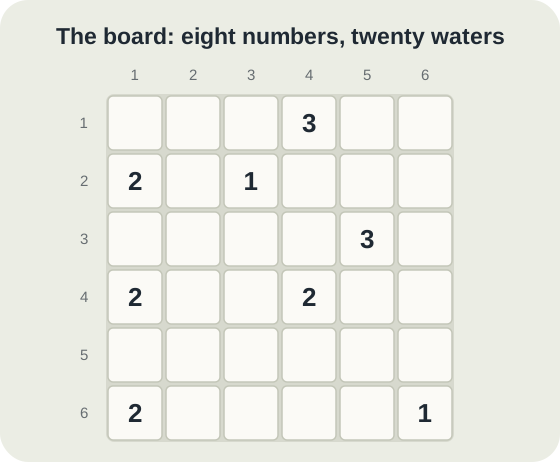
This board has eight numbers adding up to sixteen, so sixteen squares are land and twenty are water. An exhaustive search over every legal arrangement of the islands finds exactly one solution, and the game's own solver finishes it without trial and error.
Ten waters before anything grows
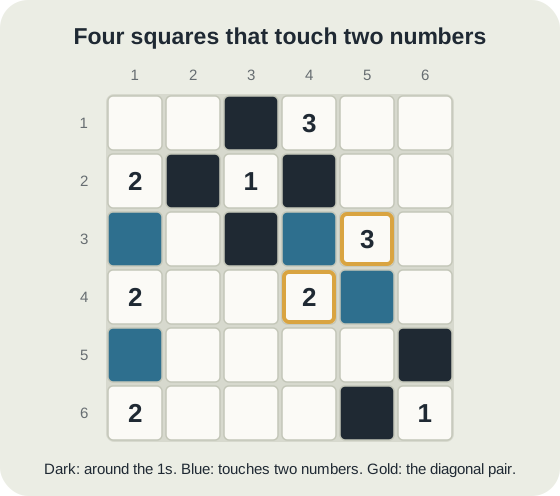
Start with the two 1s. A 1 is already a finished island, so every square beside it is water. That gives six waters: row 1 column 3, row 2 column 2, row 2 column 4 and row 3 column 3 around the 1 at row 2 column 3, and row 5 column 6 and row 6 column 5 around the 1 in the corner.
Now look for squares touching two numbers. Column 1 has 2s in rows 2, 4 and 6, each one square apart. Row 3 column 1 touches the 2 above and the 2 below, and so does row 5 column 1. Both are water.
The 3 at row 3 column 5 and the 2 at row 4 column 4 touch corner to corner. They share two neighbours, row 3 column 4 and row 4 column 5, and each of those touches both numbers. Both are water.
There is a second diagonal pair at the top: the 1 at row 2 column 3 and the 3 at row 1 column 4. Their shared squares are row 1 column 3 and row 2 column 4, which the 1 had already made water. The two rules agree, which is a useful check.
The rule fires again after a move
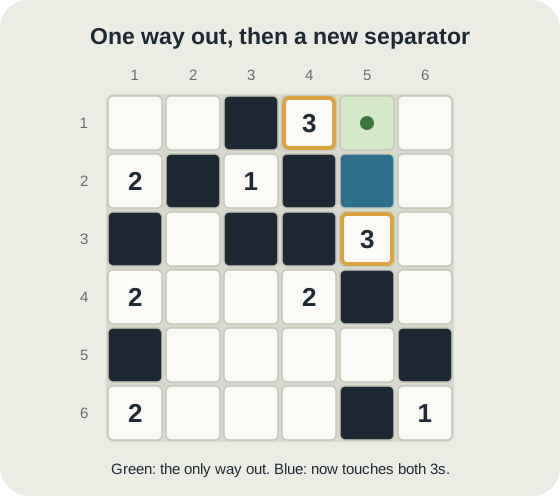
The waters matter because of where they sit. The 3 at row 1 column 4 now has water to its left and water below it. The top edge is off the board, so its only way out is row 1 column 5. That square is land.
Row 1 column 5 sits directly above row 2 column 5, and row 2 column 5 also sits directly above the other 3, at row 3 column 5. It touches two different islands now, so it is water. At the start this square touched no number at all. It became a separator only because an island grew next to it.
That water closes the top 3's downward exit, so its third square is row 1 column 6. The island is complete, and row 2 column 6 below it is water.
Every island has one way out
From here each island is walled in by the waters already found, so each one has exactly as many open squares as it still needs. Finish an island and the squares around it become water, which walls in the next.
- The 2 at row 2 column 1 has water to its right and below it, so it takes row 1 column 1. Row 1 column 2 becomes water.
- The 3 at row 3 column 5 has water above, to its left and below it. It goes right to row 3 column 6, and from there down to row 4 column 6, because row 2 column 6 is water.
- The 2 at row 4 column 1 has water above and below it, so it takes row 4 column 2. Row 3 column 2, row 5 column 2 and row 4 column 3 become water.
- The 2 at row 4 column 4 now has water above, left and right, so it takes row 5 column 4. Row 5 column 3, row 5 column 5 and row 6 column 4 become water.
- The 2 at row 6 column 1 has water above it, so it takes row 6 column 2, and row 6 column 3 is the last water.
The finished board
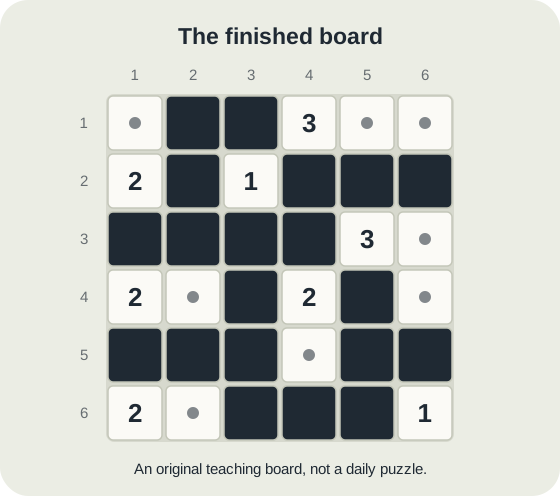
Sixteen land squares, twenty waters, one connected sea and no solid two by two block. Every island that had to grow was placed by the one-way-out rule, and every one of those exits was closed by a finished island or a separator.
The mistakes this rule catches
The first is scanning for separators only at the start. On this board row 2 column 5 was a separator only after the top 3 grew. Each time you add land to an island, check the empty squares around the new square for a different island on another side.
The second runs the other way: shading the numbers themselves apart. Islands may touch corner to corner, as the 1 and the 3 at the top of this board do in the finished solution. The rule is about the squares they share, never about the diagonal contact.
The third is leaving a square between two equal numbers open because it looks as if either could use it. The 2s in column 1 could each use row 3 column 1 on its own, but not without touching the other, so it is water just as surely as a square between a 2 and a 3.
Islands is timed. You will find it as a Just for fun board and in the Library, at sizes from 6×6 up to 9×9 as the tier climbs, and the separators on bigger boards work in exactly the same way.
Put it into practice
Try an Easy Islands Library puzzle and look for one deduction from this guide.
Play an Islands boardSign in or create an account to save your progress.