Hubbard
What the button does the moment you confirm
Give up sits under the board, below the check or submit control, in small type rather than as a main button. Pressing it does not do anything yet. A confirmation appears first, and its wording tells you both halves of what is about to happen: on Five Letters, Pipes and Lattice it reads that this shows the answer and scores 0, and on Traffic that it shows the finished jam and scores 0. The confirm button on most boards says Give up and show me.
Confirm it and two things happen together. Your attempt is closed and recorded as not completed, and the finished board is sent back to you and drawn on screen. That second part is the only time HubbardGames hands an answer to your browser. Every other route into the site withholds it, including hints, which point at what is wrong without saying what is right. Giving up is the exception, and showing you a solved board is the point of the button rather than a side effect of it.
It is also the same record as running out of guesses. On Five Letters, a sixth wrong guess closes the attempt and reveals the answer exactly as the button would. Nothing anywhere distinguishes the two afterwards.
Zero, which is also what an unopened board pays
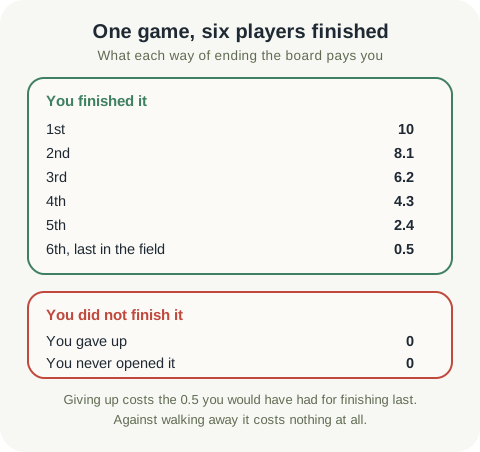
A competitive game you did not finish contributes 0 points for that day, whether you gave up on it or never looked at it. There is no additional penalty for pressing the button, and no credit for having tried.
Take a day when six players finish at least one competitive puzzle. That sets the field at six, and in every game the six places pay 10, 8.1, 6.2, 4.3, 2.4 and 0.5. The whole of what giving up costs you is the difference between the place you would have finished in and nothing, so at worst it is the 0.5 for coming last.
That is a genuinely small number against a ten game slate, and it is the figure people usually overestimate. The expensive part of the decision is in the next section, and it is not measured in points.
What it actually uses up is the board
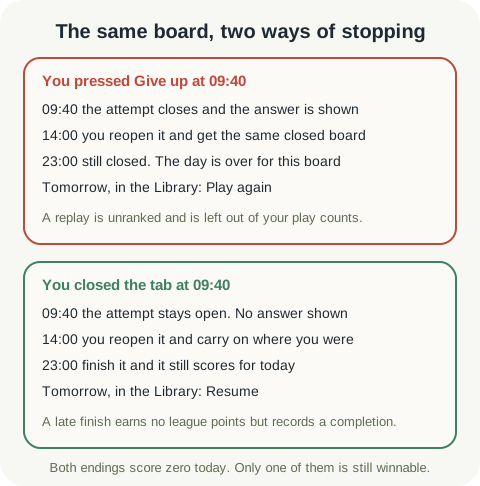
Every player gets one ranked attempt at each board. Giving up ends that attempt, and the ending is permanent for the rest of the day. Open the same daily again at two in the afternoon and you are handed the board you gave up on, already over, with the answer still on it. There is no route back into it, deliberately, because an attempt you could reopen after seeing the solution would not be an attempt at all.
So the real question when your thumb is over the button is not whether 0.5 points matter. It is whether there is a later today. A tricky Bridges board at nine in the morning is a different proposition from the same board at half past eleven at night, and the clock on a timed game does not run while you are away from it, so leaving one unfinished and coming back costs you nothing.
If you are sure you are done with it, press the button and take the answer. If there is any chance of an evening attempt, close the tab instead. Those two actions score identically today. Only one of them is still winnable.
It never lands on anybody else
A day's field is every player who completed at least one competitive puzzle that day, and completions are the only thing it counts. Giving up on a board does not add you to the field, so it cannot make the field larger and cannot move anybody else's points by a fraction. Whatever you do with the button, the standings for everyone else are the same as if you had never signed in.
The same rule keeps it out of your streak. A streak day needs a finished board, so a day spent giving up on things does not fill one, and nor does it break one any faster than a day spent away from the site.
A day of nothing but give-ups does not count against you
The all-time table ranks on league average, which is your points divided by every competitive game available on the days you entered. On a day you entered, a game you left unfinished counts as a zero in that sum, which is the usual reason to finish the slate rather than perfect one board.
Entering a day means completing at least one competitive board on it. If you gave up on everything and finished nothing, you never entered, so the date is not in the sum at all. It is not recorded as ten zeros against your average; it is simply not there, in the same way a day you were on holiday is not there.
That makes the worst case narrower than it looks. Giving up on one board on a day you are otherwise playing costs you a place in that one game. Giving up on all ten costs you a day in the table, which the average was never going to count anyway.
Tomorrow it comes back, unranked
After the London midnight reset the board moves into the Library with the rest of the day's puzzles. A board you gave up on offers Play again there, which starts a replay. Replays exist so you can go back through something that beat you, and they are unranked by design: they are left out of your play counts, out of streaks and out of every standing.
This is worth knowing because of what it rules out. A board you never started can be picked up later as an ordinary catch-up attempt, which still earns no league points after its own day but does record a completion against your activity. Once you have given up, that ordinary attempt has been used, and the replay is what is left. Giving up spends the catch-up as well as the day.
Your own pages remember it, the standings do not
On Today, the card for a game you gave up on reads a crossed missed, while a game you have not touched still reads Play. Your own view keeps the distinction, which is useful when you are working out what is left in the day.
The standings hold completions and nothing else, so both games are simply absent from your row. Nobody reading the Board can tell a board you fought and abandoned from one you never opened, and there is no separate mark anywhere for having given up.
Put it into practice
Explore the league and find a puzzle that suits you.
See today's boardsSign in or create an account to save your progress.