Hubbard
Why some totals have only one set
Every run of white squares must add up to its clue, using the digits 1 to 9 with no digit repeated inside the run. The smallest total a two-square run can make is 1 + 2 = 3, and the next is 1 + 3 = 4. Each can be made only one way, because 2 + 2 repeats a digit.
The top of the range mirrors the bottom. The largest two-square total is 9 + 8 = 17, and the next is 9 + 7 = 16, since 8 + 8 is also a repeat. Step either end one total inwards and a second set appears: 5 can be 1 + 4 or 2 + 3, and 15 can be 6 + 9 or 7 + 8.
The same thing happens at every run length on our boards. The two lowest totals and the two highest each have one set of digits, and every total between them has at least two. A one-set clue does not tell you the order of its digits, but it does tell you exactly which digits are in the run, and that is often enough to settle a crossing square.
The one-set totals for runs of two to five squares
Every run in a sample of 42 boards from our generator was between two and five squares long, so this list should cover the one-set clues you meet in Cross Sums.
- Two squares: 3 is 1 and 2. 4 is 1 and 3. 16 is 7 and 9. 17 is 8 and 9.
- Three squares: 6 is 1, 2 and 3. 7 is 1, 2 and 4. 23 is 6, 8 and 9. 24 is 7, 8 and 9.
- Four squares: 10 is 1, 2, 3 and 4. 11 is 1, 2, 3 and 5. 29 is 5, 7, 8 and 9. 30 is 6, 7, 8 and 9.
- Five squares: 15 is 1 to 5. 16 is 1, 2, 3, 4 and 6. 34 is 4, 6, 7, 8 and 9. 35 is 5 to 9.
A shortcut for the second entry
You only need to remember the extreme set at each end. At the low end, the second total is the lowest set with its largest digit raised by one: 1, 2 and 3 make 6, so 1, 2 and 4 make 7. At the high end, it is the highest set with its smallest digit lowered by one: 7, 8 and 9 make 24, so 6, 8 and 9 make 23.
The lowest set is always the run of digits counting up from 1, and the highest is the run counting down from 9. So a four-square run of 30 is 6, 7, 8 and 9, and a four-square run of 29 swaps the 6 for a 5.
A board that opens from both ends
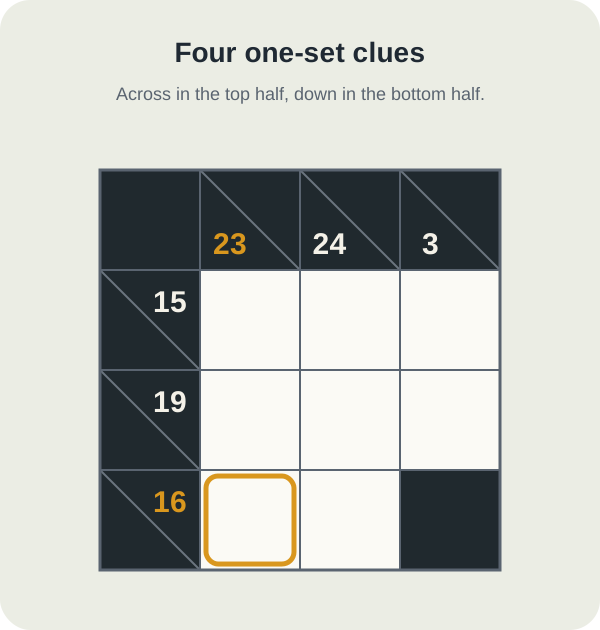
Here is a small original board with eight white squares. As on the game board, a dark square carries its across clue in the top-right half and its down clue in the bottom-left half. The across totals are 15, 19 and 16 from the top row down. The down totals are 23, 24 and 3 from the left column across. The bottom row has two white squares, and so does the right-hand column.
Four of the six clues are one-set totals: 16 in two squares, 23 in three, 24 in three and 3 in two. Only 15 and 19 across are ordinary, with several sets each. It is a teaching example built for this guide, not a current daily board.
Where 16 meets 23
The bottom-left white square sits in the two-square across run of 16 and the three-square down run of 23. From 16 it must be 7 or 9. From 23 it must be 6, 8 or 9. Only 9 is on both lists, so it is 9.
The other square of the bottom row is now 16 minus 9, which is 7. The two squares above the 9 in the left column must hold the rest of the set for 23, which is 6 and 8, in some order.
The middle column is 24 in three squares, so it holds 7, 8 and 9. Its bottom square is the 7 just placed, which leaves 8 and 9 for the two squares above it. The right-hand column is 3 in two squares, so it holds 1 and 2.
Every white square now has two candidates or fewer, and nothing harder than one subtraction has been needed.
Let an ordinary total choose
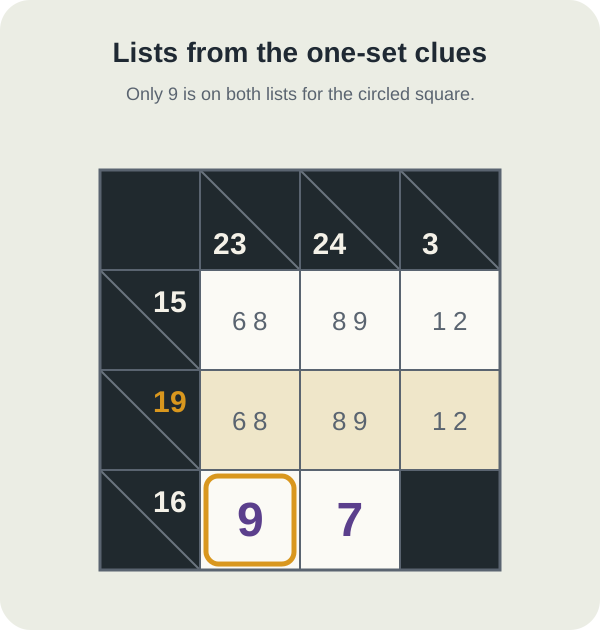
Now look at the middle row, 19 across. Its squares hold 6 or 8, then 8 or 9, then 1 or 2. Suppose the first square were 6. The other two would need to make 13, but the most they can make is 9 + 2 = 11. So the first square is 8.
With an 8 already in that row, the middle square cannot be 8 as well, so it is 9. The last square is 19 minus 8 minus 9, which is 2.
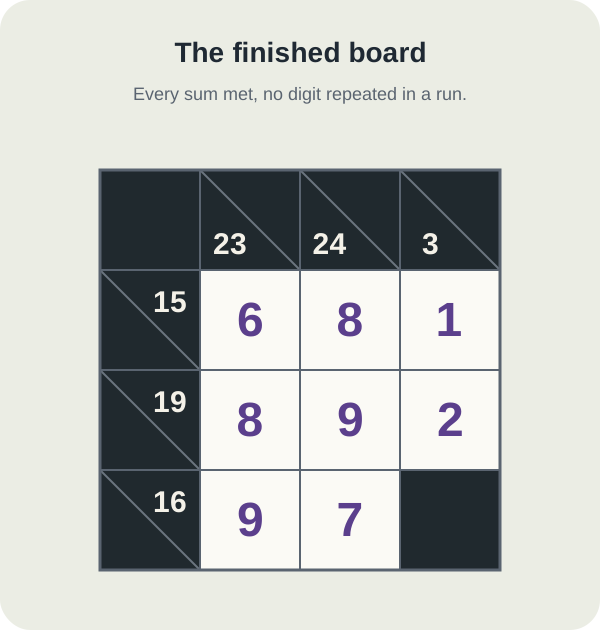
Each column then gives up its other digit. The top of the left column is 6, the top of the middle column is 8 and the top of the right-hand column is 1. Check the top row: 6 + 8 + 1 = 15, which matches its clue. The engine that builds Cross Sums boards confirms this layout and these clues have only this one solution.
The mistake to avoid: a total that is nearly one set
The totals just inside the one-set ones look almost as tight, but they are not. 15 in two squares can be 6 and 9 or 7 and 8. 22 in three can be 5, 8 and 9 or 6, 7 and 9. 8 in three can be 1, 2 and 5 or 1, 3 and 4. Treat one of these as a fixed set and you can write a digit that does not belong. The board turns a run red only when it repeats a digit or cannot reach its total, so a wrong digit that still fits its sums can sit there unnoticed for a long time.
The same number also means different things at different lengths. 16 in two squares is only 7 and 9, and 16 in five squares is only 1, 2, 3, 4 and 6, but 16 in three squares has eight possible sets. Count the squares in the run before you read its total.
Cross Sums is a timed Practice and Just for fun game rather than one of the daily league games, so a slip here costs you seconds, not standings.
Try it on your next board
Open an Easy Cross Sums board from the Library and scan it for one-set clues before you write anything.
- Count the squares in each run, then check its total against the list above.
- Look at both ends of the range: 16, 17, 23, 24, 29, 30, 34 and 35 are as useful as the small totals.
- Where two one-set runs cross, keep only the digits on both lists.
- Use an ordinary total last, by testing which candidate would make it too big or too small.
Put it into practice
Try an Easy Cross Sums Library puzzle and look for one deduction from this guide.
Play a Cross Sums boardSign in or create an account to save your progress.