Hubbard

What a cage tells you before anything else is known
Every row and column holds each number from 1 up to the board width exactly once, and each outlined cage has to reach its target using the operation printed with it. Two cells of one cage that share a row or a column still cannot match; two that share neither are free to hold the same number.
That is enough to ask a useful question of any cage on its own, with the rest of the board blank: how many fillings does this clue allow? Work through every two-cell cage on a five by five board and the answers split sharply by operation. All ten times targets name exactly one pair, so 6x is 2 and 3 and nothing else. Of the seven addition targets, four name one pair, but the ambiguous three cover six of the ten pairs, so an addition cage more often than not leaves you a choice. Division is close behind multiplication, with three of its four targets decisive.
Subtraction is the outlier. It has four targets on a five wide board and only one of them, 4-, names a pair. A 1- cage allows 1 and 2, or 2 and 3, or 3 and 4, or 4 and 5, in either order: eight fillings, no information. The smallest printed number on the board is reliably the weakest clue on it.
A board where that difference decides the opening
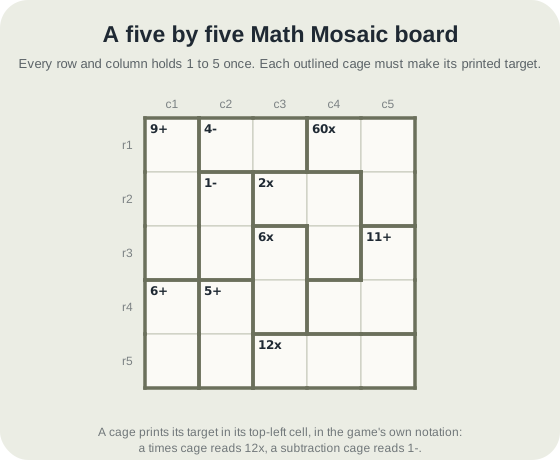
Below is a five by five board from the game. Rows run r1 to r5 down the side and columns c1 to c5 along the top. Each cage prints its target in its top-left cell, in the game's own notation, so multiplication reads 12x and subtraction reads 1-.
Two cages sit side by side in the middle of it. The 1- cage covers r2c2 and r3c2. The 2x cage covers r2c3, r2c4 and r3c4. The subtraction target is the smaller number and the cage is the smaller cage, and it is the one that tells you nothing.
The 2x cage fills itself
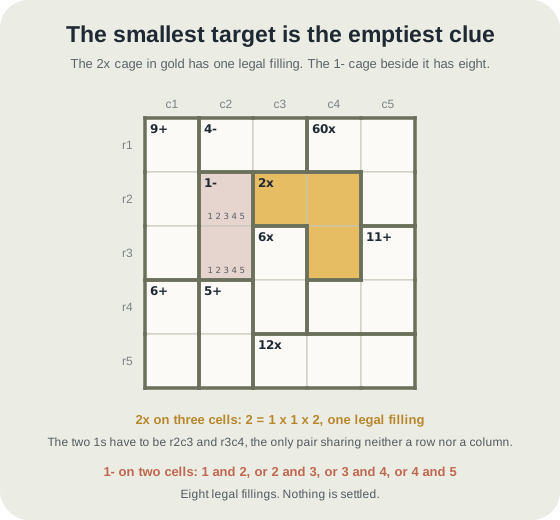
The 2x cage holds r2c3, r2c4 and r3c4, and the three numbers in it must multiply to 2. Using 1 to 5, the only way to write 2 as a product of three of them is 1 x 1 x 2. So the cage holds two 1s and a 2, and the only remaining question is which cell takes the 2.
The two 1s have to sit in cells that share neither a row nor a column, or they would break the Latin rule. Check the three pairs. r2c3 and r2c4 are both in row 2, so they cannot match. r2c4 and r3c4 are both in column 4, so they cannot match either. That leaves r2c3 and r3c4, which share nothing. Those two hold the 1s, and the 2 goes to r2c4.
Three cells filled, with no other cell on the board known and nothing guessed. Enumerating every assignment the clue permits confirms there is exactly one: r2c3 = 1, r2c4 = 2, r3c4 = 1.
Now do the same for the 1- cage next door. Its two cells differ by 1, which allows four pairs in either order, and the cage is not even narrowed by the Latin rule because its cells are already in the same column and so already have to differ. Eight fillings stand, and the cage stays blank for several moves.
What those three cells unlock
A solved cage is only worth what it rules out elsewhere, and this one pays immediately.
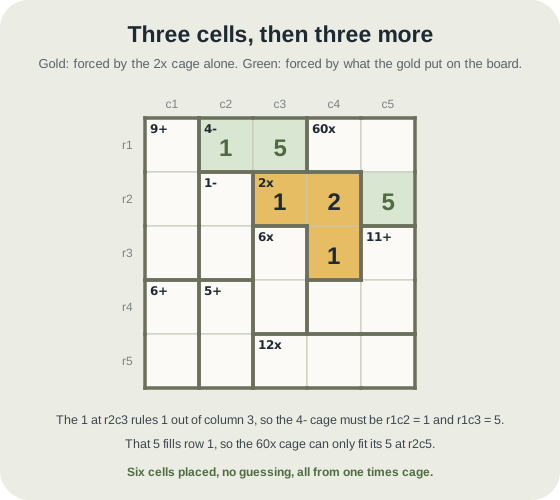
The 1 at r2c3 puts a 1 in column 3. Look at the 4- cage at r1c2 and r1c3: a difference of 4 on a five wide board can only be 1 and 5, the one decisive subtraction target there is. Column 3 has now used its 1, so r1c3 cannot take it. That fixes r1c3 = 5 and r1c2 = 1.
The 5 now sitting at r1c3 fills row 1's only 5. Look at the 60x cage at r1c4, r1c5 and r2c5: sixty is 3 x 4 x 5 and nothing else in this range, so one of those three cells is a 5. Two of them are in row 1, which has spent its 5, so the 5 belongs to r2c5.
Six cells placed from one times cage, and the board carries on the same way without a guess anywhere. The engine's own deduction solver finishes it and reaches the same grid.
The mistake, and where this stops working
The habit worth changing is scanning for the smallest printed number. A 1- or a 2- is the least informative clue on the board and a 60x is among the most, because a large product has very few ways of being made from numbers this small. Read the operation first and the target second: start at the times cages, then division, then addition, and only look at subtraction when you already know one of its two cells.
The other mistake is to treat a solved multiset as solved cells. Knowing the 12x cage in row 5 holds 1, 3 and 4 is not the same as knowing where each goes, and writing them in a plausible order will hold up for a while before the rest of the board contradicts it. The 2x cage above is unusual precisely because the Latin rule pins the order too.
One honest limit. Every two-cell times cage names its pair on a four or five wide board, but Math Mosaic also runs six and seven wide, and there two targets stop being decisive: 6 can be 1 and 6 or 2 and 3, and 12 can be 2 and 6 or 3 and 4. Every other times target on those boards still names one pair. So on a wider board the rule holds with two exceptions worth memorising, which is still a far better place to start than a subtraction clue.
Put it into practice
Try an Easy Math Mosaic Library puzzle and look for one deduction from this guide.
Play a Math Mosaic boardSign in or create an account to save your progress.