Hubbard
Where the numbers live
Open Profile from the avatar in the header. The first view, Overview, is headed Your puzzle life. It has four cards: Current streak, Puzzles completed, League average and Tracked puzzle time. Under them, Your league record lists your all-time place, league days entered, daily overall wins, per-game first places, league puzzles completed and per-game top-three finishes.
Choose Progress from the row of section buttons and you get four more views. By game has a game picker with that game's detail, and your recent league form sits underneath it. Compare players puts your league days next to one other player's. Records covers time, Practice and Just for fun. Insights is part of Plus, and an account without Plus sees a short description of it instead.
Everything in Overview and By game includes today, and today's results can still change until the London midnight reset. Compare players leaves today out completely. That difference matters later on.
One example, two league days
Every competitive place now pays a fixed amount: first is worth 10, second 9.5, third 9, and each place after that half a point less, down to a floor of 0.5 for any finish. A game you do not play or do not finish is worth 0. There are currently ten competitive games a day.
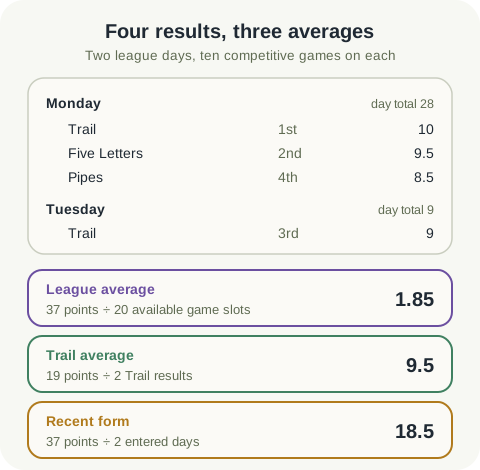
Take two days. On Monday you finish first in Trail, second in Five Letters and fourth in Pipes. That is 10, 9.5 and 8.5, a day total of 28. On Tuesday you only have time for Trail and finish third, which is 9. Across both days you have four results and 37 points. The illustration below lays it out, and every figure in the rest of this guide comes from it. We checked each one by running the example through the same league code that builds the Profile.
League average: points per available game
The League average card divides your points by every competitive game that was available on the days you entered. Two days of ten games is 20 slots, so 37 points becomes 1.85 out of 10. The seventeen games you did not play on those days count as zero. Days you did not enter at all are left out, so a week away does not drag the number down.
This is the only average that decides your all-time place. Equal averages are separated by days entered and then by total points. Because the empty slots are in the denominator, the fastest way to raise it is to finish more of the games on a day you are already playing. Add one more Tuesday game, finished sixth, and the total becomes 44.5 over the same 20 slots: 2.23. Finishing badly still pays at least 0.5, and a skipped game pays nothing.
A game's own average: points per result in that game
Pick Trail in By game and League performance divides only your Trail points by only your Trail results. That is 19 over 2, so 9.5 out of 10. The panel says so directly: each completed daily contributes once to this game's average, and your overall league average has a different denominator.
The same panel ranks you against everyone with a Trail result, by that same per-result average, and players on an equal average share the place. The ranking does not weight how many times people have played. Someone who has played Trail once and won it averages 10 and sits above your 9.5, however many days you have behind you. Treat the per-game place as a sign of what you are good at, not as a table of the most consistent players.
Adding that sixth-place Tuesday game in a different game leaves your Trail average at exactly 9.5. The two numbers move independently, which is why a strong game can sit beside a modest league average.
Recent form: points per day you played
Recent league form, under the By game detail, takes your latest seven entered days and divides your points by the number of days. In the example there are only two, so it is 37 over 2: 18.5 points per entered day. It is not out of ten, and a full ten-game day can score far more than ten.
Once you have entered more than seven days, the panel also shows the seven entered days before those, so you can see whether you are scoring more per day than you were. Entered days are the days you played, not consecutive calendar dates, so a gap in the middle does not break the comparison. Today is included and can still change.
What else By game shows
The top of each game's detail counts completions from starts, split into Practice and dated play. Dated play includes league, Just for fun and catch-up boards. Unfinished and failed starts stay in the total, and replays are left out.
Best recorded daily result is your best time, guess count or swap count on a league or Just for fun daily. Boards vary, so the panel calls this a record rather than a trend. Tracked time in this game is active puzzle time with each attempt capped at 20 minutes, so a tab left open overnight does not count.
Latest dated results lists up to five of your recent daily finishes. A league row reads like 4th of 5 finishers with 8.5 / 10 points. The finisher count is only the players who completed that game on that date. A Just for fun row shows a place too, marked no league points.
Compare players counts shared, settled days
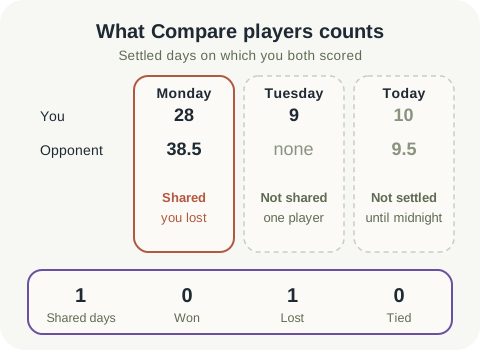
Choose a player in Compare players and the panel adds up each of your days and theirs, then compares the day totals. A day only counts when both of you scored at least one competitive result on it and the day is over. The panel's own label says Settled league days only.
Suppose your opponent played four games on Monday and made 38.5, did not play on Tuesday, and today is Wednesday. Monday is shared, and your 28 loses to their 38.5. Tuesday is not shared, even though you scored, because they have nothing on it. Today does not count yet, whatever the provisional scores say. So the panel reads one shared day, no wins, one loss, no ties, with 28 against 38.5 points per shared day.
Records sit outside the league
The Records view is for play that never changes league points. Most time puzzling ranks visible play time across every mode, with the same 20-minute cap per attempt. Practice champions counts completed dateless Practice boards only. Your Just for fun standings shows your average daily placing in each fun game once you have completed three fun dailies of that game.
The misreading to avoid
The common mistake is to add the per-game averages together in your head and expect the league average to follow. It does not. A 9.5 in Trail cannot lift a league average that is being divided by twenty slots, and the per-game place can be headed by someone with a single lucky day.
If you want to know where you stand, read League average and your all-time place. If you want to know what you are good at, read By game. If you want to know whether this week is better than last, read Recent league form. If you want to know how you are doing against one particular player, use Compare players and remember it waits for midnight.
Put it into practice
Explore the league and find a puzzle that suits you.
Open your ProfileSign in or create an account to save your progress.