Hubbard
Where the number comes from
Open Profile from the avatar in the header. The overview is headed Your puzzle life, and the first of its four cards is Current streak, with your best run named underneath it.
The card counts consecutive London dates, and a date is either alive or it is not. Finishing one qualifying board makes the day count. Finishing ten makes it count exactly as much. Nothing about the streak rewards volume, which is the opposite of how most people play it.
Three kinds of play keep a day
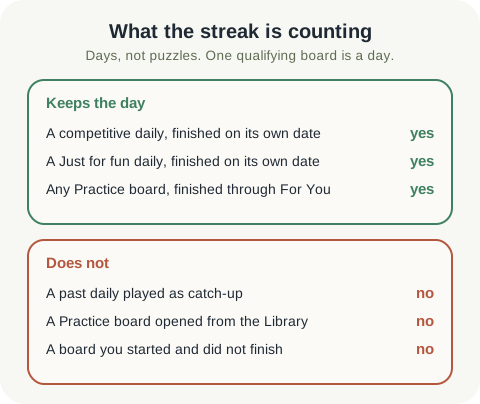
A competitive daily finished on its own London date keeps the day. So does a Just for fun daily finished on its own date, even though it pays no league points at all. And so does any Practice board you finish through For You, which records the date you finished it on rather than any date attached to the board.
That third route is the useful one. For You draws on the dateless Practice pool, so there is always something there, and finishing one short board at eleven at night keeps the date alive as surely as a full competitive slate does.
Three that look like play and are not counted
Catch-up does not count. A past daily played after its date still records your result and still feeds your achievements, but the dated tables the streak reads only accept a board finished on the date it ran, so a Thursday spent on Monday's Traffic leaves Thursday blank.
A Practice board opened from the Library does not count either, and this is the one that catches people out, because it can be the same board For You would have handed you. The credit is attached to the For You route rather than to the puzzle, so the Library plays it without recording the day.
A board you started and did not finish does not count. Running out of guesses on Five Letters or giving up on a timed board pays nothing, and the streak reads the same thing the standings read.
It does not break the moment you miss
The streak allows one blank day before it falls. The count walks back from today if you have played today, and from yesterday if you have not, so a run that ended last night still shows its full length all through the following day.
This is why the number can sit unchanged on an evening you know you played nothing. It has not quietly forgiven the day. It is still counting the run that ended yesterday, and it will read zero tomorrow unless something qualifying lands before midnight.
One week, evening by evening
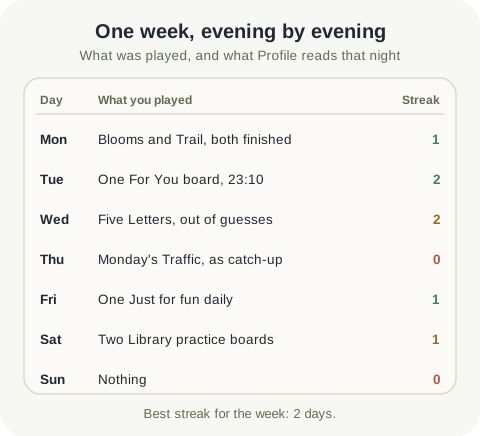
Take a week with a bit of everything in it. Monday, two competitive dailies finished, so the streak reads 1. Tuesday, nothing until 23:10 and then one For You board, so it reads 2. Wednesday, Five Letters started and lost, which is a blank day, and the card still reads 2 because no full day has yet been missed.
Thursday is spent on Monday's Traffic as catch-up. That is a second blank day in a row, and the streak falls to 0. Friday, one Just for fun daily, so it reads 1 again. Saturday, two Library practice boards, which is a blank day, and the card holds at 1. Sunday, nothing, and it reads 0.
Best streak for that week is 2, on a week when this player finished a puzzle on five of the seven evenings. The streak is not measuring how much you played. It is measuring whether the right kind of board landed on consecutive dates.
What a streak is actually worth
No points. The standings rank on league average, which is your points divided by every competitive game available on the days you entered, and a streak does not enter that sum anywhere. A long run next to a thin average is exactly what it looks like.
What it does carry is five achievements: On a Roll at 3 days, Weekly Warrior at 7, Fortnight Fire at 14, Unstoppable at 30 and Diamond Streak at 60. All five test your best run rather than your current one, so breaking a streak never takes one back. Two of them open a whole-site edition in Profile as well: Weekly Warrior unlocks Seasonal Garden, and Diamond Streak unlocks Night Logic.
So the streak is a record of showing up, and it is priced accordingly. It is worth keeping because the habit is worth keeping, not because the league pays for it.
The cheap way to keep one
If it is late and the competitive slate is not going to happen, open For You and finish one board. It counts the same as a perfect day, it takes a couple of minutes on an easy board, and it will not drag your league average, because nothing outside the competitive dailies touches that number.
The mistake worth avoiding is the opposite move: opening a hard competitive daily at ten to midnight to save the streak. A rushed finish on a timed board goes into the standings at the time you posted, and the streak would have taken the two-minute Practice board just as happily.
Put it into practice
Explore the league and find a puzzle that suits you.
See today's boardsSign in or create an account to save your progress.