Hubbard

What the clues actually give you
The board is a square of letters with a few blank squares mixed in. Under it sits a row of blanks, one per hidden word, each the length of the word it stands for. That is the whole clue list. You are never told a letter, a starting square or a first letter.
You find a word by dragging through letters that touch above, below, left or right. Diagonals do not join, so a word can turn a corner but it can never cut across one. Blank squares take no letter and no word passes through them.
The rule that does the real work is the last one: every lettered square belongs to exactly one word, and words never overlap. The finished board is not a word search with spare letters lying around. It is a complete carve-up of the grid into the words on the clue list.
Answers come from a UK English bank, so COLOUR and CENTRE are words here and their American spellings are not. Word Weave is timed and runs in Practice and Just for fun only, so a slow solve costs you a time and never any league points.
Why the longest clue is the easiest
Every letter you add to a word narrows it twice over. There are fewer long words in the bank to begin with, and each extra letter is another square that has to sit next to the last one and carry the right letter.
A three-letter word needs two lucky neighbours. A seven-letter word needs six in a row, and it has to thread them through a grid that has blanks in it. The bank holds 63 three-letter words and 35 seven-letter ones, which is a real difference but a small one. The difference that counts is not how many words of each length exist. It is how many of them can physically be drawn on the grid in front of you.
So the longest clue is where you should look first, every time. It is the clue with the fewest places to go.
A board to try it on
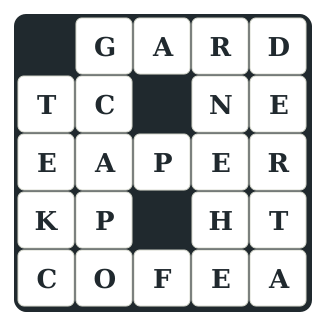
Five by five, twenty-two letters, three blank squares. The clue row reads 3, 6, 6, 7, so there are four words to find and two of them are six letters long.
Read the grid row by row. Row 1 is blank, G, A, R, D. Row 2 is T, C, blank, N, E. Row 3 is E, A, P, E, R. Row 4 is K, P, blank, H, T. Row 5 is C, O, F, E, A.
There are short words visible all over it. RED runs up the right-hand side. TEA comes down the left. HEN and PEN both reach up to the N. None of that is progress yet.
The seven has exactly one home
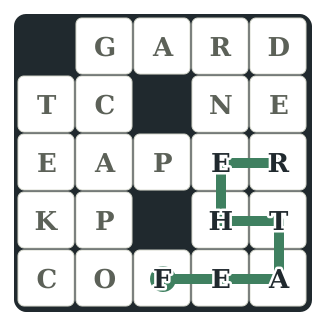
Take the seven-letter clue and look for somewhere it could go. The bottom row starts F, E, A, and from the A at row 5 column 5 the only way on is up, into T and then H. FEATHER wants an E and an R after that, and they are sitting in row 3 at columns 4 and 5.
So FEATHER traces from the F at row 5 column 3, right along the bottom to row 5 column 5, up to row 4 column 5, left to row 4 column 4, then up to row 3 column 4 and right to row 3 column 5.
That is not one option among several. Trace every seven-letter word in the answer bank from every square on this grid and FEATHER on that path is the only one that can be drawn at all. The seven-letter clue is solved before you have looked at anything else.
The two sixes have nowhere else to go
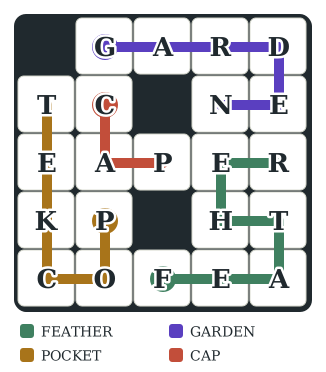
Now do the same for six. GARDEN runs along the whole of row 1 from the G at column 2, drops to row 2 column 5 and finishes left at row 2 column 4. POCKET starts at the P in row 4 column 2, goes down to row 5 column 2, left to the C in row 5 column 1, then straight up column 1 to the T in row 2.
Those are the only two six-letter traces on the board, and the clue list wants exactly two six-letter words. There is no choosing to be done: both are in. Neither one crosses the other, and neither one touches a square FEATHER has already taken, which is the check worth making before you commit.
This is the pattern to expect. Once the longest word is down it does not just fill squares, it removes the squares that the next-longest word would otherwise have had a choice about.
What is left is the answer
Three words are down and three lettered squares are still free: row 2 column 2, row 3 column 2 and row 3 column 3. They read C, A, P, and they form a legal path, down one and right one.
CAP is the three-letter answer. Notice that you never had to identify it. The three-letter clue was the hardest to pin down when the board opened and the easiest once everything else was placed, because by then it was the only thing that would fit in the space left over.
Work the clue list from the long end and the short words solve themselves. Work it from the short end and you spend the whole board guessing.
The mistake worth naming
The trap is treating a word you can see as a word that is there. On this board there are seven different three-letter traces waiting when it opens, spread across six words: CAP twice, plus HEN, PEN, RAG, RED and TEA. Only one of the seven is an answer.
RED and TEA are perfectly good traces of perfectly good words, and both are wrong. They are letters that belong to GARDEN and POCKET, read in a direction those words do not go. The grid is full of accidents like that, because once you have carved twenty-two squares into four words, the leftovers spell other things by chance.
A wrong trace of the right length is not free. The board tells you it is not one of the hidden words and your clock keeps running. A trace of a length that is not on the clue list at all is refused before it is even checked, so you cannot lose time hunting for a five-letter word here. Undo word takes back the last one you found if you want the squares released again.
On a bigger board
Word Weave boards come in five by five, six by six and seven by seven, and the harder ones carry more words rather than longer ones. The method does not change. Sort the clue list, start at the longest, and only move down a length when the one above it is placed.
The one habit to add on a larger grid is reading the blanks before the letters. No word passes through a blank square, so every blank is a wall, and a run of them can cut a corner of the board off from the rest. A long word has to fit on one side of that wall, which rules out a lot of the grid before you trace a single letter.
Put it into practice
Try an Easy Word Weave Library puzzle and look for one deduction from this guide.
Play a Word Weave boardSign in or create an account to save your progress.