Hubbard
Where the button is and what it does
The Share button sits in the panel that appears when a board ends, under your result and above the button that takes you back. On a phone it opens the normal sharing sheet with a small picture attached, so it drops into WhatsApp or Messages as an image with a line of text. On a desktop browser, where attaching a file to a share is usually not available, it quietly falls back to copying the text version to your clipboard and tells you it has done so.
Practice boards from the Library have no Share button at all. Neither does a timed board you did not finish. On the guess games the button is there whether you won or not, and a failed board posts X/6 rather than a number, which is its own kind of honesty.
The grid without the words
A Five Letters share is the coloured grid from your board with every letter removed. Green for a letter in the right place, gold for a letter in the wrong place, grey for a letter that is not in the word, and no characters anywhere. The same treatment covers Equation, where the digits and operators go the same way.
That sounds like a small edit and it is the whole trick. A green tile in position four is a statement about a letter, and once the letter is gone the tile says only that something was right there. Somebody reading your share knows the shape of your reasoning and nothing about its subject, because the subject was the words you typed and those are the part that was thrown away.
Two solves, one share
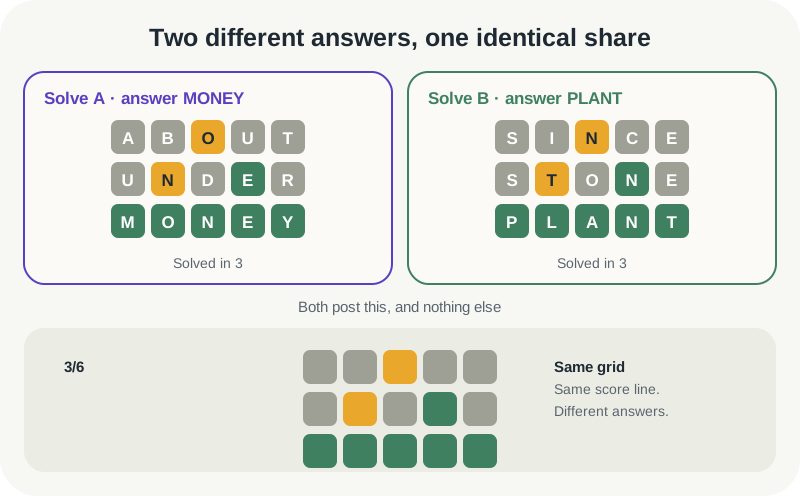
Here is the proof, worked on the game's own scoring code. Two players finish in three guesses. The first is solving a board whose answer is MONEY and opens with ABOUT, which puts a single gold on the O. Their second guess is UNDER, which golds the N and greens the E in fourth place. Their third guess is the answer.
The second player is solving a board whose answer is PLANT. They open with SINCE, which puts a single gold on the N. Their second guess is STONE, which golds the T and greens the N in fourth place. Their third guess is the answer.
Every tile matches. Both players post a grey-grey-gold-grey-grey row, a grey-gold-grey-green-grey row, a row of five greens and the score 3/6. Nothing in that share distinguishes MONEY from PLANT, and neither word is a recent or upcoming daily answer.
The general version is stronger than one coincidence. Five Letters draws from 2,315 possible answers, and 2,295 of them admit a legal three-guess solve that produces that exact grid. Posting it removes twenty words from consideration. Somebody who studied your share for an hour would have narrowed tomorrow's field by less than one per cent, and they would have had to know which grid to study.
The timed five post a clock and nothing else
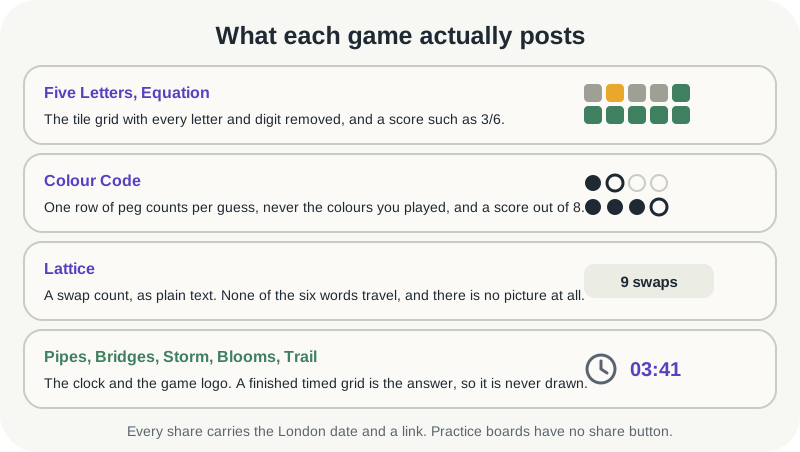
Pipes, Bridges, Storm, Blooms and Trail are ranked on time, and a finished grid in any of them is the answer, drawn out in full. So none of them ever draw it. The share is a card with the game logo, the date and your time in large type, and that is the complete contents.
There is no placing on it either. The code that builds a timed share can carry a rank line, and none of the five daily boards passes one in, so what goes out is the game, the date, the clock and the link. If you want to know where that time actually put you, the standings panel in the same result box will tell you, and it stays on your screen.
Colour Code and Lattice post a count
Colour Code gives you a row of pegs after each guess: filled for a colour in the right place, outlined for a right colour in the wrong place. The share is those rows and the score out of eight. The colours you actually played never appear, which matters more here than it looks, because in Colour Code the feedback is meaningless without the guess it answers. Three filled pegs tells a reader that three of something were right.
Lattice is the plainest of the nine. It is ranked on swaps, so the share is the swap count, as text, with no picture attached. Six words sit on a finished Lattice board and none of them travel.
The part that does travel
A share is not information-free, and it is worth being clear about the bit that is real. It tells people how you did: three guesses, or four minutes and a second, or nine swaps. It tells them the London date the board belongs to. On a loss it tells them you lost. And it carries a link to the site, which is the point of sharing it.
The one genuinely useful thing a reader takes from your grid is difficulty, loosely. A board that several friends finished in three is probably not a cruel one. That is the same signal you get from watching a crossword thread, and it is a long way from a spoiler.
The result panel you are looking at is a different matter. On Five Letters it does show you the word when you fail, in bold, right under the message. That is for you, on your screen, and the share you send from the same panel does not include it. Take a screenshot instead and you have posted the answer, which no button can prevent.
Put it into practice
Explore the league and find a puzzle that suits you.
Play today's boardsSign in or create an account to save your progress.