Hubbard

What closes a side
Each tree is paired with one tent directly above, below, left or right of it. Diagonal squares never count for a tree. Tents may not touch one another, even at a corner, and the numbers outside the grid give the exact tent total for each row and column.
So a side of a tree is closed when any of four things is true. It is off the edge of the board. It holds another tree. It is in a row or column whose total is already met. Or it touches a tent that is already placed, including diagonally, because a tent there would be touching that tent.
The last two are the ones that change as you play. Every tent you place closes the eight squares around it and may finish a row or a column as well, and each of those closures can leave some other tree with a single open side.
Tents is a timed Practice and Just for fun game rather than one of the daily league games, so this does not affect your standings. It only saves you seconds.
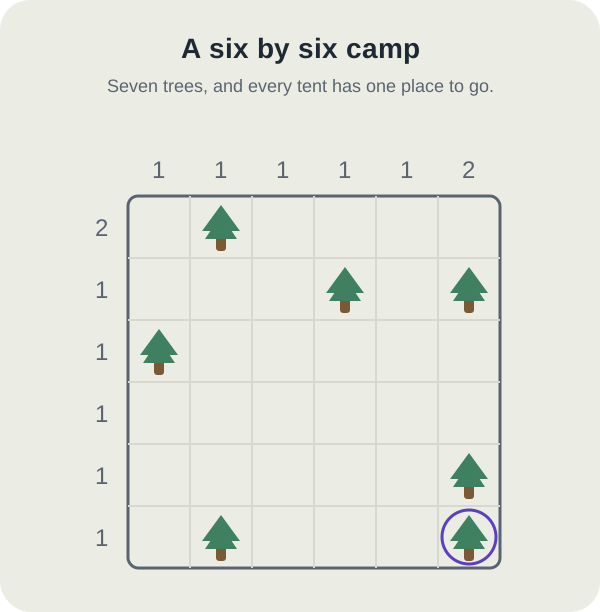
The corner tree has one side before you begin
The tree at row 6, column 6 sits in the bottom right corner, so two of its sides are off the board. Its third side, above it at row 5 column 6, is another tree. Only the square to its left is open, so row 6 column 5 is a tent. Nothing else on the board had to be checked first.
Now close everything that tent closes. The squares around it are grass. Row 6 has a total of 1, so the rest of row 6 is grass. Column 5 also has a total of 1, so every other square in column 5 is grass, all the way to the top.
That second closure matters most. A whole column of grass has just shut the left side of both trees in column 6.
Walk up the right-hand column
The tree at row 5, column 6 had three possible sides: above, left and below. Below is the corner tree and left is now grass in column 5. Only row 4 column 6 is left, so it is a tent. Row 4 has a total of 1, so the rest of row 4 turns to grass, and row 3 column 6 is grass because it touches the new tent.
The tree at row 2, column 6 is next. Its left side is grass from column 5, and the square below it, row 3 column 6, was just closed. Only row 1 column 6 remains, so that is a tent too. Column 6 has a total of 2, and now holds both of them.
Three tents are down, and none needed a row or column total to be worked out. Each total was used afterwards, only to shut squares.
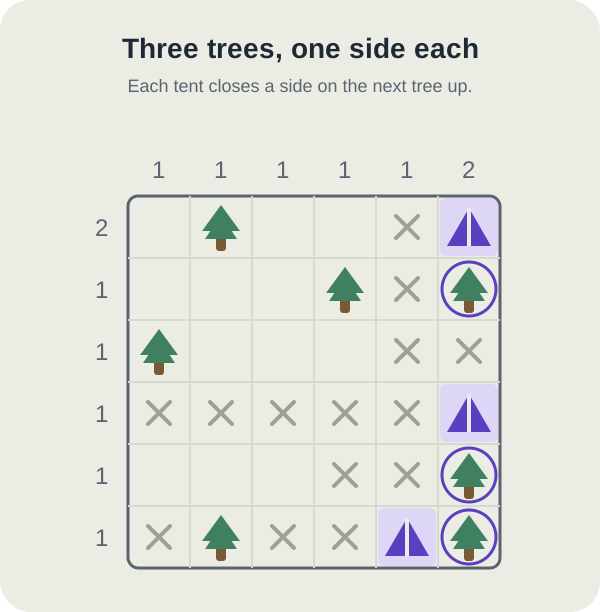
The left side falls the same way
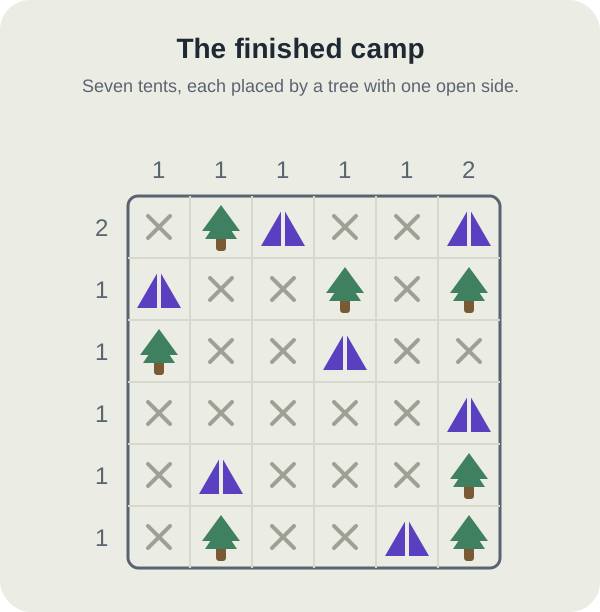
The tree at row 6, column 2 sits on the bottom edge, and both squares beside it were closed when row 6 filled. Only row 5 column 2, above it, is open, so that is a tent. Row 5 and column 2 are both now complete, which turns the rest of column 2 to grass.
The tree at row 3, column 1 is on the left edge. Below it, row 4 column 1 is grass from the full row 4. To its right, row 3 column 2 is grass from the full column 2. Only row 2 column 1 is open, so it is a tent. That completes row 2 and column 1.
The tree at row 1, column 2 is on the top edge. Row 2 column 2 below it is grass. Row 1 column 1 to its left touches the tent at row 2 column 1 at a corner, so it is closed as well. Only row 1 column 3 is open, which makes the second tent row 1 needed.
The last tree was the first one you could see
The tree at row 2, column 4 is in the middle of the board, with four open sides at the start. By now three are gone. Row 1 column 4 is in a row that already has its two tents. Row 2 column 3 is in row 2, which is complete. Row 2 column 5 has been grass since the very first tent. Only row 3 column 4 is left, and it is the seventh tent.
That is the whole board: seven trees, each checked the same way, each with exactly one open side when its turn came. The engine that builds these boards confirms it has only this one solution, and a separate count of every possible tent layout agrees.
The mistake to avoid: a diagonal tent is not a pair
When the tent at row 2 column 1 went down, it sat diagonally next to the tree at row 1 column 2. It is easy to read that tree as done and move on. It is not. A tent pairs only with a tree directly above, below, left or right of it, so that tree still needed its own tent, and the diagonal tent closed one of its sides instead of settling it.
The reverse slip is just as common: counting a side as open when it touches a tent at a corner. Row 1 column 1 looks empty and sits beside a tree, but a tent there would touch the one at row 2 column 1, so it was never available.
When you are stuck, pick any tree without a tent and name its four sides out loud: edge, tree, full line, touching a tent, or open. If only one says open, you have your next tent.
Put it into practice
Try an Easy Tents Library puzzle and look for one deduction from this guide.
Play a Tents boardSign in or create an account to save your progress.