Hubbard

The rules this uses
Every Storm row and column holds three bolts and three clouds. No row or column may have three of the same symbol in a line. An equals sign between two cells means they match; a cross means they differ.
Storm is one of the timed competitive dailies, so a deduction you can make without trial and error is time off your finish.
Count the crossed pair before you solve it
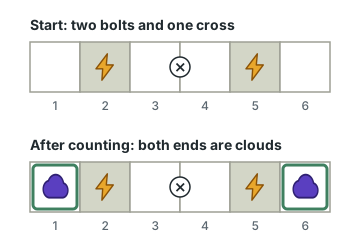
Here is an original row. Cells 2 and 5 hold given bolts, and a cross joins the blank cells 3 and 4. Every other cell is blank.
Two bolts are already placed. The crossed pair holds one more, whichever way round it goes. That makes three bolts, which is the most a row can have, so neither cell 1 nor cell 6 can be a bolt. Both are clouds.
Without the cross, neither end is decided. We checked every legal way to finish this row: with only the two given bolts, cell 1 can be a bolt or a cloud. The cross is what fixes it.
Let a column decide which way the cross goes
The row now reads cloud, bolt, blank, blank, bolt, cloud, and it cannot go further on its own. Bolt then cloud across the cross is legal, and so is cloud then bolt. So look down the columns through the crossed cells.
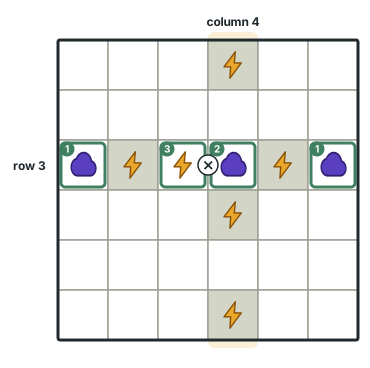
In our board the row is row 3, and column 4 already has given bolts in rows 1, 4 and 6. That column is full of bolts, so its cell in row 3 is a cloud. The cross then makes the cell beside it, in column 3, a bolt.
Row 3 finishes as cloud, bolt, bolt, cloud, bolt, cloud. We ran every completion of this board through the game's own solution checker, and every one of them has that row.
An equals sign counts as two of the same
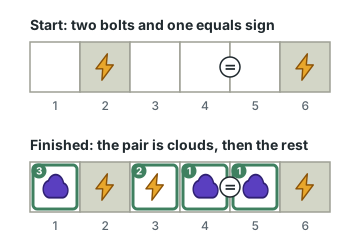
The same counting works for an equals sign, and it is often stronger. In this second row, cells 2 and 6 hold given bolts and an equals sign joins the blank cells 4 and 5.
If the matched pair were bolts, the row would have four bolts. So the pair is two clouds. Cells 3, 4 and 5 can't all be clouds, so cell 3 is a bolt. That is the row's third bolt, and cell 1 takes the last cloud.
The row reads cloud, bolt, bolt, cloud, cloud, bolt, and it is the only legal finish. Take the equals sign away and three different finishes are legal.
The common mistake: counting a sign that points out of the line
A cross only counts as one of each for a line when both of its cells are in that line. A cross between a cell in row 3 and the cell above it, in row 2, says nothing about row 3's totals. Only one of its two cells is in the row, and that cell could be either symbol.
We checked this too. Put the two given bolts back in cells 2 and 5, remove the cross from between cells 3 and 4, and add a vertical cross touching cell 3 instead. Then the row still has four legal finishes, and cell 1 can be a bolt in one of them. Treat a vertical sign as a clue for the column it sits in.
A quick routine
When a row or column has two of one symbol placed, look for a sign with both ends inside that line. A cross adds one of each, so that symbol is full and every other blank is the opposite. An equals pair adds two of the same, so if that would make four, the pair is the opposite symbol.
Then check the columns through any crossed pair you could not settle. One full column is usually all it takes.
Put it into practice
Try an Easy Storm Library puzzle and look for one deduction from this guide.
Play a Storm boardSign in or create an account to save your progress.