Hubbard

The rules this uses
Shade cells until no number appears twice unshaded in any row or column. Two shaded cells may never touch side by side, though corners are fine. Every unshaded cell must stay joined to the rest in one group.
Only the first two rules matter here. The third, the one about staying connected, never comes up on the board below.
Why a touching pair keeps one of its two
Take two equal numbers next to each other in a row, say two 5s. They cannot both stay unshaded, because that would repeat the 5. They cannot both be shaded either, because they touch. So exactly one of them is shaded and exactly one stays.
That surviving copy is the whole point. You do not yet know whether it is the left 5 or the right one, but one 5 in that row is definitely staying unshaded. Any other 5 in the same row would repeat it, so every other 5 in the row is shaded.
The same holds down a column, at any board size, and for any number of extra copies. If a row reads 5, 5, 1, 4, 5, the last 5 is shaded. If it had two more 5s spread along it, both would be.
The board
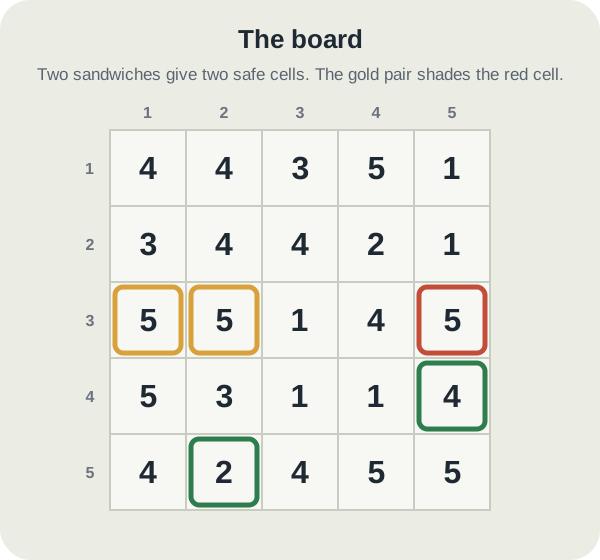
Here is a five by five board. Reading across the rows: 4, 4, 3, 5, 1, then 3, 4, 4, 2, 1, then 5, 5, 1, 4, 5, then 5, 3, 1, 1, 4, and finally 4, 2, 4, 5, 5.
Start with the pattern from the earlier guide. Row 5 reads 4, 2, 4, so the 2 at row 5, column 2 sits between two 4s and is safe. Column 5 reads 1, 1, 5, 4, 5 from the top, so the 4 at row 4, column 5 sits between two 5s and is safe too.
Neither safe cell helps yet. There is no other 2 in row 5 or column 2, and no other 4 in row 4 or column 5, so neither one repeats anything. Nothing is shaded, and there are no shaded cells to make neighbours safe. The sandwiches have run out.
Now look at row 3: 5, 5, 1, 4, 5. The two 5s at the left touch. One of them stays, so the 5 at row 3, column 5 is shaded. That is the first shaded cell on the board.
One shaded cell, and what follows
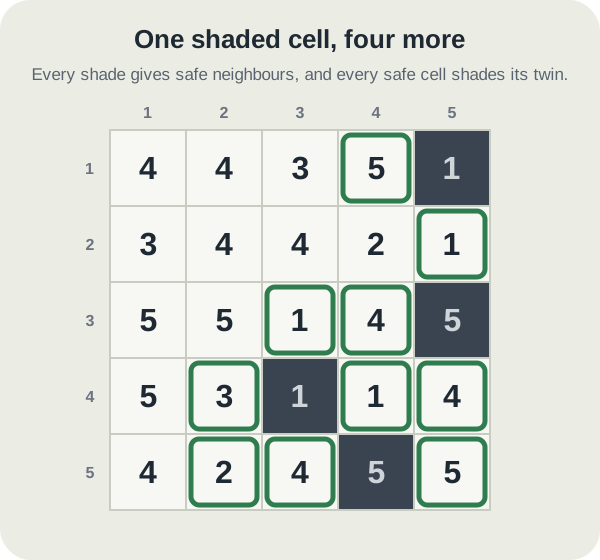
A shaded cell makes its neighbours safe, and a safe cell shades any twin in its row or column. On this board that pair of rules does everything else.
The shaded 5 at row 3, column 5 makes the 1 above it safe. Column 5 already has a 1 in row 1, so that one is shaded. Its neighbour, the 5 at row 1, column 4, is safe, which shades the other 5 in column 4, at the bottom. That in turn makes the 1 at row 4, column 4 safe, and the 1 beside it at row 4, column 3 is shaded.
Keep going the same way. The bottom row's 4 at column 3 is now safe, so the 4 at row 5, column 1 is shaded. That makes the 5 above it safe, and column 1 cannot keep two 5s, so the 5 at row 3, column 1 is shaded. The last two shaded cells fall out of columns 3 and 2 in the same fashion.
The mistake: shading one of the pair
The tempting move is to shade one of the two touching 5s straight away. The pair looks like the problem, so it feels as if one of them should go now.
But the pair only tells you that one of them goes. It does not say which. On this board it turns out to be the left one, at row 3, column 1, and that was settled by column 1 near the end of the chain, not by row 3. Shade the right one on a hunch and you have made a wrong move that the board will not complain about for several steps.
So leave the pair alone and shade the third copy. Most touching pairs on a board have no third copy at all. This board has nine touching pairs and only the one in row 3 has an extra copy. Each of the other eight just tells you that one of its two cells is shaded, and you wait for another reason before choosing.
The finished board
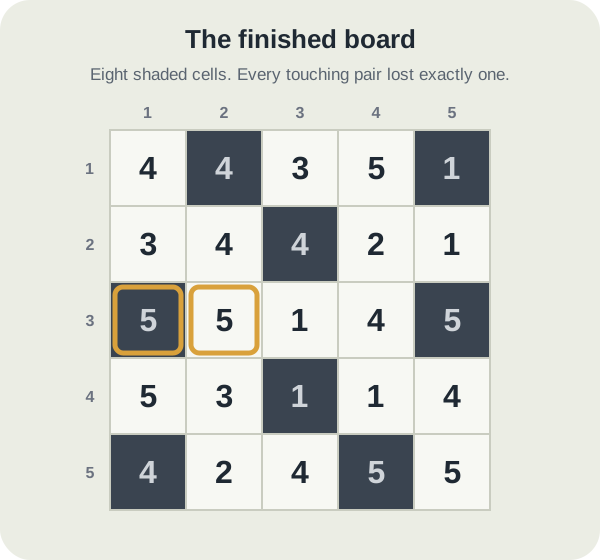
Eight cells end up shaded: row 1 at columns 2 and 5, row 2 at column 3, row 3 at columns 1 and 5, row 4 at column 3, and row 5 at columns 1 and 4. No two touch, nothing repeats, and the unshaded cells stay in one group.
Look back at the nine touching pairs and each has exactly one cell shaded, which is what the argument promised. We checked the board twice: the game's own step-by-step solver finishes it with no guessing, and a separate search through every legal way of shading the grid finds exactly one solution, this one.
Three in a row, the special case
If three equal numbers sit in a line, such as 3, 3, 3, the touching-pair rule fires twice and settles all of them. The middle 3 must stay: shading it would leave both ends unshaded, and they repeat. With the middle staying, both ends are other copies of a surviving 3, so both are shaded. They do not touch each other, so that is legal.
Where to try it
Shade Out is a Practice game and a dated Just for fun puzzle. It is timed, and your fastest valid finish is what ranks, but it pays no league points, so it is a comfortable place to drill a pattern.
On each new board, read every row and column twice. First for equal numbers one cell apart, which give safe cells. Then for equal numbers side by side, and whether the same number appears again in that line. The first pass tells you what stays; the second tells you what goes.
Put it into practice
Try an Easy Shade Out Library puzzle and look for one deduction from this guide.
Play a Shade Out boardSign in or create an account to save your progress.